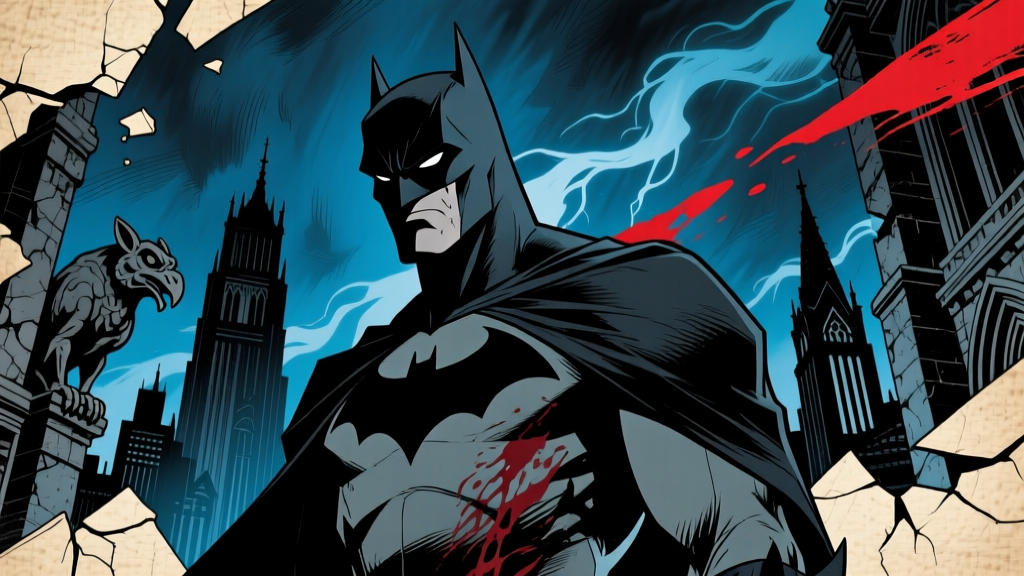
Look at any page of Mike Mignola's Batman work and you can tell it is his within a single glance. The shadows are not drawn — they are cut, sliced into the page with flat black shapes so heavy they seem to swallow the light around them. A bat silhouette hunches on a rooftop, its cape rendered as two or three angular slabs of ink, and behind it a crooked chimney stacks against a moon the color of old parchment. No crosshatching. No gradients. Just black and not-black, arranged with the precision of a woodcut and the mood of a funeral.
Mike Mignola is not primarily known as a Batman artist. He is the creator of Hellboy, the architect of the B.P.R.D. universe, and one of the most distinctive visual storytellers in American comics. But his brief time with the Dark Knight — most notably on the 1989 graphic novel Batman: Gotham by Gaslight — produced some of the most visually enduring Batman imagery ever committed to a page. This is the story of what happens when a master of Gothic horror applies his particular vision to a character who was, in many ways, waiting for exactly that treatment.
Before Gaslight: Mignola's Path to Gotham
Mike Mignola broke into comics in the early 1980s, inking for Marvel on titles like Daredevil and Power Man and Iron Fist. His early work showed flashes of what was coming — the heavy spotting of blacks, the angular figure work, the obsession with occult architecture — but it was still recognizably superhero art, constrained by house styles and editorial expectations. When he moved to DC in the mid-1980s, the shift in environment gave him room to develop. He worked on Cosmic Odyssey (1988–1989), a cosmic-scale miniseries written by Jim Starlin that paired New Gods mythology with Lovecraftian horror. The art on Cosmic Odyssey was a revelation: Mignola's figures were blocky and monumental, his shadows no longer served as mere shading but as structural elements of the composition, and his backgrounds looked like engravings pulled from a Victorian occult manual.
That work put him on the map. DC's editors noticed that Mignola's visual vocabulary — gargoyles, crumbling stone, ritual circles, towering architecture dwarfing human figures — was a natural fit for horror-adjacent storytelling. And Batman, particularly in the post-Dark Knight Returns era of the late 1980s, was a character DC was actively pushing into darker, more atmospheric territory. The pairing was logical. What nobody anticipated was how completely Mignola would reshape the visual language of Batman's world.
Gotham by Gaslight: The Victorian Batman
Batman: Gotham by Gaslight was published in 1989 as a one-shot prestige-format graphic novel, written by Brian Augustyn with art by Mike Mignola. The premise was deceptively simple: take Batman out of the modern era and place him in Victorian Gotham City, 1889, where the streets run with fog and gaslight and the police carry truncheons instead of radios. A killer is stalking the women of Gotham's lower wards — the narrative borrows freely from the Jack the Ripper mythology — and a young Bruce Wayne, recently returned from years abroad, dons a crude leather-and-cowl costume to hunt the murderer through cobblestone alleys and opium dens.
The book was part of DC's early "Elseworlds" concept, though the Elseworlds branding itself was not formalized until 1991. Gaslight predated the label, sitting instead under the more general "Prestige Format" banner — square-bound, painted covers, no Comics Code stamp, aimed at the direct market and book trade. It was a format that gave creators more freedom than the standard monthly floppy, and Mignola used every inch of that freedom.
The Art That Defined a Gotham No One Had Seen Before
What Mignola delivered in Gotham by Gaslight was not simply a Batman story set in the past. It was a complete visual reimagining of what Gotham City could look like. His Gotham is a city of impossible architecture — buildings lean at angles that should not be structurally sound, bridges arch over canals that reflect no light, and the sky is a permanent overcast slashed by the silhouettes of iron fences and church spires. The city looks like it was designed by the same people who built the sets for The Cabinet of Dr. Caligari and Nosferatu, and that is not a coincidence.
Mignola has spoken openly about his influences, and German Expressionism sits at the top of the list. The German Expressionist cinema of the 1920s — films like Fritz Lang's Metropolis, Robert Wiene's Caligari, and F.W. Murnau's Nosferatu — used distorted architecture, extreme chiaroscuro lighting, and deliberately unnatural set design to externalize psychological states. Mignola absorbed these films and translated their visual strategies onto the comic page. His Gotham is a city that looks the way Batman feels: angular, oppressive, haunted, and fundamentally hostile to the people who live in it.
The Batman design itself is stripped down to essentials. There is no high-tech armor, no utility belt bristling with gadgets. Mignola's Victorian Batman wears a leather cowl with crude stitched seams, a heavy cape that hangs in flat angular folds, and a chest emblem that looks like it was cut from sheet metal with tin shears. The costume reads as something a man might actually have built in a gaslit workshop at three in the morning — functional, brutal, and utterly without vanity. This is a Batman whose silhouette is less superhero and more urban legend, a shape glimpsed in fog and forgotten before you can be sure you saw it at all.
"The thing about Mignola's shadows is that they are not the absence of light. They are the presence of something else — something solid, something with weight and texture. When Batman steps out of a Mignola shadow, he is not emerging from darkness. He is emerging from the architecture of fear itself."
— Scott McCloud, Understanding Comics lecture series, Rhode Island School of Design (2004)
The Narrative: Pulp Detective Story Meets Gothic Horror
Brian Augustyn's script for Gotham by Gaslight is solid genre fiction — a Victorian mystery with enough period detail to feel grounded and enough Batman mythology to satisfy fans of the character. The story introduces a Victorian-era Commissioner Gordon (a police inspector here, wrestling with institutional corruption), a Selina Kyle who operates as a madam with connections to every level of Gotham's underworld, and a Bruce Wayne whose public persona is that of a wealthy eccentric with too much time and too many foreign interests.
But the script, competent as it is, functions primarily as a vehicle for Mignola's art. The pacing is deliberately slow — long sequences of Batman moving through the city without dialogue, panels that linger on architectural details, pages where the only movement is fog drifting past a streetlamp. Mignola treats Gotham itself as the primary character, and the murder mystery as an excuse to explore its corners. The climactic confrontation, when it arrives, takes place in a cathedral so vast and ornate that the combatants look like insects crawling across its floor. It is pure Mignola: human drama dwarfed by the weight of ancient stone.
The Gothic and the Expressionist: Tracing Mignola's Visual DNA
To understand why Mignola's Batman works so well, you have to look at what he was doing differently from every other Batman artist working in the late 1980s. The two dominant visual modes for Batman at that time were the Frank Miller mode — hardboiled, muscular, urban-decay noir — and the Neal Adams mode — photorealistic, anatomically precise, dynamically posed. Mignola did neither. His figures are not anatomically realistic. His poses are not dynamic in the traditional superhero sense. And his city is not the crumbling-but-recognizable New York stand-in that Miller drew.
Instead, Mignola reached backward, pulling from sources that predated the superhero genre entirely. His primary references were not comic books but woodcuts, engravings, and early horror illustration. The flat, unmodulated blacks that define his style descend directly from the woodcut tradition — artists like Albrecht Dürer and Hans Holbein the Younger, who worked in a medium that forced them to think in terms of pure positive and negative space. Mignola's hatching is minimal; when he needs a midtone, he uses a few precisely placed parallel lines, and when he needs deep shadow, he fills the entire area with black ink and moves on. The result is a page that reads more like a linocut print than a conventional comic.
German Expressionism in Four Colors
The Expressionist influence extends beyond set design into the way Mignola composes individual panels. His angles are consistently off-kilter — buildings lean, streets recede at exaggerated perspectives, and horizons tilt in ways that create a subtle but persistent sense of unease. In one memorable page from Gaslight, Batman stands on a rooftop overlooking a street where the buildings on either side converge toward a vanishing point so extreme that the street appears to be a tunnel. The effect is claustrophobic despite the open sky above. It is the same trick that Fritz Lang used in M (1931) to make Berlin's streets feel like a trap closing around the protagonist, and Mignola deploys it with the same psychological intent.
The Gothic literary tradition is equally present. Mignola's Gotham is a place of crumbling grandeur — mansions with broken windows, cathedrals with missing stones, bridges whose ironwork has rusted into organic shapes that look almost biological. This is the architecture of decay, and it serves the same narrative function that it served in the Gothic novels of Ann Radcliffe and Matthew Lewis: the environment is a mirror for the psychological state of the characters. Bruce Wayne lives in a manor that looks like it is slowly being consumed by ivy and shadow, and the reader understands instinctively that the building is a portrait of its owner.
Mignola's Gotham is not a city that happens to contain Batman. It is a city that produced Batman — the way a wound produces a scar.When Hellboy Met Batman: The Cross-Pollination
Gotham by Gaslight was published five years before Hellboy: Seed of Destruction hit shelves in 1994, but the visual DNA was already fully formed. Mignola's Batman and his Hellboy share the same silhouette language — heavy shoulders, oversized hands, angular jawlines, and a tendency to be framed against backgrounds of ritual architecture and supernatural menace. When you line up a page of Gaslight next to a page of early Hellboy, the Batman looks like he could walk across the panel border and into the B.P.R.D. headquarters without anyone raising an eyebrow.
This cross-pollination became explicit in later years, as Mignola's Hellboy aesthetic gained mainstream recognition and his Batman work was reassessed through that lens. Critics and fans began to describe Gotham by Gaslight as "Hellboy before Hellboy" — a characterization that is partially accurate. The visual vocabulary is the same: the flat blacks, the architectural obsession, the folk-horror details scattered through the backgrounds (look closely at the stonework in Gaslight and you will find carved faces, occult symbols, and decorative elements that would fit seamlessly into a Hellboy story). What differs is the emotional register. Hellboy, for all its horror trappings, is fundamentally warm — its protagonist cracks jokes, drinks beer, and treats the apocalypse as an inconvenience. Batman in Mignola's hands is cold, remote, and genuinely frightening. The same visual tools produce radically different emotional effects depending on the character they serve.
Mignola himself has acknowledged the connection. In interviews, he has noted that Gaslight was where he first worked out the visual problems that would later define Hellboy — specifically, how to draw a figure that reads as both human and monstrous, and how to use architecture as a storytelling device rather than mere background filler. Batman was the test case. Hellboy was the finished product.
Beyond Gaslight: Mignola's Other Batman Work
While Gotham by Gaslight remains Mignola's most significant Batman project, his relationship with the character extended beyond that single graphic novel. He contributed cover art and promotional illustrations for various Batman-related DC publications throughout the late 1980s and early 1990s, each one reinforcing the visual identity he had established in Gaslight.
The Batman: Black and White Connection
DC's Batman: Black and White series — which began as a backup feature in Batman: Gotham Knights in 2000 — was a natural home for Mignola's aesthetic. The format invited artists to render Batman using only black and white, with no gray tones or color, and Mignola's entire style is predicated on exactly that binary. His contribution to the Black and White concept reinforced the idea that Batman, at his visual core, is a creature of contrast: light against dark, figure against void, man against shadow. The fact that Mignola could produce a definitive Batman image using nothing but black ink on white paper speaks to how deeply his visual philosophy aligns with the character's fundamental nature.
Other artists who worked in the Black and White format — including Alex Toth, Bill Sienkiewicz, and Kyle Baker — brought their own strengths, but Mignola's pages stood out for their economy. Where other artists used the constraint as an occasion for experimental mark-making, Mignola treated it as business as usual. He had been working in black-and-white all along; the rest of the industry was just catching up.
Cover Art and Promotional Pieces
Mignola's Batman covers — for reprints, special editions, and promotional materials — constitute a small but significant body of work. His cover for the 2006 reprint of Gotham by Gaslight is a masterclass in minimalism: Batman's silhouette against a full moon, rendered in flat shapes with no interior detail, the cape spreading across the composition like a pool of spilled ink. The image communicates everything a viewer needs to know about both the character and the artist in a single frame. It is also, not incidentally, one of the most widely reproduced Batman images in merchandise history — appearing on posters, t-shirts, phone cases, and wall scrolls in quantities that Mignola himself has joked about in convention panels.
| Work | Year | Type | Significance | Availability |
|---|---|---|---|---|
| Batman: Gotham by Gaslight | 1989 | Graphic Novel | First and most complete Mignola Batman story; established Victorian Gotham aesthetic | Multiple reprints; included in Batman: The Dark Knight Archives collections |
| Cosmic Odyssey | 1988–89 | Miniseries (4 issues) | Pre-Gaslight DC work; demonstrated Mignola's horror-architecture style applied to DC characters | Trade paperback; DC collected editions |
| Gotham by Gaslight promotional art | 1989 | Promo Illustration | Iconic Batman-silhouette-on-moon image; one of the most reproduced Batman artworks of the 1990s | Prints; merchandise; convention exclusives |
| Batman: Black and White contributions | 2000s | Short Story / Backup | Pure black-and-white Batman pages; demonstrated Mignola's style stripped to its essentials | Batman: Black and White collected volumes |
| Cover art (various) | 1989–2010s | Covers / Variant | Minimalist Batman covers that influenced a generation of variant cover artists | Individual issues; collected editions; art prints |
| McFarlane Batman Black & White Statue | 2021 | Collectible Statue | Resin figure based on Mignola's Batman design; part of McFarlane's designer series | Secondary market; limited availability |
| DC Designer Series Batman Statue | 2020 | Collectible Statue | 7-inch mini statue based on Mignola's angular Batman silhouette | Amazon; specialty retailers |
The Mignola Effect: How His Batman Influenced the Broader Mythology
The influence of Mignola's Gotham by Gaslight on subsequent Batman media is more pervasive than most fans realize. The 2018 animated film Batman: Gotham by Gaslight — produced by Warner Bros. Animation as part of the DC Universe Animated Original Movies line — adapted the source material directly, though the film's visual design softened Mignola's angular extremes into something more palatable for mainstream animation. The movie retained the Victorian setting and the Ripper-inspired plot but could not fully replicate the oppressive, woodcut-quality atmosphere of Mignola's pages. Animation, by its nature, requires consistent line work across thousands of frames; Mignola's style depends on the kind of precise, hand-controlled inking that does not translate easily to a production pipeline.
More subtly, Mignola's approach to Gotham's architecture influenced the way the city was depicted across multiple media. The Batman: Arkham video game series, particularly Arkham Asylum (2009) and Arkham City (2011), drew heavily on the Gothic-Expressionist visual vocabulary that Mignola had helped popularize in comics. The games' Gotham — all flying buttresses, iron gates, and gargoyles perched on crumbling parapets — is a direct descendant of the city Mignola drew in 1989. The architectural team at Rocksteady Studios cited Gaslight as one of several visual references during development, and the influence is visible in every environment the player explores.
Christopher Nolan's Batman Begins (2005) and The Dark Knight (2008) took a different approach — grounding Gotham in a recognizable contemporary urban landscape — but even there, traces of Mignola's influence appear in the production design of Wayne Manor and the Narrows. The Narrows, in particular, with its Gothic bridges, elevated railways, and decaying institutional architecture, looks like a Mignola streetscape translated into three dimensions. Production designer Nathan Crowley has not cited Mignola directly, but the visual parallels are difficult to dismiss as coincidence.
Influence on Comic Artists
Within the comics industry, Mignola's Batman work influenced a generation of artists who came to the character in the 1990s and 2000s. Eduardo Risso, whose work on 100 Bullets and Batman: Broken City (2003–2004) applied a similar heavy-shadow approach to Gotham, has cited Mignola as a formative influence. Andrea Sorrentino's pages on Old Man Logan and his Batman covers display the same commitment to using flat black shapes as compositional anchors. Even artists who do not draw in a Mignola-derived style have absorbed his lesson that Batman is most effective visually when he is treated as a shape first and a figure second — a silhouette that registers as a threat before the reader has processed any anatomical detail.
Collecting Mignola's Batman: What to Buy and What It Costs
The collector market for Mike Mignola's Batman work is a niche within a niche, but it is a niche with serious demand. The intersection of Batman collectors and Mignola collectors creates a bidding war whenever key pieces surface, and the limited supply of original Mignola Batman art drives prices upward at auction.
Comics and Prints
The original 1989 printing of Batman: Gotham by Gaslight in near-mint condition trades in the $80 to $150 range — respectable for a prestige-format one-shot but far from the most expensive Batman graphic novel of the era. CGC-graded 9.8 copies have sold for $250 to $400 at auction. The real collector prize is the original art pages. Mignola's pages from Gaslight have appeared at Heritage Auctions and Comic Art Fans galleries, where individual pages from the book have sold for $3,000 to $8,000 depending on content and condition. Splash pages and key scenes — particularly any page featuring a full-figure Batman shot or an architectural vista — command the highest prices.
DC has reprinted Gaslight multiple times, including in trade paperback and hardcover collected editions. The 2006 reprint edition, with a new Mignola cover, is the most widely available version and can be found for $10 to $15 in good condition. For reading purposes, any reprint will do. For collecting purposes, the 1989 first printing in top condition is the target.
Statues and Figures
The collectible statues based on Mignola's Batman design occupy a distinct tier of the Batman merchandise market. The McFarlane Toys Batman Black & White resin statue, designed by Mignola and released as part of McFarlane's collector line, stands approximately 10 inches tall and was produced in limited quantities. On the secondary market, this piece trades between $120 and $250 depending on condition and packaging. The statue captures Mignola's angular aesthetic in three dimensions — the cape sweeps backward in a flat geometric arc, the cowl is simplified to its essential lines, and the overall silhouette looks like it was extruded from a two-dimensional Mignola panel.
The DC Designer Series Batman mini-statue (2020), a 7-inch piece based on Mignola's design, is more affordable — typically $40 to $80 on the secondary market — and serves as an accessible entry point for collectors who want a physical representation of Mignola's Batman without the resin-statue price tag. Both pieces are well-regarded in the collector community for their fidelity to the source art, which is not always a given when translating a highly stylized two-dimensional design into a three-dimensional sculpt.
Original Art and Convention Sketches
Mignola's original art commands premium prices across the board, and his Batman pages are among the most sought-after. A full page of original Gaslight art — ink on bristol board, with Mignola's distinctive hand-lettered sound effects and marginal notes — has sold at Heritage Auctions for figures ranging from $4,000 to over $10,000 for the most iconic images. Convention sketches are more accessible: Mignola has been a regular presence at San Diego Comic-Con and other major shows, where his table sketches of Batman (typically a quick but precise silhouette in marker) have sold for $300 to $600 in recent years. These sketches, despite their speed, are unmistakably Mignola — the same flat blacks, the same angular cape, the same moody minimalism compressed into a 4x6 card.
- Batman: Gotham by Gaslight (1989, first print) — $80–$150 raw; $250–$400 CGC 9.8
- Original Gaslight art pages — $3,000–$10,000+ at auction depending on content
- McFarlane Batman Black & White statue (Mignola design) — $120–$250 secondary market
- DC Designer Series Batman mini-statue — $40–$80 secondary market
- Convention sketches (Batman, Mignola) — $300–$600 depending on detail and year
- 2006 Gaslight reprint (Mignola cover) — $10–$15; accessible reading copy
- Promotional poster (1989, Batman silhouette on moon) — $50–$200 depending on size, condition, and edition
Why Mignola's Batman Still Matters
The comic book industry has produced thousands of Batman stories across nearly a century of publication. Most of them are forgettable. Some are excellent. A handful change the way every subsequent artist and writer approaches the character. Mignola's Gotham by Gaslight belongs in that last category, and it earns that place not through narrative innovation — the Victorian Batman concept is clever but not revolutionary — but through the sheer force of its visual argument.
Mignola demonstrated, in 48 pages of ink and shadow, that Batman is fundamentally a Gothic character. Not in the sense of "dark and brooding" — every Batman artist since Neal Adams has played that note — but in the deeper, literary sense: a figure defined by architecture, by the weight of the past pressing down on the present, by the tension between human fragility and the inhuman scale of the environments he inhabits. Batman in a Mignola drawing is small. The buildings around him are enormous. The shadows are deeper than any flashlight can penetrate. And yet he moves through this world with absolute purpose, a human will imposed on an inhuman landscape. That visual tension — small man, vast darkness, relentless forward motion — is the essence of Batman, and Mignola captured it more purely than almost anyone who has drawn the character before or since.
For readers coming to Mignola's Batman for the first time, the recommendation is simple: find a copy of Gotham by Gaslight, turn off the overhead lights, and read it by lamplight. The experience of those pages — the heavy blacks, the crooked streets, the Batman who is more shadow than man — is closer to the character's emotional core than any animated series or blockbuster film has managed. Mignola did not just draw Batman. He carved him out of ink and darkness, and the result has not aged a day in over three decades.
Frequently Asked Questions
What is Mike Mignola best known for in comics? Mike Mignola is best known as the creator of Hellboy, a character he introduced in 1994 through Dark Horse Comics. Hellboy spawned an entire universe of spin-offs — B.P.R.D., Abe Sapien, Lobster Johnson — and established Mignola as one of the most visually distinctive artist-writers in American comics. His work on Batman, particularly Gotham by Gaslight, predates Hellboy and demonstrates the same Gothic/Expressionist visual style that would define his career.
When was Batman: Gotham by Gaslight published, and who wrote it? Batman: Gotham by Gaslight was published by DC Comics in 1989 as a prestige-format one-shot graphic novel. It was written by Brian Augustyn with art by Mike Mignola. The story places Batman in Victorian-era Gotham City (1889), where he pursues a serial killer inspired by the Jack the Ripper case. It was one of DC's earliest "Elseworlds"-style stories, predating the formal Elseworlds branding by two years.
How did German Expressionism influence Mignola's Batman art? German Expressionist cinema of the 1920s — particularly films like The Cabinet of Dr. Caligari, Nosferatu, and Metropolis — used distorted architecture, extreme lighting contrasts, and deliberately unnatural set design to convey psychological states visually. Mignola adopted these strategies for comics: his Gotham features buildings that lean at impossible angles, streets that recede into exaggerated vanishing points, and a chiaroscuro lighting approach that uses flat black shapes instead of gradual shading. The result is a city that externalizes Batman's psychological landscape.
Is there an animated movie based on Gotham by Gaslight? Yes. Warner Bros. Animation released Batman: Gotham by Gaslight as a direct-to-video animated film in 2018. It was part of the DC Universe Animated Original Movies line. The film adapts the core premise of the graphic novel — Victorian Batman versus a Ripper-like killer — but modifies plot details and character roles significantly. The visual design draws on Mignola's aesthetic but adapts it for the practical constraints of animation, resulting in a softer, more conventional look than the original comic pages.
How does Mignola's Batman connect to his Hellboy work? Gotham by Gaslight (1989) predates Hellboy: Seed of Destruction (1994) by five years, and Mignola has described the Batman project as a testing ground for visual ideas he would later refine in Hellboy. The shared elements include flat black shadow work, architectural obsession, occult background details, and blocky, angular figure design. The primary difference is tonal: Mignola's Batman is cold and menacing, while Hellboy is warm and sardonic, despite operating in visually similar environments.
What collectible statues exist based on Mignola's Batman design? Two primary statues have been produced. The McFarlane Toys Batman Black & White resin statue (approximately 10 inches, released in limited quantities) trades at $120–$250 on the secondary market. The DC Designer Series Batman mini-statue (7 inches, released 2020) is more accessible at $40–$80. Both are praised for their fidelity to Mignola's angular, shadow-heavy design aesthetic.
How much does original Mignola Batman art cost? Original pages from Gotham by Gaslight have sold at Heritage Auctions and other venues for $3,000 to over $10,000, with splash pages and key Batman images commanding the highest prices. Convention sketches — quick marker drawings of Batman that Mignola produces at shows — typically sell for $300 to $600. Prices have trended upward as Mignola's profile has grown and original art markets have tightened.
Did Mignola work on any other Batman stories besides Gotham by Gaslight? Mignola's primary Batman work is Gotham by Gaslight. Beyond that, he contributed to the Batman: Black and White series, produced cover art and promotional illustrations for various DC publications, and created the iconic 1989 promotional image of Batman's silhouette against a full moon. He has not written or illustrated a full Batman series or ongoing storyline beyond the Gaslight graphic novel.