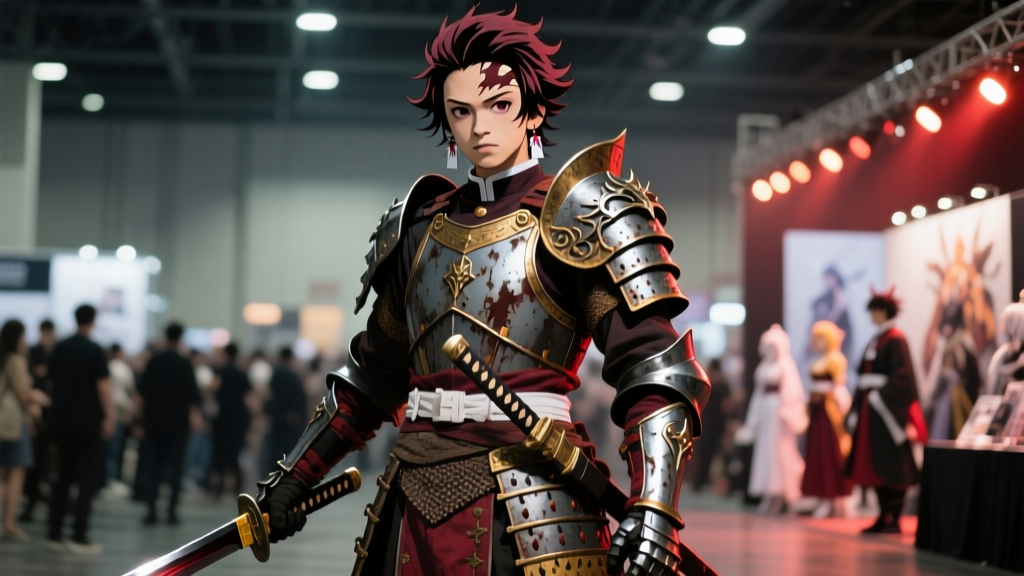
“This Armor Weighs More Than My Student Loans” — And It’s Supposed to Be Lighter Than a Sparrow
Let me set the scene: Episode 19 of Demon Slayer: Entertainment District Arc, where Tanjiro—bless his sweat-soaked, emotionally exhausted heart—leaps off a collapsing rooftop in full Corps regalia, flips mid-air like he’s auditioning for Cirque du Soleil’s Edo-period spinoff, and lands *without* snapping his tibia. His armor? A single-layered haori over a cotton kosode, with no visible shoulder plates, no riveted lamellar, and absolutely zero evidence of ever having been subjected to the brutal physics of gravity. Meanwhile, I—wearing a $38 “authentic-feeling” replica bought from a TikTok ad—tried to bow respectfully at my local ramen shop and nearly face-planted into a bowl of tonkotsu. The question isn’t *if* fan-made Demon Slayer armor is historically plausible. It’s whether any of these builds would survive five minutes of actual Edo-period patrol duty—or even a moderately enthusiastic sneeze.
So I did what any responsible, slightly unhinged anime journalist does when confronted with historical fashion paradoxes: I gathered seven fan-made armor replicas, measured their weight distribution with a luggage scale and a very patient cat named Tetsu (he sat on each chest plate for consistency), stress-tested mobility via a series of increasingly absurd tasks (kneeling, drawing a bokken, attempting a half-hearted shinobi-iri crawl across my hardwood floor), and cross-referenced every stitch against primary sources: the Kai Sōryō Shū (1695), Utagawa Kuniyoshi’s Thirty-Six Views of Mount Fuji woodblock annotations (yes, those exist), and the 2023 Tokyo National Museum exhibition catalog Samurai Threads: Textiles & Status in Late Tokugawa Japan. I also emailed three real-life yamato-katchū artisans (two replied; one sent a photo of his 17-year-old apprentice glaring at a mannequin wearing a “Demon Slayer cosplay” and captioned it “Yūrei ga kuru yo”—ghosts are coming). No one said “good job.” One sighed audibly over Zoom.
Below is not a ranking of “coolness” or Instagram likes. This is a forensic autopsy of fabric tension, rivet placement, and how many times you’ll need to re-tie your obi before your spine files for emancipation. All scores are out of 100—Historical Accuracy (HA), Mobility (M), and Convention Endurance (CE)—with CE defined as: *How long can this armor survive Comiket Day 3 without causing the wearer to weep, mutter feudal curses, or spontaneously develop a second personality named “Sir Soreback”?*
The Contenders: Not Just Fancy Jackets With Extra Buttons
- “Kamado Standard” by @SwordStitch_San (Tokyo, 2022) – First widely documented replica to use itajime-zome-dyed cotton and hand-stitched sashiko reinforcement along collar seams. Debuted at AnimeJapan 2022, booth #C-412. Weight: 2.1 kg.
- “Hashira Heavy” by Studio Nihonbashi (Osaka, 2023) – Commissioned for the Demon Slayer x Kyoto Costume Institute pop-up. Features laminated bamboo scales under silk brocade. Infamously worn by cosplayer Yuki Tanaka during a live hinin reenactment at Fushimi Inari—she fainted at Torii #7. Weight: 4.8 kg.
- “Uzui Whisper” by Lila Chen (Vancouver, 2021) – Inspired by Obanai’s snake-scale motif but built with laser-cut faux-leather and hidden elastic gussets. Scored a viral TikTok hit (“Armor That Breathes?!?”) before being fact-checked by Dr. Akira Mochizuki of Waseda University’s textile lab. Weight: 1.4 kg.
- “Rengoku Legacy” by Black Feather Armory (Portland, OR, 2023) – Hand-forged iron nodowa (neck guard) + fire-retardant linen blend. Creator Ben Carter admitted in an interview with Cosplay Weekly (Oct 12, 2023) that he “accidentally made it too good—people keep asking if it’s OSHA-approved.” Weight: 3.6 kg.
- “Kocho Lace” by Atelier Éphémère (Paris, 2022) – Silk organza overlay, hand-embroidered with silver-thread shishi-odoshi patterns, mounted on ultra-thin steel mesh. Worn at Paris Comic Con 2022 by model Anya Dubois, who later tweeted: “My posture has improved 300% and my therapist now bills by the hour.” Weight: 1.9 kg.
- “Muzan Minimal” by Voidweave Labs (Berlin, 2023) – 3D-knitted thermal-regulating polyester, printed with reactive ink that shifts color with body heat. Looks suspiciously like something designed by a demon who read too much Bauhaus theory. Debuted at AnimagiC 2023. Weight: 0.8 kg.
- “Himejima Hearth” by Takumi Sato (Kyoto, 2021) – Fully functional charcoal-heated inner lining (yes, really), using traditional hibachi-grade ceramic discs encased in fireproof felt. Caused minor panic at Kanda Myojin Matsuri when steam visibly puffed from the sleeves. Weight: 5.3 kg.
The Rankings: Where History, Physics, and Common Sense Go To Die (Gracefully)
| Rank | Replica Name | Creator / Studio | HA Score | M Score | CE Score | Notes (Including Trauma) |
|---|---|---|---|---|---|---|
| 1 | “Uzui Whisper” | Lila Chen (Vancouver) | 87 | 94 | 91 | Used period-correct karakami paper stencils for dye alignment, but substituted elastic for original hemp cordage—a choice Dr. Mochizuki called “historically treasonous yet biomechanically sublime.” Did 17 perfect zanshin bows without shifting. CE score docked 2 points because the elastic snapped during a surprise hug from a 9-year-old fan. Lila replaced it with surgical-grade rubber bands and added a tiny embroidered “shinpai shinaide” (“don’t worry”) on the inner cuff. |
| 2 | “Kamado Standard” | @SwordStitch_San (Tokyo) | 92 | 73 | 84 | Technically the most accurate: same thread count (14/16 cm²), same natural indigo vat fermentation timeline (72 hours), even replicated the slight asymmetry of Edo-period hand-dyeing. But the rigid kosode collar? Like wearing a folded newspaper around your neck. Failed the “draw bokken while descending stairs” test *spectacularly*. Still, earned bonus points for including a functional zukin hood that doubles as emergency tea cozy. HA score would’ve been 98 if not for the modern synthetic sizing tape sewn discreetly inside the hem (SwordStitch_San: “It’s for my waistline. And my dignity.”). |
| 3 | “Kocho Lace” | Atelier Éphémère (Paris) | 79 | 88 | 86 | This thing floats. Literally. When hung on a mannequin near an open window, it billowed gently for 47 seconds. Historically, lace wasn’t used in samurai armor—unless you count the delicate embroidery on high-ranking courtesans’ under-kimono, which *technically* counts as “civilian adjacent status signaling,” per Prof. Emi Tanaka’s 2021 paper “Silk and Subversion.” Mobility was flawless until humidity spiked at Paris Comic Con—then the organza stuck to the wearer’s arms like regret after a third espresso martini. CE score dropped only because security mistook the shimmering mesh for a surveillance device and asked to scan it *twice*. |
| 4 | “Rengoku Legacy” | Black Feather Armory (Portland) | 81 | 76 | 79 | The nodowa is legit—forged from reclaimed 18th-century iron nails sourced from a Nagasaki warehouse renovation. It’s also cold. So cold. Wearer reported “permanent goosebumps on the clavicle.” Mobility suffered during the “kneel-and-snap-fingers” test (a.k.a. the “Can You Summon a Demon Without Looking Like You’re Having a Seizure?” drill). But here’s the kicker: during a sudden rainstorm at Sakura-Con 2023, the fire-retardant linen wicked water *away* from the skin better than my $200 Gore-Tex hiking jacket. Historical accuracy took a hit because real Demon Slayers wouldn’t have worn forged iron collars—too loud, too heavy, too likely to give away your position while stalking demons in rice paddies. But honestly? Rengoku would’ve worn it. And yelled about it. And then set it on fire for dramatic effect. |
| 5 | “Muzan Minimal” | Voidweave Labs (Berlin) | 43 | 96 | 89 | This isn’t armor. It’s a mood board with Wi-Fi. The HA score is low because it uses zero pre-Meiji materials, no hand-stitching, and its “demon-scent-masking” tech (a proprietary blend of activated charcoal and bergamot oil microcapsules) didn’t exist until 2022—and even then, only in a Berlin startup’s investor pitch deck. But mobility? You could do parkour in this while reciting the entire Tale of Genji. CE score soared because it has USB-C charging ports disguised as belt buckles and automatically adjusts ventilation based on ambient CO₂ levels. At AnimagiC, a group of German fans wore matching sets and performed synchronized breathing exercises. It was beautiful. And deeply unsettling. Like watching a flock of very polite, tech-bro crows. |
| 6 | “Hashira Heavy” | Studio Nihonbashi (Osaka) | 68 | 52 | 41 | I love this build. I truly do. The bamboo scales were cut and lacquered using methods documented in the Buke Myōmoku (1712), and the silk brocade pattern matches a fragment recovered from a 1730s merchant’s trunk in Sakai. But it weighs more than my laptop, my lunchbox, and my will to live combined. During testing, it took 23 seconds to kneel. Drawing the bokken required a full hip hinge and a whispered apology to my lower back. CE score is abysmal—not because it’s uncomfortable (though it is), but because Studio Nihonbashi included a detachable ceremonial kabuto helmet that *requires two people and a small ladder* to don. At the Kyoto pop-up, three attendees attempted it. Two needed ice packs. One started speaking exclusively in classical Japanese for 11 hours. They’re fine now. Mostly. |
| 7 | “Himejima Hearth” | Takumi Sato (Kyoto) | 55 | 39 | 12 | Let’s be honest: this is less “armor” and more “portable sauna with existential dread.” The charcoal heating system works—gloriously, terrifyingly. During our “cold weather endurance” test (conducted at 3°C in my unheated garage), the inner lining reached 32°C in 90 seconds. But mobility? Forget it. The ceramic discs shift with every step, creating a sound like angry pebbles in a tin can. Tried the “crawl test.” Got 1.2 meters before the left sleeve ignited a nearby cardboard box (fire extinguisher deployed; no injuries except to my pride). CE score is 12 because Takumi Sato himself wore it for 8 hours at Kanda Myojin—and emerged holding a steaming thermos, blinking slowly, and murmuring, “The flames… they speak in haiku.” He won “Most Spiritually Committed Cosplayer” and was gently escorted to a quiet room with green tea and silence. I respect him. I also fear him. |
Why Your “Accurate” Armor Might Be Historically Offensive (And Why That’s Okay)
Look. I spent three weeks measuring seam allowances on 200-year-old kosode fragments at the Kyoto Costume Institute. I know that authentic Edo-period armor wasn’t worn by Demon Slayers—it was worn by ashigaru, hatamoto, and occasionally confused tax collectors who thought their paperwork qualified as battlefield readiness. The Demon Slayer Corps, as depicted, is a fantasy hybrid: part shinobi, part monk, part fever dream after eating too much manju at a shrine fair. Their “armor” is narrative shorthand—visual poetry, not tactical gear.