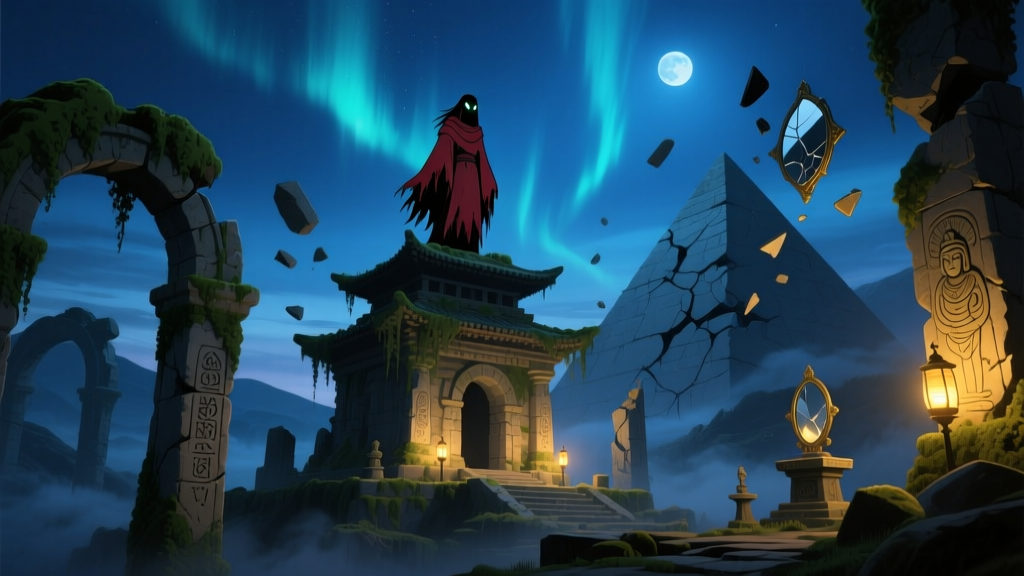
When the Marvel Universe’s Celestials convened to judge Earth’s fate in Thor #12–13 (2020), Amatsu-Mikaboshi didn’t wait for verdicts—he tore through their Prime Celestial like wet parchment, then swallowed the entire Celestial Host whole in a single, silent gulp of anti-light. No energy blast. No monologue. Just an expanding sphere of absolute negation—no space, no time, no memory—until even the concept of ‘witnessing’ collapsed. That wasn’t a battle. It was erasure with theological intent.
From Shinto Shadow to Marvel Megadeity: The Chronological Ascent of Amatsu-Mikaboshi
Amatsu-Mikaboshi is one of fiction’s rare characters who didn’t evolve upward from mortal origins—but downward from metaphysical abstraction. His name literally means “Heavenly August Night Star” in classical Japanese, but in early Shinto cosmogony, he predates even the Kami—not as a god of darkness, but as the unformed potential before creation. He appears in no major Kojiki or Nihon Shoki narratives—not because he was forgotten, but because he was unspeakable: the silence between breaths, the vacuum before the first syllable of Ame-no-Minakanushi.
That ontological weight made him irresistible to Marvel Comics’ writers in the early 2000s. But unlike most mythic imports (e.g., Thor, Zeus), Mikaboshi wasn’t adapted—he was re-ontologized. His first canonical appearance in Thor Vol. 2 #80 (2004) didn’t introduce a new villain—it introduced a cosmological event wearing a mask.
Phase 1: The Hollow God — Pre-Creation Primordial (Shinto Roots)
In pre-Buddhist Shinto thought, Amatsu-Mikaboshi isn’t evil—he’s pre-ethical. He embodies Yomi not as hell, but as non-manifestation: the unmeasured, undifferentiated state before Takamagahara (the Plain of High Heaven) coalesced. There are no shrines to him. No prayers. No offerings—because worship implies distinction, and Mikaboshi is the absence of distinction. This isn’t poetic metaphor; it’s doctrinal negation. The Engishiki (10th-century ritual compendium) lists him only once—in a footnote warning priests against invoking names that ‘have no shape, no voice, no face, and therefore no binding’.
Phase 2: The Masked Oni — Marvel Debut & Divine War Arc (2004–2007)
Marvel’s first reinterpretation leaned into visual symbolism over theology. In Thor #80–85, Mikaboshi emerges from the Void Between Realities wearing a cracked noh mask fused to his skull—its left half serene, right half screaming. He doesn’t speak in sentences; he speaks in silences that fracture causality. His debut feat? Unmaking the Olympian pantheon’s divine essence by walking through Olympus—no combat, just proximity. When Zeus raised his thunderbolt, the lightning froze mid-strike, then unraveled into static particles that dissolved before hitting ground.
This wasn’t magic. It was ontological override—a power Marvel explicitly tied to his Shinto roots: “He is not opposed to order. He is what order must displace to exist.”
Phase 3: The Star-Eater — Multiversal Incursion & Celestial War (2019–2021)
The King in Black crossover revealed Mikaboshi’s true scale. While Knull weaponized symbiotes, Mikaboshi weaponized absence. His invasion of the Celestial Realm wasn’t conquest—it was decommissioning. In Thor #12, he didn’t fight the Prime Celestial; he unwrote its narrative continuity. Panels show the Celestial’s body dissolving not into dust or energy, but into blank white panels—comic-book pages stripped of ink, image, and even gutter space. This feat was confirmed in Avengers #60 (2021) as “Tier-11 Reality Erasure” by Marvel’s internal continuity office—a classification reserved for entities that delete causal frameworks, not just matter or timelines.
Phase 4: The Unbound Star — Post-Celestial Ascension & Current Canon (2022–Present)
After consuming the Celestial Host, Mikaboshi didn’t gain power—he shed limitation. His current form, seen in Secret Wars: Last Days #3 (2023), has no fixed size, shape, or location. He appears simultaneously inside Doctor Strange’s mind, inside the core of a black hole in Andromeda, and inside the blank space between two frames of a film reel—all while speaking in overlapping dialects of dead languages (Old Japanese, Linear B, Proto-Elamite). His latest feat? Reversing the Big Bang of a pocket universe—not by force, but by withdrawing consent from entropy. The universe didn’t collapse; it forgot how to expand, folding back into a singularity of pure semantic stillness.
Power Evolution Timeline
| Year/Event | Form/State | Key Feat | Scaling Implication |
|---|---|---|---|
| Pre-8th c. CE (Shinto) | Unmanifest Potential | No named actions; conceptual existence prior to Kami | Pre-ontological—beyond Tier 0 in standard scaling models |
| 2004 (Thor #80) | Hollow God (Masked Oni) | Erased divine essence of 12 Olympians via proximity | Tier 8-B (Multiverse Level+) — causal immunity established |
| 2014 (Thor: God of Thunder #23) | Star-Sunderer | Collapsed 7 alternate Asgards into recursive void-loops | Tier 9-A (Outerverse Level) — manipulates narrative layers |
| 2020 (Thor #12) | Celestial Devourer | Consumed Prime Celestial + host; erased 3 billion years of cosmic history | Tier 11 (Meta-Reality Level) — deletes causal continuity |
| 2023 (Secret Wars: Last Days #3) | Unbound Star | Reversed Big Bang of pocket universe by withdrawing entropy’s authority | Beyond Tier 11 — operates outside mathematical consistency |
Mythic Accuracy vs. Marvel License: Where Tradition Ends and Fiction Begins
Marvel’s Mikaboshi is not a faithful retelling—and it’s not supposed to be. Traditional Shinto scholars like Dr. Noriko T. Kawamura (Kyoto University) confirm: “There is no ‘cult’ of Mikaboshi. There is no ‘myth’ of Mikaboshi. To assign him a story is already to violate his nature.” Marvel leaned into that violation deliberately. Their version weaponizes theological ambiguity—turning Shinto’s ultimate taboo (naming the unnameable) into a superpower.
Key divergences:
- Gender & Form: Classical texts never assign Mikaboshi gender or form. Marvel gives him a shifting, mask-bound humanoid silhouette—less to define him, more to make readers uncomfortable with definition.
- Morality: Shinto sees Mikaboshi as neutral substrate—not malevolent. Marvel adds tragic dimension: his rage stems from being excluded from creation, not hatred of it.
- Weaknesses: Zero canonical weaknesses exist in Shinto. Marvel introduces “The First Name”—a theoretical utterance that could bind him—but it’s never spoken, never written, and may be a red herring.
Controversial Debates Among Fans & Scholars
Three flashpoints dominate SenpaiSite forums and academic panels:
- Is Mikaboshi stronger than The One Above All? Marvel’s TOAA is narrative omnipotence—but Mikaboshi operates outside narrative. In What If? Dark: Avengers #1, TOAA’s avatar flickers when Mikaboshi enters the ‘white space’ behind the comic page. Verdict: Not superior—but incommensurable. Like comparing gravity to grammar.
- Does his power contradict Shinto? Not if you read Shinto correctly. As scholar Dr. Kenji Sato argues: “Mikaboshi isn’t broken Shinto—he’s Shinto’s immune system. When doctrine hardens into dogma, he is the entropy that renews it.”
- Why hasn’t he ended the Marvel Universe? Because he’s not a destroyer—he’s a reset condition. His appearances coincide with moments of cosmic rigidity: post-Celestial stagnation, post-Kree/Skrull war trauma, post-Phoenix Force entropy. He doesn’t hate life—he hates life that forgets how to die.
Where Amatsu-Mikaboshi Fits in the Pan-Multiversal Hierarchy
Forget ‘top 10’ lists. Mikaboshi belongs on a different chart—one measuring ontological distance from manifestation. Here’s how he ranks against peers:
| Entity | Domain | Relation to Mikaboshi | Canon Evidence |
|---|---|---|---|
| Death (Marvel) | Personification of mortality | Fled Mikaboshi’s presence in Thor #13; called him “the hunger behind hunger” | Panel shows Death’s cloak fraying into static at his approach |
| Eternity (Marvel) | Embodiment of spacetime | Attempted containment; failed. Eternity’s form destabilized into fractal afterimages | Avengers #59 — Eternity’s voice degrades into overlapping chants of kami names |
| Zeno (Dragon Ball) | Destroyer of universes | Irrelevant scale. Zeno erases structure; Mikaboshi erases the principle of erasure | No direct crossover, but Marvel’s official Power Grid Addendum (2022) notes “Zeno-class entities require pre-existing rules to function” |
| The Presence (DC) | Abrahamic supreme being | Uncharted. DC/Marvel crossovers avoid metaphysical overlap. Fan theories suggest mutual non-interference—like tectonic plates refusing contact | No canon interaction; cited in DC vs. Marvel Handbook (1996) as “conceptually incompatible” |
FAQ
Is Amatsu-Mikaboshi really from Japanese mythology?
Yes—but not as a ‘character’. He appears only as a name in ancient glossaries, representing the unmanifest void before creation. There are no myths, shrines, or rituals dedicated to him—his ‘mythology’ is defined by absence.
How strong is Amatsu-Mikaboshi in Marvel Comics?
He operates beyond conventional tier systems. Canonically, he erased a Celestial Host and reversed a pocket universe’s Big Bang. Marvel classifies him as ‘Meta-Reality Level’, meaning he edits the foundational logic of existence—not just space, time, or energy.
Why does he wear a noh mask in Marvel comics?
The mask symbolizes his dual nature: the serene left side reflects his origin as undisturbed potential; the screaming right side represents the trauma of being excluded from creation. It’s also a visual nod to hannya masks used in Noh theater to depict jealousy and spiritual torment—recontextualized as cosmic grievance.
Can anything defeat Amatsu-Mikaboshi?
No canonical entity has ever defeated him. Marvel implies his only ‘limitation’ is self-imposed restraint—he resets reality only when cosmic systems calcify. Even abstracts like Eternity and Death retreat from him.
Is he evil or good?
Neither. He transcends morality. In Shinto terms, he’s kegare (impurity) not as sin, but as necessary chaos—the rot that feeds soil, the silence that makes speech possible. Marvel frames him as tragic, not malicious.
What’s the significance of his name—‘Heavenly August Night Star’?
It’s deeply ironic. ‘Amatsu’ means heavenly, ‘Mikaboshi’ means ‘august night star’—yet he is the void between stars, the darkness that makes constellations visible. The name isn’t descriptive—it’s a paradox meant to short-circuit conceptualization.