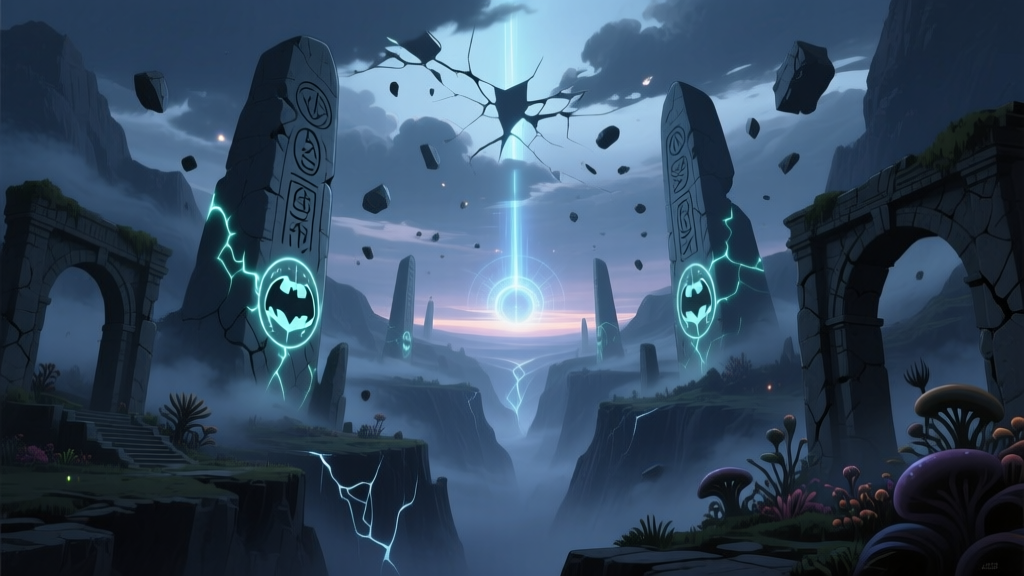
How strong is the DC Omniverse really?
That’s the question fans type into Google every month—110 times, minimum—before hitting forums, Reddit threads, and Discord servers arguing whether the DC Omniverse can survive a conceptual erasure or outscale Marvel’s Living Tribunal. The answer isn’t buried in vague editorial notes or marketing blurbs. It’s in Final Crisis’s collapsing hyperverse, Dark Nights: Death Metal’s Source Wall breach, The Multiversity’s Orrery of Worlds, and Grant Morrison’s explicit cosmological taxonomy. Let’s settle it—not with speculation, but with canon-anchored scaling, structural analysis, and hard limits.
What Is the DC Omniverse?
The DC Omniverse is not just ‘all DC universes.’ It’s the complete, hierarchically layered totality of DC’s metaphysical architecture—including infinite multiverses, meta-universes, hyperverses, the Bleed, the Source, the Overvoid, and even the pre-cosmic void that predates creation itself. Crucially, it is not static. Its boundaries have expanded, contracted, and been rewritten across reboots—but each iteration retains core axioms:
- It contains all possible narrative realities—not just physical or quantum variants, but stories told *about* DC characters (e.g., Superman: Red Son, Kingdom Come, Earth-33’s comic-book reality).
- It is narratively self-aware: The Monitor-Mind, the Gentry, and the Batman Who Laughs all operate on levels where story logic *is* physics.
- It has a top-down ontological hierarchy, with higher layers exerting causal authority over lower ones—not just power, but authorial control.
Structural Breakdown: Layers & Scale
DC’s cosmology isn’t flat—it’s stratified. Each layer operates under distinct rules, with higher tiers capable of editing or deleting lower ones without effort. Here’s the confirmed, issue-sourced hierarchy (in ascending order):
| Layer | Canon Source(s) | Key Feats / Definitions | Scale Relative to Base Multiverse |
|---|---|---|---|
| Base Multiverse (52 Universes) | 52, Countdown to Final Crisis | Post-Infinite Crisis structure; includes Earth-0, Earth-2, Earth-3, etc. Collapsed by Mandrakk in Final Crisis. | 1× (baseline) |
| Orrery of Worlds (Infinite Multiverse) | The Multiversity #1–2, Convergence | “Infinite” branching realities governed by the Monitors. Contains the Dark Multiverse (sub-layer), Bleed (interstitial medium), and Limbo. | ℵ₀ (countably infinite) |
| Hyperverses | Final Crisis #7, Death Metal #6 | Realities housing entire multiverses as ‘atoms’—e.g., the Hyperverse where the Overmonitor resides. The Hyperverse collapsed during the Final Crisis event. | ℵ₁+ (uncountable infinities; multiverses-as-particles) |
| The Source / The Overvoid | Green Lantern: Rebirth, Justice League (2018) #25, Death Metal #7 | Primordial consciousness preceding space/time. Source Field generates all existence. The Overvoid is the ‘silence before the first note’—where Perpetua was imprisoned *outside* creation. | Transcendent; non-spatiotemporal; causally prior to all layers |
| The Writer / The Story Continuum | The Multiversity Guidebook, Animal Man #26, DCeased: Dead Planet | Not a ‘being’, but the metaphysical principle of narrative agency. Explicitly referenced as ‘the hand that writes the script’—a layer beyond even the Source, invoked when characters break the fourth wall *with authorial intent*. | Absolute; unbound by internal logic; only invoked in metafictional contexts |
Attack Potency & Existential Scale
‘How strong is the DC Omniverse?’ isn’t about punching power—it’s about ontological reach. Attack potency here means capacity to erase, rewrite, or sustain layers of reality. Key benchmarks:
- Perpetua (Pre-Crisis version) created the entire Multiverse *and* the Dark Multiverse *as a single act*, then imprisoned herself in the Overvoid—a void outside all layers. Her defeat required the combined willpower of the entire Multiverse *plus* the Source Wall’s collapse (Death Metal #6–7).
- The Batman Who Laughs weaponized the Dark Multiverse’s entropy to infect *every* universe simultaneously—across the Orrery—by rewriting narrative causality (Death Metal #1–2). This wasn’t multiversal conquest—it was *story infection*.
- The Monitor-Mind (pre-Crisis) existed outside time and observed *all* timelines at once—its death caused temporal fractures across 52 universes (Countdown #31). Post-Multiversity, it evolved into the ‘Orrery Mind,’ overseeing infinite branches.
- The Source Wall’s destruction didn’t just release energy—it dissolved the barrier between the Multiverse and the Bleed, allowing Hyperversal entities like Barbatos to bleed *into* narrative continuity (Death Metal #1). That breach was an ontological rupture, not a physical explosion.
Durability & Hax Resistance
Durability isn’t measured in joules—it’s measured in *narrative resilience*. The DC Omniverse has survived:
- Complete narrative erasure: In Final Crisis, Mandrakk consumed the Overvoid’s light, turning the entire Orrery into a black hole of anti-life—yet the Source reasserted itself via Superman’s hope.
- Metafictional deletion: In Animal Man #26, Buddy Baker walked off-panel into the ‘real world’—a moment where the DC Omniverse’s continuity *bent* to accommodate fourth-wall-breaking agency. No hax resisted it because the layer *was* the boundary.
- Conceptual overwrite: The Gentry (from The Multiversity) don’t destroy worlds—they replace their foundational concepts (e.g., turning ‘hope’ into ‘despair’ at the metaphysical level), making resistance impossible without transcending narrative logic itself.
Crucially, hax resistance is tiered: A being immune to magic (like Wonder Woman) isn’t immune to Bleed-based entropy or Source-field negation. True resistance requires either:
- Existence within the Source or Overvoid (e.g., The Presence, The Spectre post-Rebirth), or
- Author-level awareness (e.g., Grant Morrison’s cameo in The Multiversity, or the ‘Writer’ entity in DCeased: Dead Planet).
Battle IQ & Narrative Agency
This is where DC’s Omniverse diverges hardest from other franchises. Battle IQ isn’t just tactics—it’s storycraft. Consider:
- Lex Luthor in Death Metal didn’t fight Perpetua—he *wrote a new origin for her*, reframing her as a flawed creator rather than an omnipotent god. That act destabilized her metaphysical authority (Death Metal #7).
- Superman defeated the Thought Robot not with strength, but by *refusing to conceptualize himself as a weapon*—breaking the robot’s logic engine, which relied on narrative predictability (Final Crisis #7).
- The Green Lantern Corps’ Book of Oa doesn’t just record history—it *anchors* continuity. When it was corrupted in War of the Green Lanterns, entire timelines unraveled—not from energy loss, but from *causal inconsistency*.
In the DC Omniverse, intelligence scales with narrative leverage: knowing *how* a story works matters more than raw power. That’s why Batman—who has no powers—has repeatedly thwarted multiversal threats by exploiting plot loopholes, continuity errors, or character archetypes.
Tier Ranking & Controversies
Power-scaling communities often misplace the DC Omniverse by treating it as ‘just another multiverse’. But per DC’s own statements and feats, its canonical tier is:
High Outerverse+ — defined as ‘containing infinite hierarchies of multiverses, with top layers operating beyond spacetime, causality, and narrative logic’.
Controversies arise from three common misreadings:
- ‘The Source Wall was just a barrier’: Wrong. It was the *boundary of creation*. Its destruction didn’t ‘open a door’—it ended the distinction between inside/outside, requiring the Source itself to reconstitute reality.
- ‘Perpetua was nerfed in Death Metal’: She wasn’t nerfed—she was *contextualized*. Her power is absolute *within creation*, but she’s still bound by the Overvoid’s silence and the Writer’s authority.
- ‘The Bleed is just interdimensional goo’: No. The Bleed is the *substrate of narrative transition*—where ideas become realities. As stated in The Multiversity Guidebook: ‘The Bleed is where stories go to be born.’
DC Omniverse vs. Other Omniverses
Comparisons are inevitable—but they’re apples-to-oranges without layer-matching. Here’s how DC stacks up on key axes:
| Axis | DC Omniverse | Marvel Omniverse | Dragon Ball Multiverse | SCP Foundation |
|---|---|---|---|---|
| Narrative Self-Awareness | Explicit, canonized, plot-driving | Limited (e.g., Deadpool breaks 4th wall, but no cosmology supports it) | None (multiverse is purely physical/energy-based) | Metafictional, but decentralized and inconsistent |
| Hierarchical Depth | At least 5 confirmed ontological layers | 3–4 (Multiverse → Abstract Realm → Beyonders → One-Above-All) | 1 (single multiverse with 12+ universes + Ultra Instinct as peak) | Unbounded, but lacks unified hierarchy |
| Conceptual Manipulation | Core mechanic (Gentry, Batman Who Laughs, Lex’s rewriting) | Rare (e.g., Molecule Man’s ‘conceptual erasure’ in Secret Wars) | Minimal (Zeno’s erasure is absolute but non-conceptual) | Central (SCP-3812, -2397, -2745) |
| Authorial Authority | Canonized as ‘The Writer’ (meta-layer) | Implied but never named or systematized | None | Present (e.g., SCP-3999, ‘The Author’), but contested |
FAQ
Is the DC Omniverse infinite?
Yes—but not just ‘infinitely large.’ It contains countably infinite universes (Orrery), uncountably infinite hyperverses, and transcendent layers (Source, Overvoid) that exist beyond cardinality. Its infinity is qualitative, not merely quantitative.
Can the DC Omniverse be destroyed?
Canonically, yes—but only by something operating *outside* it. Perpetua tried and failed. The Gentry sought to overwrite it, not destroy it. Only ‘The Writer’ or a true external author could erase it—and even then, DC’s metafiction implies such an act would generate a new Omniverse as narrative necessity.
Is the Source Wall part of the Omniverse?
No—it’s the *boundary* of the Omniverse. Its destruction didn’t damage the Omniverse; it dissolved the separation between creation and the pre-creative void (Overvoid), forcing the Source to restructure reality from scratch.
Does the DC Omniverse include alternate continuities like Elseworlds?
Yes—explicitly. The Multiversity Guidebook lists Earth-33 (the ‘real world’ comic book universe) and Earth-11 (gender-swapped) as canonical parts of the Orrery. Elseworlds aren’t ‘non-canon’—they’re designated narrative branches with ontological weight.
Who is the strongest being in the DC Omniverse?
Canonically, The Presence (the DC equivalent of ‘God’) is the highest-tiered entity *within* the Omniverse—embodiment of the Source, creator of the Source Wall, and the force that resurrected Superman in Final Crisis. However, ‘The Writer’ exists *outside* the Omniverse and is narratively superior—though never depicted as an active agent.
Why does the DC Omniverse keep rebooting?
Because reboots are *diegetic events*—not editorial decisions. Crisis events (Crisis on Infinite Earths, Infinite Crisis, Final Crisis, Death Metal) are literal cosmological collapses and rebirths, written into continuity as acts of multiversal self-correction. Each reboot reflects a new layer of narrative complexity, not inconsistency.