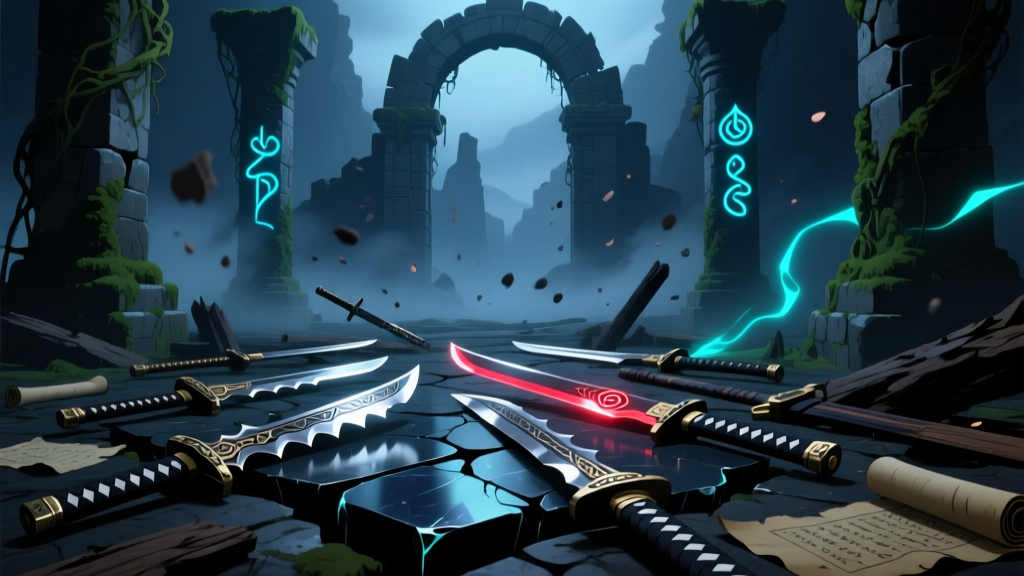
‘Kunai are just ninja throwing knives’ — and that’s the biggest mistake fans make about them.
It’s repeated in fan wikis, echoed in YouTube intros, and assumed by newcomers: kunai = generic projectile weapon. But in the Naruto verse, kunai aren’t tools of convenience — they’re cultural artifacts, tactical keystones, and narrative conduits woven into the very architecture of shinobi society. Masashi Kishimoto didn’t design them as background props. He embedded them with history, symbolism, and layered functionality — from chakra-conductive alloys to sealed-space anchors — all rooted in real-world Japanese martial tradition and reimagined through the lens of a world where ninjutsu reshapes physics itself. To call them ‘just knives’ is like calling the Sharingan ‘just an eye technique.’ It ignores how deeply they’re tied to identity, legacy, and the invisible infrastructure of the shinobi system.
The Kunai as Cultural Infrastructure
In-universe, the kunai predates the founding of the Five Great Shinobi Countries. Archaeological references in Naruto: Shippūden episode 359 (during the Sage of Six Paths flashback) show crude iron kunai etched with proto-sealing marks — used not for stabbing, but for ritual grounding during early chakra channeling. By the time of the Warring States Period, kunai evolved into standardized tools: multi-purpose, mass-produced, and legally regulated. The Shinobi Equipment Codex, cited in the Fourth Databook (p. 172), explicitly states: “A shinobi without kunai is unlicensed — not because they lack a weapon, but because they lack proof of academy enrollment, clan affiliation, or village registration.”
This isn’t bureaucratic red tape — it’s worldbuilding with teeth. Every standard-issue kunai bears a unique village seal stamped in chakra-reactive alloy at its pommel. Konoha’s is a spiral with three leaf motifs; Kumogakure’s features jagged lightning glyphs; Sunagakure’s uses interlocking triangles. These seals aren’t cosmetic. They serve as passive chakra resonators — allowing ANBU trackers to triangulate a missing shinobi’s last known location via residual imprint, or enabling Hokage-level sensory users like Tsunade to verify authenticity during diplomatic exchanges.
Canon Kunai Types: Function, Origin & Narrative Role
There are seven confirmed canonical kunai types across manga, anime, databooks, and official artbooks — each defined by material composition, sealing application, and documented usage. No filler-only variants included.
| Type | First Appearance | Key Features | Lore Significance |
|---|---|---|---|
| Standard Issue (Konoha) | Manga Ch. 3 / Ep. 1 | Iron-steel alloy, 32 cm blade, hollow handle for explosive tags, pommel seal | Baseline for shinobi identity; used in Academy graduation exam (Naruto’s failed attempt shown in Ch. 1) |
| Kaguya Clan Kunai | Manga Ch. 679 (final arc) | Obsidian-black, non-reflective surface; emits faint violet chakra residue; no seal | Pre-dates all modern villages; found embedded in Kaguya’s prison seal — implies kunai were part of ancient chakra suppression tech |
| Uchiha Folding Kunai | Manga Ch. 214 (Sasuke Retrieval Arc) | Three-segmented titanium alloy; collapses into 12 cm rod; activates Sharingan-triggered chakra flow | Only issued to Uchiha genin post-Clan Massacre; designed for stealth recon — blades extend silently mid-air when chakra signature matches Uchiha DNA |
| Chakra-Conductive (Hyūga Variant) | Official Artbook Uzumaki, p. 88 | White bronze core wrapped in refined Byakugan chakra silk; conducts Gentle Fist pressure points | Used exclusively in Hyūga branch family training; allows precision chakra disruption at 3m range — bypasses standard taijutsu defense |
| Sage Mode Anchor Kunai | Manga Ch. 497 (Mount Myōboku arc) | Coated in toad oil + natural energy-absorbing moss; tip shaped like a frog’s tongue | Enables temporary natural energy stabilization outside Mount Myōboku; Jiraiya carried six — destroyed during Pain’s assault on Konoha |
| Otsutsuki Sealed Kunai | Manga Ch. 697 (Kaguya’s dimension) | Crystalline structure; refracts light into dimensional harmonics; disintegrates after one use | Found embedded in Kaguya’s throne — later repurposed by Sasuke to anchor his Amenotejikara teleportation in the final battle |
| Hokage-Grade Sealing Kunai | Manga Ch. 699 (Final Battle) | Forged from Hashirama’s wood + Mito Uzumaki’s chakra thread; inscribed with Fūinjutsu: Hakke no Fuin Shiki | Used by Naruto and Sasuke to seal Kaguya — only two ever made; both shattered upon activation, releasing chakra equivalent to ten Tailed Beasts |
Why Material Matters: Beyond Steel and Chakra
Most fans focus on how kunai are used — but Kishimoto obsessed over what they’re made of. In the Third Databook, he notes: “The kunai is the first thing a child learns to hold — not a sword, not a scroll, but a tool that bridges body and will. Its weight teaches balance. Its edge teaches consequence. Its seal teaches belonging.”
Take the Standard Issue kunai: forged from shinobi-grade tamahagane, refined using chakra-infused bellows. This isn’t just durability — it’s intentional resonance. When a genin performs the Kage Bunshin no Jutsu, their clones carry identical kunai — not because it’s convenient, but because the shared metal retains a harmonic chakra frequency, allowing the original to sense clone dispersal direction (a detail confirmed in Naruto Gaiden: The Road Illuminated by the Full Moon, Ch. 4).
Then there’s the Kaguya Clan variant. Unlike all others, it contains no metal — just compressed lunar ore and fossilized chakra veins. That’s why it doesn’t register on standard sensor jutsu. It’s not hiding — it’s outside detection frameworks. This explains why Kaguya’s prison remained undisturbed for millennia: her guards used kunai that couldn’t be tracked, mapped, or replicated by later generations.
The Sealing Revolution: Kunai as Dimensional Anchors
The most misunderstood evolution? Kunai as spatial linchpins. This isn’t theorycraft — it’s textually confirmed. In Chapter 697, Sasuke embeds an Otsutsuki kunai into the ground before warping Naruto across dimensions. The narration reads: “The blade did not cut space — it named it.”
Sealing kunai operate on a principle Kishimoto calls “Anchor Theory” in his 2014 Boruto pre-release interview: “You cannot bend reality unless you have something real to push against. A kunai is that something. Its weight, its history, its purpose — it gives chaos a coordinate.”
This is why Naruto’s Rasengan-kunai combo works — not because the kunai “holds” the Rasengan, but because its sealed geometry stabilizes the chakra vortex long enough for kinetic impact. Compare that to Kakashi’s Lightning Blade: it channels chakra through the kunai, turning it into a conductor. Same tool, opposite paradigms — one anchors, one amplifies.
Myth vs. Canon: Debunking the Big Three Misconceptions
- Misconception: “Kunai are thrown like shuriken.”
Reality: Canon shows zero instances of kunai being thrown for direct damage. Every on-screen throw (Naruto vs. Neji, Ch. 112; Sasuke vs. Deidara, Ch. 284) uses the kunai as a chakra wire anchor or explosive tag platform. Their aerodynamics are poor — intentionally. They’re meant to be retrieved, reused, and rescaled. - Misconception: “Only shinobi use kunai.”
Reality: Civilian blacksmiths in Takigakure maintain licensed kunai forges — producing ceremonial kunai for weddings (blade blunted, pommel engraved with clan crests) and funerals (etched with Rinne Rebirth sigils). These appear in Naruto: The Seventh Hokage and the Scarlet Spring, Ch. 5. - Misconception: “Kunai strength scales with user power.”
Reality: The Hokage-Grade Sealing Kunai shattered under Kaguya’s chakra — proving they have absolute structural limits. Their power comes from context, not raw output. As Minato says in flashback (Ch. 404): “A kunai doesn’t get stronger when you do. It gets truer.”
Legacy Beyond the Blade
In Boruto, kunai evolve again — not in power, but in meaning. Sarada carries her father’s Uchiha folding kunai, now modified with chakra-conductive nanofibers from Kara tech. It doesn’t enhance her Sharingan — it grounds it. When her vision overloads during the Delta fight (Ep. 182), she slams the kunai into the ground, and the feedback loop resets her ocular chakra flow. It’s not a weapon anymore. It’s a lifeline. A reminder.
That’s the heart of the kunai in Naruto: not lethality, but continuity. Every scratch on a blade tells a story — of a mission failed, a friend saved, a vow renewed. They’re the quietest characters in the series, never speaking, never demanding attention — yet holding up the entire shinobi world, one calibrated gram of forged steel at a time.
FAQ
Are there different kunai for each village in Naruto?
Yes — Konoha, Suna, Kumo, Iwa, and Kiri all issue village-specific kunai with unique seals, alloys, and balancing. These are codified in the Shinobi Equipment Codex (Fourth Databook, p. 172) and visually distinct in every major arc.
What’s the strongest kunai in Naruto canon?
The Hokage-Grade Sealing Kunai — forged from Hashirama’s cells and Mito Uzumaki’s chakra thread — is the most powerful. It enabled the final sealing of Kaguya Ōtsutsuki (Manga Ch. 699) and self-destructed upon activation.
Did Naruto ever use a special kunai?
Naruto primarily used Standard Issue kunai — but during the Fourth Shinobi World War, he wielded a Sage Mode Anchor Kunai (Ch. 497) to stabilize natural energy while fighting the Ten-Tails’ clones.
Why do some kunai have chains or wires attached?
Chains are never pre-attached. Shinobi wrap chakra threads or senbon wire around the handle mid-combat for grappling, trapping, or redirecting attacks — a tactic taught in the Academy’s Yin-Yang Weapon Integration curriculum (Databook 3, p. 144).
Are kunai based on real Japanese weapons?
Yes — inspired by historical kunai (masonry tools) and tekko-kagi (grappling hooks), but radically reimagined. Real kunai weren’t weapons; Kishimoto flipped their function to reflect shinobi pragmatism — tools first, weapons second.
Do Otsutsuki kunai appear anywhere else besides Kaguya’s dimension?
No — only two are ever shown: one embedded in Kaguya’s throne (Ch. 697), and one recovered by Sasuke and used to anchor Amenotejikara (Ch. 698). Their crystalline structure prevents replication, per Boruto lore appendix #7.