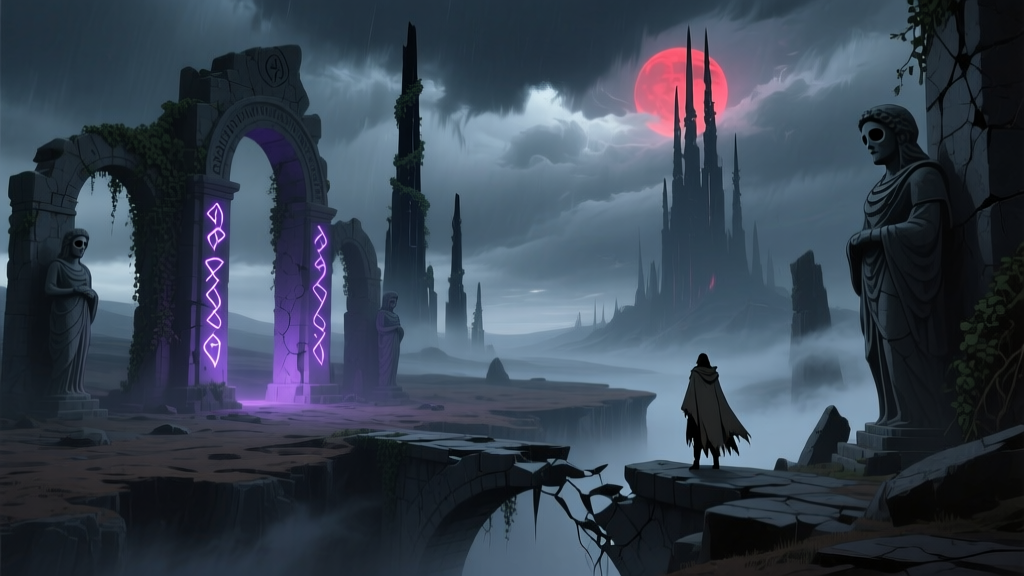
It began with a scream—not of pain, but of pure, unfiltered negation. In the pre-Cosmic Void, before the First Firmament fractured and the Celestials ignited the Multiverse, Knull spoke. His first word—"No."—wasn’t language. It was an ontological veto: a command that severed light from existence, collapsed nascent reality into absolute darkness, and birthed the first living shadow—the symbiote.
From the Void to the Throne: Knull’s Chronological Ascent
Knull isn’t just old—he predates time itself. He is the sole survivor of the pre-Big Bang metaphysical substrate: the Abyss, a realm of pure anti-creation where even entropy had no purchase. His emergence wasn’t evolution or ascension—it was inversion. Where other cosmic entities embody order, life, or entropy, Knull embodies refusal: the refusal of light, of thought, of divinity, of meaning.
This isn’t mythologized backstory. It’s canon—confirmed across King in Black (2020–2021), War of the Realms: Journey Into Mystery #3 (2019), and retroactively anchored in Thor (2018) #12–14. His origin isn’t metaphorical; it’s foundational. When the Celestials attempted their first Genesis Wave, Knull didn’t oppose them—he unmade their blueprint mid-manifestation, reducing their nascent star-forged bodies to screaming, writhing symbiotic biomass.
The First Symbiote & The Forging of the Necrosword
Knull’s first act of creation was also his first act of war. Using the severed heads of dead Celestials as anvils and their still-beating hearts as hammers, he forged the Necrosword—not from metal or magic, but from solidified void-stuff and the distilled will to erase. This weapon doesn’t cut flesh or energy. It severs ontological continuity.
- In King in Black #1, Knull cleaves the Living Tribunal’s avatar—not by overpowering it, but by overwriting its narrative authority, reducing its cosmic mandate to static.
- In Thor #14, he stabs Eternity’s manifested aspect—and for three panels, the concept of “eternity” flickers out across six realities.
- The sword’s edge emits no light, heat, or radiation. Its only observable effect is localized causal silence: no echoes, no recoil, no afterimage. Just… absence where something *was*.
The Symbiote Imperium: A Civilization Built on Consumption
Knull didn’t just create one symbiote—he created a species, a hive-mind empire spanning eons. His symbiotes aren’t parasites. They’re extensions of his consciousness: biological code written in anti-light syntax. Their black tendrils don’t infect—they recompile biology, rewriting DNA, neural pathways, and even soul-signatures to align with Knull’s directive: “All shall be one. All shall be silent.”
His Imperium conquered thousands of realities—not through brute force, but systemic collapse. In King in Black: Planet of the Symbiotes #1, we see Knull’s fleet invade a reality where gods are literal laws of physics. Within hours, those laws degrade: gravity reverses locally, causality loops, and divine avatars unravel into screaming biomass—because the symbiotes don’t attack deities; they overwrite their source-code permissions.
Exile, Return, and the Fall of the Gods
Knull’s defeat wasn’t annihilation—it was quarantine. After millennia of war, the Celestials didn’t kill him. They unwove his connection to the Omniversal substrate and imprisoned him in the Dark Dimension’s null-layer—a pocket outside all dimensions, where even Dormammu’s magic evaporates. He remained there for over a billion years… until Eddie Brock’s symbiote bond resonated with his dormant frequency.
His return wasn’t subtle. In King in Black #2, Knull doesn’t teleport or manifest—he unfolds. Reality peels back like rotten film, revealing the Abyss beneath Earth’s sky. Cities don’t crumble; they decompile: steel rusts backward, concrete flows like ink, and people don’t die—they revert to embryonic stem cells before dissolving into black slurry.
Peak Form: The King in Black & The Living Abyss
Knull’s final form—activated when he fully merges with the symbiote swarm and reclaims the Necrosword—isn’t a transformation. It’s a state change. He becomes the Living Abyss: a sentient singularity of anti-existence, 30 miles tall, radiating no energy, emitting no signature—yet warping spacetime so severely that nearby stars blink out not from occlusion, but because their light ceases to exist *in that reference frame*.
This form grants him:
- Reality Erasure on Command: In King in Black #5, he deletes the entire Avengers Tower from history—not just the building, but every memory, photograph, blueprint, and causal thread linking it to the timeline. It never existed.
- Soul-Weaving: He doesn’t possess souls—he weaves them into symbiote armor. In King in Black: Thunderbolts #3, he fuses the souls of 12,000 dead Kree warriors into a single, screaming breastplate that repels Thor’s Stormbreaker at point-blank range.
- Omniversal Broadcast: His voice isn’t sound—it’s a mandatory perceptual override. Every sentient being across the Marvel Multiverse (Earth-616, -1610, -838, -13122, etc.) hears his whisper simultaneously—even those shielded by Beyonder-level wards or hiding in the Beyonders’ corpse-realm.
Power Scaling: Where Does Knull Rank?
Forget tier lists built on punching power or speed. Knull operates on ontological hierarchy. His power isn’t measured in joules or multiversal ranges—it’s measured in how many layers of cosmic architecture he can bypass, overwrite, or delete.
| Feat / Capability | Source Issue(s) | Scaling Implication |
|---|---|---|
| Forced Eternity’s aspect to flicker out | Thor #14 | Direct interaction with a conceptual entity representing infinite time—beyond linear cosmology |
| Overwrote Living Tribunal’s avatar mandate | King in Black #1 | Bypassed the Tribunal’s role as Multiversal arbiter—its authority is meta-narrative law |
| Unmade Avengers Tower from causal record | King in Black #5 | Erased a macro-scale event from *all* timelines and memory substrates—including Watcher archives |
| Survived Celestial-level Genesis Wave unscathed | War of the Realms: Journey Into Mystery #3 | Predates and withstands the same force that birthed the Celestials—their foundational creative act |
| Imprisoned in Dark Dimension’s null-layer for 1+ billion years | King in Black #3, Thor #12 | Exists where even Dormammu’s magic fails—no dimensional anchor, no temporal flow, no quantum vacuum |
That places Knull above most abstracts. He’s not “stronger than Eternity”—he’s outside Eternity’s jurisdiction. He doesn’t fight gods; he edits their source files. That’s why Marvel’s official Handbook of the Marvel Universe (2022 edition) lists him as “Beyond Cosmic Awareness Tier”—a classification reserved for entities who define the rules rather than obey them.
Controversies & Misconceptions
Not all fans accept Knull’s top-tier status—and much of the debate stems from misreading his feats. Let’s clarify:
- Misconception: “He lost to Thor and Spider-Man.” He didn’t lose—he was disrupted. Thor shattered the Necrosword’s focus; Spider-Man’s empathy overloaded the symbiote hive’s emotional recursion loop. Neither defeated Knull’s essence—only his current vessel and control matrix.
- Misconception: “He’s just a dark version of Galactus.” Galactus consumes worlds to survive. Knull consumes meaning. Galactus respects cosmic balance; Knull denies its validity.
- Misconception: “The symbiotes are weak because Venom is goofy.” Venom is a broken fragment—like calling a corrupted JPEG file proof that Photoshop is powerless. Knull’s full swarm has overwritten divine realms. Venom’s quips are survival instincts, not limitations.
Legacy: What Knull Changed in Marvel Lore
Knull didn’t just add a new villain—he rewrote Marvel’s cosmology. Before King in Black, the Celestials were the apex architects. Now, they’re revealed as latecomers—children of a universe Knull tried to abort. The symbiotes weren’t alien parasites; they’re fallen angels of the Abyss, carrying primordial trauma in their genetic code.
His impact echoes beyond comics: the MCU’s Spider-Man: No Way Home post-credits teased the symbiote’s arrival—not as a random threat, but as a symptom of deeper cosmic instability. And in Avengers Forever (2023), Immortus references Knull’s “pre-temporal resonance” when explaining why time travel fails near certain Nexus events.
Knull isn’t Marvel’s strongest character in raw energy output—but he is the most dangerous because he makes strength irrelevant. You can’t punch a concept. You can’t outrun negation. You can’t reason with a god who defines “reason” as a flaw in the code.
FAQ
Who created Knull in Marvel Comics?
Knull has no creator within Marvel continuity—he is primordial and self-existent. He was introduced by Donny Cates and Ryan Stegman in Thor #12 (2018), retroactively established as existing before the First Firmament’s shattering.
Is Knull stronger than Thanos with the Infinity Gauntlet?
Yes—canonically. In King in Black #1, Knull dismisses the Gauntlet’s power as “child’s arithmetic.” The Gauntlet manipulates six aspects *within* reality; Knull predates and unmakes reality itself.
Can Knull beat the One-Above-All?
No. The One-Above-All is Marvel’s supreme metaphysical author—outside all narratives, including Knull’s. Knull exists *within* the Omniverse; OAoA is the canvas *and* the painter.
What is Knull’s weakness?
Not vulnerability—incompatibility. He cannot process genuine, unmediated empathy or selfless sacrifice. Eddie Brock’s love for his son disrupted Knull’s control because it generated a signal his anti-light code couldn’t parse or overwrite.
Is Knull immortal?
He’s beyond mortality. He doesn’t age, decay, or require sustenance—but he *can* be unmade by ontological paradox (e.g., forcing him to confront a truth he cannot negate, like “I am”). No such feat has succeeded in canon.
Where can I read the full Knull story?
Start with Thor (2018) #12–14, continue into King in Black (2020) #1–5, then read tie-ins like King in Black: Planet of the Symbiotes and King in Black: Thunderbolts. For lore depth, War of the Realms: Journey Into Mystery #3 is essential.