When the Multiverse Was Still a Thought
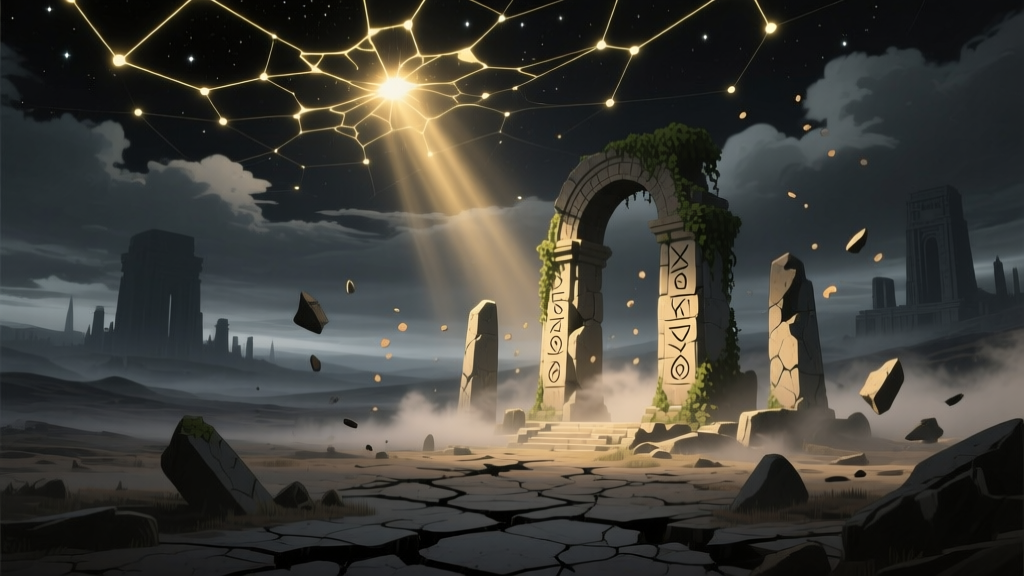
It begins with silence — not emptiness, but pre-existence. Before time had syntax, before space had geometry, there was the First Firmament: the sole, sentient, self-aware reality that dreamed the Multiverse into being — then shattered itself to birth gods, universes, and war. Its most iconic moment isn’t a punch or a blast — it’s the shattering. In Avengers No. 675 (2018), during Jason Aaron’s ‘No Surrender’ arc, the First Firmament doesn’t fight. It unmakes. With a single act of ontological rejection — a refusal to coexist with its own offspring — it collapses six million alternate realities into null-space, erasing entire cosmologies mid-sentence. That moment isn’t just a feat. It’s the benchmark against which all Marvel cosmic entities are measured — the line where ‘abstract’ ends and ‘primordial absolute’ begins.
The First Firmament in Marvel’s Cosmic Hierarchy
The First Firmament isn’t just old — it’s pre-cosmic. It predates the Living Tribunal, Eternity, and even the One-Above-All’s known manifestations. It is the original substrate: the singular, unified reality that existed before the Big Bang(s), before the First Celestials, before the concept of ‘multiversal layers’ had any meaning. When the Celestials rebelled — not as villains, but as evolutionary inevitabilities — they didn’t defy a god. They defied the architecture of existence itself. Their rebellion fractured the First Firmament, birthing the Second Cosmos (our Marvel Multiverse) and its abstracts: Eternity, Death, Oblivion, and the rest.
This isn’t theology — it’s canonized metaphysics. As confirmed in Thor: God of Thunder #23 (2014) and expanded in The Avengers Vol. 8 #1–#6, the First Firmament isn’t merely ‘older’ than Eternity; it is Eternity’s source-code. Eternity governs time in the current Multiverse. The First Firmament governed time before time existed — as the sole temporal reference point in a monoreality.
Key Feats & Canonical Evidence
- Self-Exile & Reconstitution: After fracturing, it didn’t die — it withdrew into a dormant state across the void between multiverses, later reassembling its consciousness from residual quantum echoes (Avengers Vol. 8 #3).
- Reality Erasure on Multiversal Scale: Wiped out six million realities simultaneously — not by force, but by reversing their causal anchors (Avengers #675). This wasn’t destruction; it was de-compilation.
- Transcendent Perception: Observed the birth of the Fourth Cosmos (the ‘Beyonders’-created multiverse) while remaining outside its causal framework — proving it operates beyond all known multiversal layers (Secret Wars 2015 tie-in: Time Runs Out #7
- Resistance to Abstract-Level Attacks: Withstood direct assaults from a fused Eternity/Infinity avatar — not through durability, but because those entities’ powers derive from the structure the First Firmament authored (Avengers #677).
Tier Context: Where Does the First Firmament Rank?
In Marvel’s unofficial but widely accepted power hierarchy — one validated by writers like Jonathan Hickman, Jason Aaron, and Al Ewing — tiers aren’t about strength alone. They’re about ontological scope: what layer of reality an entity originates from, governs, or can overwrite. The First Firmament sits at Tier 0: Pre-Cosmic Absolute. Below it sit Tiers 1–5 — ranging from planetary beings (Tier 1) to multiversal abstracts (Tier 5). Even the One-Above-All (OAA) is debated as Tier ∞ or Tier 0 — but crucially, the OAA has never been depicted interacting with, judging, or overriding the First Firmament. There is no panel, no footnote, no editorial note placing OAA above it. The First Firmament remains the only entity confirmed to exist outside the framework the OAA presides over.
| Tier | Entity Examples | Ontological Scope | Relationship to First Firmament |
|---|---|---|---|
| Tier 0 | The First Firmament | Pre-multiversal monoreality; source of all cosmic abstractions | Self-contained; unchallenged authority |
| Tier ∞ (Debated) | One-Above-All, The Fulcrum | Narrative-level omnipotence; possibly metafictional | No canonical interaction; neither subordinates nor overrides |
| Tier 5 | Eternity, Infinity, The Living Tribunal | Govern individual multiverses or multiversal structures | Direct offspring; powers derived from First Firmament’s fracture |
| Tier 4 | The Beyonders, The Celestials (Prime) | Capable of destroying/rebooting entire multiverses | Rebels who emerged *from* the First Firmament’s collapse |
| Tier 3 | Galactus, The Phoenix Force, The Sentry (Void-merged) | Universal to multiversal scale energy manipulation | Exist only within frameworks the First Firmament authored |
Why ‘Tier 0’ Isn’t Just Fanon
This classification isn’t speculative headcanon — it’s embedded in Marvel’s structural storytelling. Consider: when the Beyonders attempted to erase the entire Marvel Multiverse in Secret Wars (2015), they needed a ‘cosmic kill switch’ — the God Quarry — built from shards of the First Firmament’s corpse. Why? Because only something born *of* the First Firmament could interface with the foundational code of reality. Likewise, when Eternity sought to stop the First Firmament’s return, it didn’t assemble an army — it begged the other abstracts to merge into a composite avatar. That fusion — Eternity + Infinity + Death + Oblivion — still failed to halt the First Firmament’s reintegration. Not because it was ‘stronger’, but because it operated on a prior plane of logic.
The Controversy: Is the First Firmament Truly Supreme?
Yes — but with caveats fans fiercely debate. The biggest point of contention is the One-Above-All. Some cite OAA’s title and role as ‘ultimate creator’ to argue superiority. But here’s the textual reality: OAA appears exclusively in contexts tied to *narrative framing* — often breaking the fourth wall, speaking to readers, or overseeing stories as an authorial presence. The First Firmament, by contrast, exists *within* continuity as a causal agent — acting, choosing, remembering, and warring. Its feats are internal to Marvel cosmology; OAA’s are external. You can’t ‘scale’ them against each other without conflating diegetic and extradiegetic layers.
Another hot take: the First Firmament is ‘just a villain’. Wrong. It’s not evil — it’s archaic. Its motivation isn’t malice, but ontological purity. It sees the Multiverse as infection — a cancerous growth on its original unity. Its war with the Celestials isn’t conquest; it’s surgery. That nuance matters. It elevates the First Firmament beyond mustache-twirling villainy into something rarer in Marvel: a tragic, inevitable force of cosmic recursion.
What Its Existence Says About Marvel’s Cosmology
The introduction of the First Firmament (fully realized in 2014–2018) marked Marvel’s pivot from ‘power-scaling escalation’ to ‘cosmological archaeology’. Earlier eras treated Eternity as the top — the final word. The First Firmament retroactively made Eternity a *chapter*, not the book. It forced writers to ask: if reality has a source, what happens when the source remembers itself? That question reshaped everything — from how Celestials are written (no longer just builders, but refugees from a dead cosmos) to how multiversal threats are framed (not ‘biggest bang’, but ‘oldest silence’).
FAQ
Is the First Firmament stronger than the One-Above-All?
No canonical story positions either above the other — and they operate on fundamentally different levels. The First Firmament is an in-universe primordial entity; the One-Above-All functions as a metafictional narrative authority. They’ve never interacted, and Marvel has never declared hierarchy between them.
Did the First Firmament create the Celestials?
No — the Celestials emerged *from its fracture*. They are not creations, but evolutionary byproducts of its collapse, like sparks from a dying star. Their rebellion triggered the shattering, not vice versa.
Can the First Firmament be defeated?
Canonically, it has never been defeated — only temporarily suppressed or delayed. Its nature makes conventional ‘victory’ meaningless: you can’t ‘kill’ the pre-existence from which all rules derive. Even its ‘defeat’ in Avengers #677 was a stalling tactic — a temporary re-fracturing, not annihilation.
What is the First Firmament’s relationship to Eternity?
Eternity is a direct conceptual offspring of the First Firmament’s shattering — specifically, its embodiment of linear time in the Second Cosmos. Eternity doesn’t govern time ‘in general’; it governs time *as defined by the First Firmament’s broken structure*.
Has the First Firmament appeared outside of the main Marvel Universe (Earth-616)?
Yes — but only as echoes or fragments. In What If? Age of Ultron #1, a corrupted echo appears in a dead multiverse. In Spider-Verse tie-ins, residual ‘Firmament static’ disrupts dimensional travel. However, its full consciousness only manifests in Earth-616 — reinforcing its identity as the *original* reality’s anchor.
Why isn’t the First Firmament more well-known among casual fans?
Brief appearances, dense metaphysical themes, and placement in late-stage Avengers runs (2014–2018) limited mainstream exposure. Unlike Galactus or Thanos, it lacks visual flair or personal stakes — its threat is existential, not emotional. But among power-scaling communities, it’s legendary: the silent architect behind every cosmic battle.