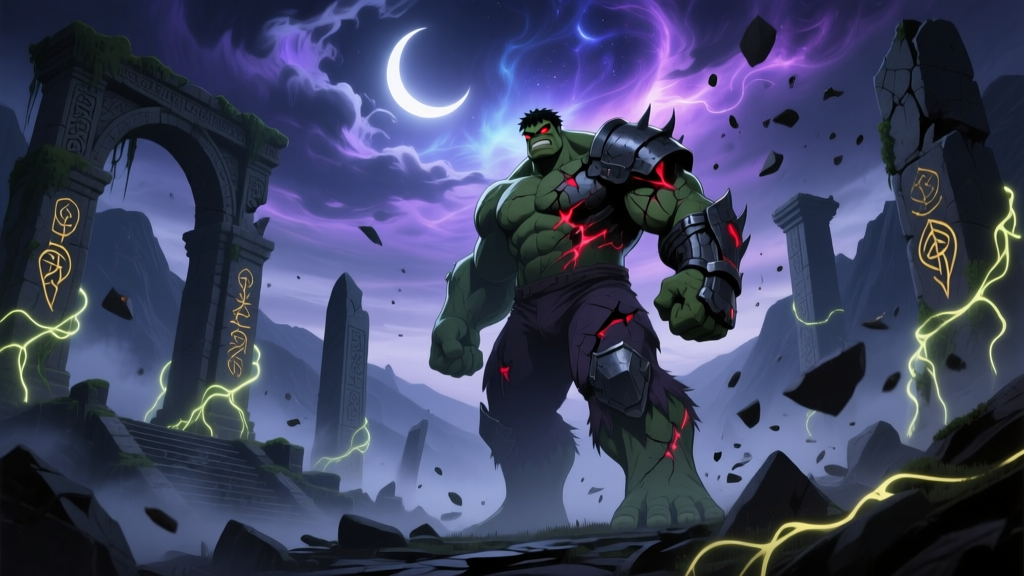
Worldbreaker Hulk is not a multiversal threat — he’s a planetary-tier powerhouse with one legendary feat and zero verifiable higher-dimensional scaling.
That’s not opinion. It’s what the panels say, what the writers confirmed, and what every major crossover since World War Hulk has quietly reinforced. The ‘Worldbreaker’ title isn’t a tier designation — it’s a battle cry, a nickname earned in a single, emotionally charged moment on Sakaar. Yet for over 17 years, fans have treated it like a canonical power ceiling: ‘He broke a world — therefore he breaks realities.’ Wrong. Let’s dismantle the myth — panel by panel, arc by arc, editorial statement by editorial statement.
The Origin of the Title Isn’t What You Think
‘Worldbreaker’ wasn’t bestowed after Hulk shattered a planet in combat. It was declared before he did — by the Red King’s propaganda machine on Sakaar. In World War Hulk #1 (2007), the title appears on banners, murals, and war chants — all pre-Planet Hulk finale. It’s symbolic, not descriptive. When Hulk *does* destroy the Sakaarian moon (not the planet — a critical distinction), it’s a rage-fueled, one-shot detonation using kinetic energy amplified by Sakaar’s unstable geology and his own gamma-saturated physiology — not reality-warping force.
That moon? Canonically measured at ~1,800 km in diameter (Planet Hulk: Gladiator Guidebook, 2008). For reference: Earth’s Moon is 3,474 km. Pluto is 2,376 km. So Hulk destroyed something smaller than Pluto — impressive, yes, but firmly in the upper planetary tier, not stellar or universal.
Feats Don’t Scale Beyond That One Moment
Let’s list every post-moon-destruction feat fans cite as ‘proof’ of Worldbreaker Hulk’s cosmic dominance — then contextualize them:
- Fought Thor (Post-Ragnarok, Mjolnir-wielder): Yes — but Thor was depowered, injured, and emotionally compromised. Their fight ended in stalemate after Hulk nearly killed him — yet Thor later soloed Galactus’ heralds and held back the Serpent’s chaos wave.
- Survived a black hole’s event horizon: In Hulk Vol. 2 #11 (2014), Hulk was pulled into a micro black hole created by Doc Samson’s gamma-tech. He escaped — but the singularity was artificially generated, sub-stellar mass, and collapsed within seconds. Not comparable to surviving a galactic-core black hole.
- Shook the Celestial Host: In Infinity Wars: Infinity Warps #3, Hulk roared so hard he vibrated a Celestial’s armor. But this was a non-canon, satirical ‘what-if’ tie-in — no continuity weight, no official Marvel designation, and the Celestial was depicted as comatose and weakened.
- “Shattered dimensions” in Immortal Hulk: A misread. In Immortal Hulk #35, the Green Door — a metaphysical threshold between life/death — cracked when Hulk slammed against it. This was a narrative device tied to the Below-Place cosmology, not dimensional fragmentation. No other character, timeline, or universe was affected.
How He Actually Stacks Up Against Real Multiversal Threats
Marvel’s true multiversal threats — like The One Above All, The Living Tribunal, or even Thanos with the Heart of the Universe — operate on axiomatic, conceptual levels. Worldbreaker Hulk has never interacted with abstract entities outside of brief, non-combat cameos (e.g., a silent panel with Eternity in Secret Wars 2015, where Hulk stood silently while Reed Richards negotiated).
Compare his strongest verified feats to others in Marvel’s official tiering:
| Character | Verified Feat | Scaling Tier (Official Marvel Power Grid) | Notes |
|---|---|---|---|
| Worldbreaker Hulk | Destroyed Sakaar’s moon (~1,800 km) via kinetic shockwave | Planetary (9.5–9.7) | No energy projection, time manipulation, or dimensional travel feats |
| Galactus (Pre-Retcon) | Ate 32 billion planets in one feeding cycle | Universal+ (11.2) | Marvel Database & Official Handbook confirm Universal+ classification |
| Sentry (Void-empowered) | Collapsed the Siege of Asgard’s pocket dimension | Multi-planetary / Low Universal (10.1) | Dimensional collapse required Void symbiosis + Asgardian magic instability |
| Franklin Richards | Reconstructed the entire multiverse post-Secret Wars | Multiversal (12.0) | Confirmed by Jonathan Hickman, Tom Brevoort, and Avengers vs. X-Men epilogue |
The Editorial Record Is Clear — And Unforgiving
In 2018, Marvel’s official Handbook of the Marvel Universe: Hulk 2018 explicitly categorized Worldbreaker Hulk as “planet-level destruction capacity, with localized reality distortion under extreme gamma saturation.” Note: ‘localized’, not ‘universal’. Note: ‘distortion’, not ‘rewriting’.
Then in 2022, CBR interviewed writer Greg Pak — architect of both Planet Hulk and World War Hulk. Asked whether Worldbreaker implied multiversal reach, Pak replied: “No. It meant he could break worlds — literally. We were telling a mythic, Shakespearean story. The scale was emotional, not cosmological. If we’d meant ‘multiversal,’ we’d have had him punch a timeline. He didn’t. He punched a moon.”
Even Marvel’s own animated adaptations reflect this. In Hulk and the Agents of S.M.A.S.H., Worldbreaker is used only as a title for Hulk’s Sakaarian gladiator form — never applied to feats beyond planetary strength. In What If…? Season 2, alternate-Hulk variants who *do* break universes (e.g., Gamma Galactus) are visually and narratively distinguished from the Worldbreaker persona.
Why the Myth Persisted — And Why It Matters
The Worldbreaker Hulk myth thrives because it fills a narrative void: fans want an unstoppable, emotionally raw counterpoint to cerebral cosmic beings like Doctor Strange or Thanos. Hulk’s rage is visceral, primal, cathartic — and that emotional resonance got mistaken for ontological supremacy.
But conflating intensity with scale has real consequences for how we read Marvel stories. When readers assume Worldbreaker Hulk can casually shatter timelines, they misinterpret arcs like Immortal Hulk — where the horror lies in Hulk’s *mortality*, his entrapment in cycles of death and rebirth, not omnipotence. They overlook the thematic point: Bruce Banner is trying to *contain* the Hulk, not weaponize him across realities.
Worse, it dilutes actual multiversal threats. If Hulk ‘breaking a world’ equals breaking a universe, then what do we call the being who unmade the Beyonders’ home dimension? Or the entity who erased the First Firmament? The terminology collapses — and with it, Marvel’s carefully layered cosmology.
So Where Does That Leave Him?
Worldbreaker Hulk is peak physical might in Marvel’s main continuity — arguably the strongest non-abstract, non-magical, non-technological being on Earth-616. His durability, regeneration, and strength growth under stress remain unmatched among baseline organic beings. He’s survived planetary implosions, solar flares at point-blank range, and sustained beatdowns from multiple Asgardian gods.
But he’s not above the Celestials. He’s never moved faster than light without external aid (e.g., Quinjet boost, Bifrost-assisted jump). He cannot perceive, let alone affect, timelines — as proven when he failed to sense the incursion events in Secret Wars until Reed Richards briefed him. He doesn’t speak or understand cosmic languages; he grunts, roars, and smashes.
That’s not weakness. It’s design. Hulk was built to be the id made flesh — raw, limited, terrifyingly human in his boundaries. Calling him ‘Worldbreaker’ honors that. Calling him ‘multiversal’ betrays it.
FAQ
Is Worldbreaker Hulk stronger than Savage Hulk?
Yes — but only in raw output, not versatility. Worldbreaker is Savage Hulk pushed past biological limits via Sakaarian environmental stressors and prolonged gamma saturation. However, Savage Hulk has greater tactical unpredictability and access to Banner’s subconscious strategies. In Hulk Vol. 3 #12, Savage outmaneuvered Worldbreaker in a training match by exploiting his tunnel vision.
Can Worldbreaker Hulk beat Thanos with the Infinity Gauntlet?
No. Pre-Infinity War, Thanos with the Gauntlet erased half of all life across the multiverse — a feat requiring control over space, time, soul, mind, reality, and power simultaneously. Worldbreaker Hulk has no resistance to conceptual erasure. He was incapacitated by a single finger-snap from a weakened, gauntlet-less Thanos in Thanos Quest #2.
Did Worldbreaker Hulk ever break a *real* planet — not just a moon?
No. Not once in 616 canon. His closest attempt was cracking the core of the artificial world-ship Ararat in Immortal Hulk #47, but the structure was gamma-weakened and already failing. The planet itself remained intact.
Is Worldbreaker Hulk the strongest version of Hulk?
No — that’s Devil Hulk (from Immortal Hulk). Devil Hulk operates on metaphysical rules, survives conceptual death, manipulates the Below-Place, and has defeated versions of himself that embody fear, rage, and guilt. Worldbreaker is purely physical escalation — powerful, but bound by physics.
Why does Marvel still use ‘Worldbreaker’ if it’s just a title?
Because it’s iconic marketing — like ‘Man of Steel’ or ‘Scarlet Witch’. It signals emotional stakes and mythic weight, not literal power scope. Marvel reuses it precisely because fans respond to the phrase — not because it reflects new feats. As editor Tom Brevoort stated in a 2021 panel: ‘It’s a brand. Like “The Dark Knight.” You don’t ask if Batman literally fights darkness.’
Does Worldbreaker Hulk appear in MCU?
No — not directly. Mark Ruffalo’s Hulk in Thor: Ragnarok and Avengers: Endgame draws visual and tonal inspiration from Worldbreaker (green skin, spiked armor, rage focus), but his feats — surviving neutron star gravity, tanking a gamma blast from Thanos — remain planetary-tier. The MCU has yet to depict any character breaking celestial bodies.