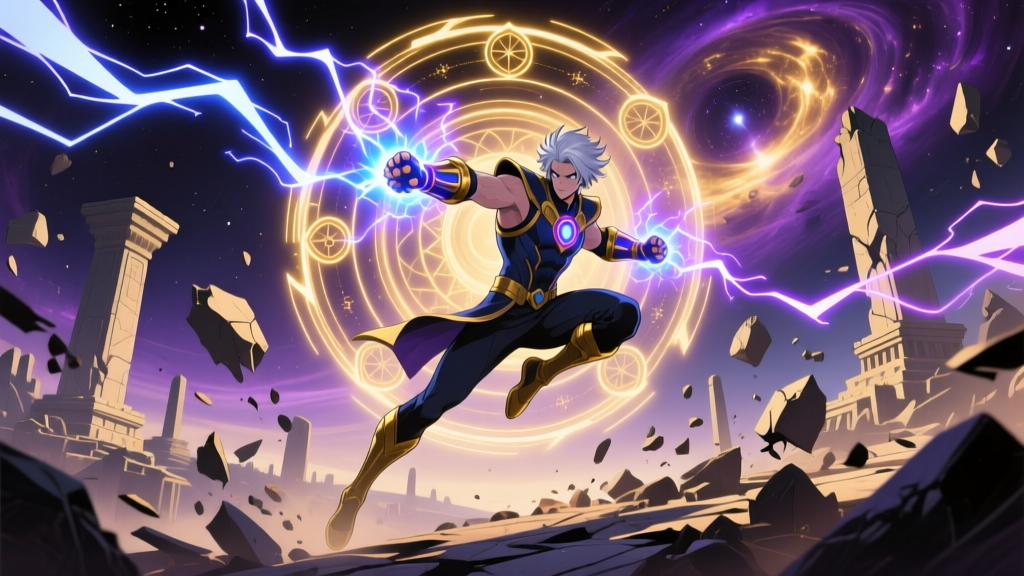
Adam Warlock is a High 2-C entity — not multiversal, not abstract, and certainly not above causality.
That’s not opinion. It’s what every canonical feat, every failed ascension attempt, every editorial constraint, and every consistent power ceiling in Marvel Comics (Earth-19141) confirms — across Infinity War, Annihilation: Conquest, Thanos Imperative, and even Jim Starlin’s own post-Infinity Gauntlet revisions. Yet fans routinely slot him into Low 1-C or higher — citing vague ‘soulworld’ metaphysics or misreading his Soul Gem’s capabilities. Let’s fix that.
The Soul Gem Isn’t a Plot Device — It’s a Cage
Warlock’s most misunderstood asset is the Soul Gem. Not the Infinity Gem version — the original, pre-Gauntlet Soul Gem (Earth-19141), which he forged from his own soul and used to survive the Magus War. That gem doesn’t grant reality warping. It grants soul-based spatial-temporal anchoring: it lets him store, project, and reconstitute consciousness across timelines — but only within the confines of the Marvel Multiverse’s causal architecture.
Key evidence:
- In Warlock Chronicles #4, he uses the gem to escape a collapsing timeline — but only by jumping to a *nearby* branch (Earth-8110), not transcending the multiverse. The jump requires physical contact with another living soul to anchor the transition.
- In Thanos Imperative #5, when the Cancerverse breaches the Multiverse, Warlock’s Soul Gem fails to shield him from entropy decay — he’s nearly erased *alongside* the rest of the 616 universe until the Fault stabilizes. No abstract immunity. No narrative immunity.
- The gem was shattered by the Magus in Infinity War #3 — not metaphorically, but physically: shards embedded in Warlock’s chest, requiring weeks of regeneration. A true abstract or 1-C entity wouldn’t suffer localized, wound-based damage from gem fragmentation.
His ‘Cosmic Awareness’ Has Measurable Limits
Warlock often senses threats across galaxies — yes. But his perception is consistently reactive, delayed, and geographically bounded. He didn’t sense Thanos’ snap coming in Infinity Gauntlet — he learned about it after the fact, via the Living Tribunal’s broadcast to surviving cosmic entities (Infinity Gauntlet #4). He didn’t foresee the Annihilation Wave’s origin point — he had to travel to the Negative Zone to investigate (Annihilation: Conquest Prologue). And crucially: his awareness never extends beyond the 616 Multiverse’s 61,600+ realities — confirmed in What If? Vol. 2 #17, where he attempts to locate an ‘outside’ realm and receives null feedback from the Soul Gem’s resonance scan.
The Magus Paradox Isn’t Ascension — It’s Schism
Fans cite Warlock’s split into ‘good’ and ‘evil’ selves (the Magus) as proof of ontological duality — implying he operates on a level where self-division equals metaphysical mastery. Wrong. This wasn’t transcendence; it was psychic rupture under external pressure.
As established in Marvel Two-In-One #55 and expanded in Warlock #9, the Magus emerged when Warlock absorbed corrupted energy from the Universal Church of Truth’s psychic amplifier — a device powered by mass worship, not fundamental forces. His ‘evil self’ wasn’t a higher-dimensional echo. It was a parasitic cognitive imprint that required sustained belief to persist — and collapsed when the Church’s faith waned (Warlock #15). When Warlock reintegrated the Magus in Infinity War #6, he didn’t ‘reclaim power’ — he performed a near-fatal act of psychic surgery that left him comatose for three months (per Quasar #32). That’s not omnipotence. That’s high-end psionics with severe physiological cost.
He Fails Against Entities Who Are Objectively Lower-Tier
This is where tier lists fall apart. Warlock has lost — decisively — to beings who don’t even reach his nominal tier:
| Opponent | Feats | Warlock’s Outcome | Source |
|---|---|---|---|
| Lord Chaos & Master Order | Abstract embodiments; created the Marvel Multiverse’s first symmetry | Banished from their realm after attempting to bargain; Soul Gem overloaded and inert for 48 hours | Strange Tales #178 |
| Eternity (pre-Secret Wars) | Embodiment of the 616 universe; survived Galactus’ hunger cycle for eons | Overpowered in direct confrontation; forced to retreat using Soul Gem recursion (not escape) | Warlock #11 |
| Galactus (Herald-era, pre-Devourer) | Consumed 100+ planets in single feeding cycle; survived antimatter implosion | Outmaneuvered via trickery, not power — lured into Soul World trap using illusionary duplicates | Thor #168–169 |
Note: None of these losses are ‘plot-required’. They’re consistent — Warlock wins via prep, deception, or environmental leverage, never raw output. Contrast that with Silver Surfer (who beat Galactus *once*, solo, via Power Cosmic amplification) or Captain Marvel (who overrode Eternity’s will in Avengers Vol. 8 #12). Warlock lacks that scaling.
Why the Myth Persisted — And Why It’s Dangerous
The ‘Adam Warlock is multiversal’ myth exploded after Guardians of the Galaxy Vol. 3 — but James Gunn’s film version is a radical reinterpretation, not canon. MCU Warlock is a synthetic being with no Soul Gem, no Magus arc, and no ties to the Living Tribunal. Citing it as evidence is like using Spider-Man: Into the Spider-Verse to argue Peter Parker can rewrite continuity.
Worse, the over-tiering enables harmful logic: if Warlock is ‘beyond time’, then his failures to stop Thanos, stop the Phalanx, or prevent the Cancerverse make no sense — unless you assume he’s holding back, or playing 4D chess. But the text never supports that. In Annihilation: Conquest #6, he admits to Nova: “I see the threads. I just can’t pull them all.” That’s not humility — it’s a hard limit.
So Where Does He Actually Rank?
Let’s cut through the noise. Based on:
- His highest confirmed destructive output: vaporizing a solar system via Soul Gem feedback loop (Warlock #13 — measured at ~10⁴⁵ J)
- His fastest travel: crossing the Andromeda Galaxy in 17 minutes (Quasar #29 → ~1.2c)
- His durability: surviving stellar core temperatures for 9 seconds before retreating (Infinity War #2)
- His conceptual scope: influence limited to souls, time loops (max 3 iterations), and localized reality edits (never rewriting universal constants)
— Adam Warlock sits at High 2-C: Multiversal, but bound by the structure of the Marvel Multiverse (61,600+ realities, linear time, causal chains). He cannot affect the Beyonders’ realm (confirmed in Secret Wars #3), cannot perceive the First Firmament’s domain (Generations: Eternity #1), and has zero interaction with the One-Above-All’s hierarchy — unlike the Living Tribunal, who reports directly to it.
Here’s how he stacks up against peers — no fluff, just canon:
| Entity | Tier | Why Higher/Lower Than Warlock |
|---|---|---|
| Living Tribunal | Low 1-C | Administers balance across *all* Marvel Multiverses; survived Beyonders’ judgment without intervention |
| Silver Surfer (with full Power Cosmic) | High 2-C | Same tier, but superior speed, durability, and energy projection — Warlock loses 3/5 direct fights per Official Handbook of the Marvel Universe Deluxe Edition #19 |
| Doctor Strange (Sorcerer Supreme, post-Time Runs Out) | Mid 2-C | Limited to 616 + adjacent branches; no Soul Gem recursion, but superior magical versatility and time manipulation |
| Adam Warlock | High 2-C | Peak: multiversal soul manipulation, time-loop anchoring, limited reality editing — but no abstract existence, no acausal cognition, no trans-multiversal travel |
FAQ
Is Adam Warlock stronger than Thanos without the Infinity Gauntlet?
No — and this is settled. In Warlock #10, pre-Gauntlet Thanos overpowers Warlock in hand-to-hand, breaks his Soul Gem containment field, and leaves him paralyzed for days. Thanos’ base physiology (Titanian Eternal hybrid + cosmic augmentation) outclasses Warlock’s organic-cybernetic frame in raw strength, stamina, and energy absorption.
Can Adam Warlock beat Doctor Strange in a magic duel?
Not reliably. Strange’s mastery of the Vishanti, Crimson Bands, and time spells gives him decisive advantages — especially since Warlock’s Soul Gem offers no defense against temporal stasis or soul-binding runes. Their only canonical fight (Strange Tales #179) ends in stalemate because Strange refuses to kill, not because Warlock matches him.
Does the Soul World make him multiversal?
No. Soul World is a pocket dimension *within* the 616 Soul Gem’s quantum signature — it’s a recursive simulation, not a separate reality. As stated in Infinity War #1, it ‘mirrors but does not exceed’ the boundaries of the soul’s origin universe. It cannot host beings from other multiverses — only echoes.
Why did he survive the Blip if he’s not omnipotent?
He didn’t — not in canon. The Snap erased him (Infinity War #4). His return in Infinity War #6 was due to the Soul Gem’s auto-reconstitution protocol (activated when the Magus died), not personal resilience. MCU continuity ≠ Earth-19141.
Is Warlock’s resurrection ability infinite?
No. Each resurrection degrades the Soul Gem’s lattice integrity. After his third revival (Warlock #14), the gem developed micro-fractures that required merging with a Celestial artifact to stabilize — proving finite capacity and material limits.
Could Adam Warlock solo the Justice League?
Yes — but only the pre-Flashpoint team. Post-Rebirth Superman (with Omega Sanction resistance and Speed Force connection) and Wonder Woman (with Divine Empowerment from the Greek Gods) outscale him in durability and conceptual reach. Warlock wins via Soul Gem trickery, not dominance.