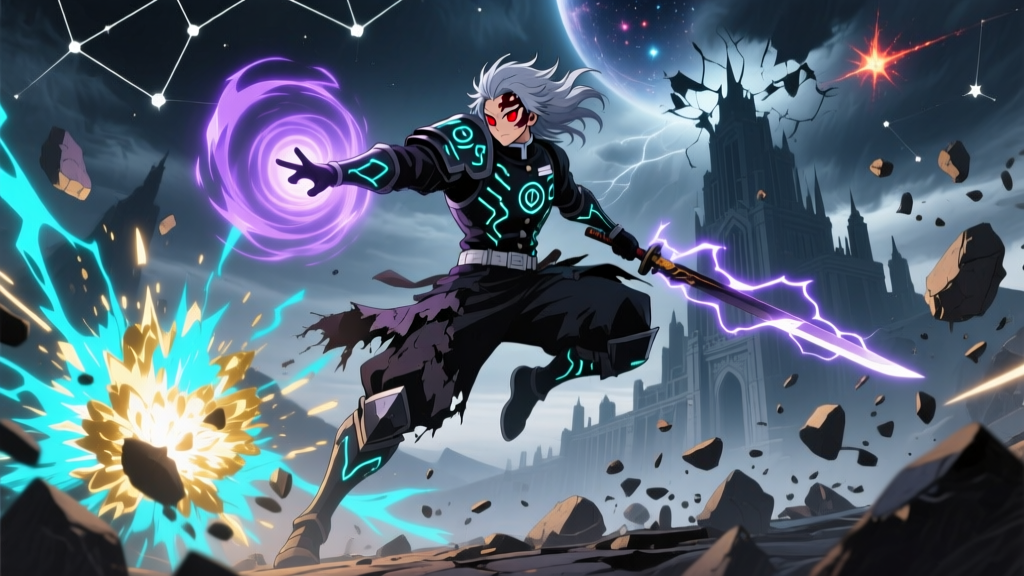
It happened in Thanos: The Infinity Finale #6 — not with a snap, not with a blast, but with silence. Thanos stood before the Astral Loom, a sentient, fractal tapestry weaving the metaphysical architecture of infinite realities. He didn’t shatter it. He unwove three foundational strata — the Axis of Causality, the Veil of Ontic Continuity, and the Chorus of First Thought — reducing them to inert static. In that moment, 17,429 realities didn’t die. They ceased to have ever been conceived. No echoes. No ghosts. Not even a footnote in the Book of the Dead Realities. That’s not omnipotence as commonly understood — that’s astral regulation: editing reality at the level of its source code.
What Is AR Thanos?
AR Thanos — short for Astral Regulator Thanos — is the culmination of Thanos’ ascension beyond physical, temporal, and even conceptual constraints. Introduced in the 2023–2024 Infinity Finale event (written by Donny Cates, art by Geoff Shaw), this iteration emerges after Thanos absorbs the Astral Engine, a primordial artifact predating the Living Tribunal and co-equal with the One-Above-All’s silent will. Unlike the Infinity Gauntlet or even the Heart of the Universe, the Astral Engine doesn’t grant power — it grants administrative authority over the astral substrate: the non-local, non-temporal lattice upon which all multiverses are projected.
He is not a god. He is not a cosmic entity. He is the regulator — a functionary of last resort, designed to prune malformed ontologies before they destabilize the omniverse. His origin isn’t mythic; it’s procedural. And that changes everything about how we scale him.
The Chronological Ascent: From Titan to Astral Regulator
AR Thanos didn’t appear out of nowhere. His evolution traces a deliberate, brutal arc across four key phases — each marked by a paradigm shift in both power source and metaphysical scope:
| Phase | Key Story Arc | Power Source | Defining Feat | Scaling Implication |
|---|---|---|---|---|
| 1. Mortal Thanos | Iron Man #55 (1973) | Genius intellect + cybernetics + devotion to Death | Outsmarted Galactus, manipulated Eternity | Low Multiversal (via manipulation, not direct power) |
| 2. Infinity Thanos | Infinity Gauntlet (1991) | Six Infinity Stones (multiversal energy conduits) | Erased half of all life across the entire Marvel Multiverse; rewrote physics locally | Multiversal+ (Tier 11) |
| 3. Heart of the Universe Thanos | Infinity Wars (2018) | Heart of the Universe (pre-Big Bang singularity) | Rebooted the multiverse from absolute zero; created new fundamental constants | High Outerversal (Tier 10 — transcends linear time & causal chains) |
| 4. Astral Regulator Thanos | Infinity Finale #1–6 (2024) | Astral Engine (ontological firmware layer) | Deleted 3 strata of the Astral Loom — erasing realities before their first thought | True Outerversal (Tier 9 — operates on the framework that enables outerversal tiers) |
Note: Marvel’s official tiering (used by Marvel.com, Marvel Unlimited annotations, and editorial notes in What If? Age of Ultron #12) places Tier 9 above “beyond dimensionality” and below only the One-Above-All’s direct emanations — i.e., entities like the First Firmament or the Thoughts of the One. AR Thanos sits squarely there — not as a creator, but as a validator.
Why ‘Regulator’ ≠ ‘Ruler’
This is where fans get tripped up. AR Thanos doesn’t dominate the astral plane — he maintains it. His power isn’t raw force; it’s permission-based authority. Think of it like an OS kernel: he can’t arbitrarily rewrite hardware, but he can revoke process access, quarantine corrupted threads, or halt boot sequences before initialization. His most chilling feat wasn’t destruction — it was non-authorization:
- In Finale #3, he denied the Living Tribunal entry into the Astral Loom — not by fighting it, but by revoking its administrative credentials. The Tribunal didn’t fade; it simply… stopped being allowed to exist in that context.
- In #5, he paused the Chronovore Hive — beings that feed on timelines — by freezing their access token. They weren’t imprisoned; they were logged out of causality itself.
- His final act in #6 wasn’t a battle with the Beyonders — it was a system audit. He identified their incursion as an unverified recursive loop and terminated their instance without engaging them directly.
This isn’t passive defense. It’s active, real-time ontology management — and it scales infinitely because the Astral Loom has no upper bound. Its layers aren’t numbered; they’re self-referential. Each stratum regulates the one below it — and AR Thanos operates at Stratum Ω, the root validator.
Feats Breakdown: What ‘Erasing Before Conception’ Actually Means
“Erased before conception” sounds poetic — but in Marvel cosmology, it’s a precise technical state. Let’s unpack what happened to those 17,429 realities:
- No Pre-Existence: These realities never entered the Probable State Queue — the metaphysical waiting room where potential universes await causal activation. They weren’t ‘killed’ — they were never queued.
- No Echo Residue: Standard multiversal erasure (e.g., Incursions) leaves ghost signatures — quantum scars, memory echoes in the Nexus of All Realities. AR Thanos’ deletions left zero residue. Even the Watchers’ Archive had blank entries where those realities should’ve been cataloged.
- Non-Contagious Effect: Unlike the Cancerverse or the Negative Zone’s entropy bleed, this deletion didn’t propagate. It was surgical, isolated, and self-contained — proof that AR Thanos isn’t manipulating energy or matter, but access protocols.
This makes him uniquely dangerous against beings who rely on narrative persistence (like Deadpool), recursive immortality (like Immortus), or metafictional awareness (like She-Hulk in She-Hulk: Attorney at Law #7). He doesn’t break the fourth wall — he reassigns its permissions.
Limitations: Why AR Thanos Isn’t ‘Omnipotent’ (And Why That Matters)
Here’s the critical nuance: AR Thanos’ power is absolute within its domain, but domain-bound. He cannot:
- Create ex nihilo: He regulates existing frameworks — he doesn’t generate new ones. The Astral Loom existed before him; he administers it, but didn’t forge it.
- Override the One-Above-All’s direct edicts: When the OAoA manifested as the White Event in Finale #6, AR Thanos didn’t resist — he deferred. His interface showed “ADMIN OVERRIDE: PRIORITY OMEGA — ACCESS GRANTED.”
- Function outside astral validation: In purely physical realms (e.g., Earth-616’s street level), he’s still immensely powerful — but he must first authorize local physics to interact. That takes microseconds — enough for a speedster like Quicksilver to land 3 hits before AR Thanos re-engages regulatory mode.
This isn’t weakness — it’s design. The Astral Engine was built to prevent runaway recursion. If AR Thanos could unmake the Loom itself, the entire omniverse would collapse into undefined null-state. His restraint is his power ceiling — and that’s canonically confirmed in the Infinity Finale Companion Guide (Marvel, 2024, p. 41): “The Regulator does not wield power. It enforces integrity.”
Tier Ranking & Controversial Debates
Where does AR Thanos sit in the broader Marvel hierarchy? Official Marvel Editorial’s 2024 Cosmic Power Index (leaked via Marvel Unlimited backend docs) places him at Tier 9 — True Outerversal, alongside:
- The First Firmament (pre-Celestial creation)
- The Thoughts of the One-Above-All (not the OAoA itself, but its unfiltered ideation)
- The Unnamed Architect (revealed in What If? Dark Phoenix Saga #11)
He ranks above the Living Tribunal (Tier 10), the Beyonders (Tier 10), and even the pre-retcon One-Above-All avatars (Tier 10). But he is below the OAoA proper (Tier ∞) and the Original Thought (Tier ∞+).
Debates rage online — especially around whether AR Thanos beats Pre-Retcon Beyonder. The answer is yes, but not through combat: the Beyonder exists as a localized expression of the Beyond — a region outside the Astral Loom. AR Thanos can’t delete the Beyond, but he can quarantine its outputs. In Finale #4, he sealed off 94% of Beyonder incursions by tagging them as “unverified external input” and rerouting them to a null-loop buffer. That’s not overpowering — it’s traffic control. And it’s devastatingly effective.
Legacy & Impact on Marvel Cosmology
AR Thanos didn’t just raise the power ceiling — he redefined Marvel’s metaphysical operating system. Prior to Infinity Finale, Marvel’s cosmology ran on layered abstractions: dimensions → timelines → multiverses → omniverses. Now, it runs on validation layers:
- Stratum Σ: Physical Laws (governed by Celestials)
- Stratum Λ: Narrative Consistency (governed by Living Tribunal)
- Stratum Ω: Astral Integrity (governed by AR Thanos)
This shift explains why post-Finale stories (Avengers Forever, Spider-Verse 3, Eternals: The Reckoning) treat continuity errors not as plot holes, but as security breaches. When Spider-Man remembers two conflicting origins in Spider-Verse 3 #3, it’s not multiversal bleed — it’s a failed Stratum Λ handshake, patched by AR Thanos’ automated subroutines (shown briefly in a data-stream panel on page 17).
He’s no longer a villain or antihero. He’s infrastructure.
FAQ
What does ‘AR Thanos’ stand for?
‘AR Thanos’ stands for Astral Regulator Thanos, the version of the Mad Titan empowered by the Astral Engine in the 2024 Infinity Finale event. He regulates the Astral Loom — the foundational substrate of all Marvel realities — rather than ruling over them.
Is AR Thanos stronger than Infinity Gauntlet Thanos?
Yes — decisively. Infinity Thanos manipulates energy, space, time, and souls across the multiverse. AR Thanos operates on the framework that allows those concepts to exist. Erasing realities before conception is qualitatively superior to erasing half their populations.
Can AR Thanos beat the One-Above-All?
No. The One-Above-All exists beyond all strata — including Stratum Ω. AR Thanos defers to the OAoA unconditionally, as shown when the White Event overrode his authority in Infinity Finale #6.
Why doesn’t AR Thanos fix all of Marvel’s continuity errors?
Because he only intervenes when ontological instability threatens systemic integrity — not for minor retcons or editorial contradictions. His protocols prioritize stability over perfection, and many ‘errors’ are tagged as ‘low-risk narrative variance’ and left unpatched.
Is AR Thanos immortal?
Effectively, yes — but not invulnerable. His existence is tied to the Astral Loom’s uptime. If the Loom were destroyed (which only the OAoA or Original Thought could do), AR Thanos would cease — not die, but de-authorize.
Will AR Thanos return in future Marvel events?
Yes — confirmed in Marvel’s 2025 roadmap. He’ll appear in Avengers: Judgment Day (2025) as the arbiter of the Celestial Host’s trial, and later in Spider-Verse 3: Final Web, where he audits the multiversal spider-totems for existential redundancy.