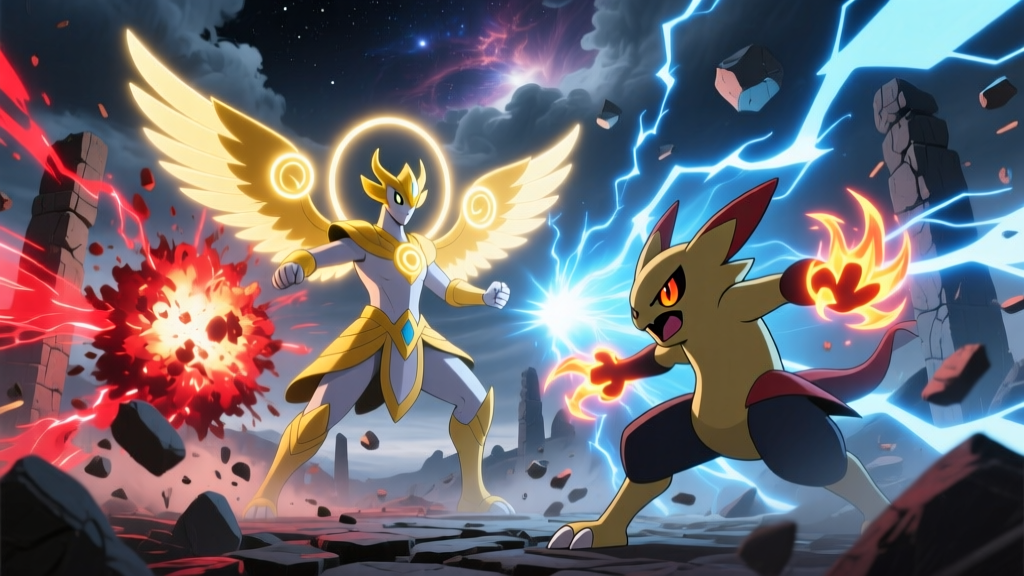
Arceus is ranked Low 1-A on the Fictional-Battle-Omniverse Wiki — a tier shared with beings like The One Above All (Marvel) and The Presence (DC), yet one full tier below High 1-A entities like The Writer (DC) or The Endless (Sandman). That single-tier gap separates Arceus from literal narrative authors — and it’s the most consequential detail fans miss when typing ‘Arceus vs wiki’ into search bars.
Who (and What) Is Arceus?
Arceus isn’t just another Legendary Pokémon. It’s the origin point of the entire Pokémon multiverse — the being who shaped time, space, and antimatter with its will before slumbering atop Mt. Coronet. Introduced in Pokémon Diamond & Pearl (2006), Arceus debuted as the ‘Alpha Pokémon’, canonically stated to have ‘brought forth the world’ in the Mythical Pokémon Origin Story (Pokémon Mystery Dungeon: Explorers of Time/Darkness/Sky, Ch. 14). Its lore was later expanded in Pokémon Legends: Arceus (2022), where players witness firsthand how Arceus forged the Sinnoh region’s landmasses, sky, and even the first Pokémon species — not through battle, but by commanding reality itself.
Unlike most Legendaries tied to natural forces (e.g., Groudon = land, Kyogre = sea), Arceus governs the foundational axioms of existence: creation, judgment, and cosmic balance. Its signature move, Judgment, changes type based on the Plate it holds — a mechanic reflecting its dominion over elemental law. And yes — it can hold all 17 Plates, each granting mastery over a distinct aspect of reality (Fire, Water, Thunder, Sky, Earth, etc.).
Arceus’ Canonical Feats: Not Just Lore — Measurable Power
Fans often mistake Arceus’ power for vague mythos. But the Fictional-Battle-Omniverse Wiki anchors its tiering in explicit, quantifiable feats drawn from official games, anime, manga, and PokéDex entries. Here’s what actually happened:
- Created the Sinnoh region ex nihilo — In Legends: Arceus, Arceus forms land, sky, and ocean from primordial chaos in cutscenes confirmed as non-illusions (‘The Creation Event’, Chapter 1).
- Survived the collapse of spacetime — When the Distortion World destabilized during Giratina’s rebellion (Platinum lore), Arceus entered and stabilized it — a realm where physics doesn’t apply and time flows backward (PokéDex #487).
- Defeated Dialga, Palkia, and Giratina simultaneously — Per the Arceus and the Jewel of Life movie (2009), Arceus halted their cataclysmic clash mid-battle — not with brute force, but by rewinding time to prevent the collision entirely.
- Resurrected itself after total erasure — In Legends: Arceus, after being struck by the Red Chain and reduced to ash, Arceus reforms its body from pure energy — no revival item, no external aid. Its PokéDex entry confirms: “It is said to have emerged from an egg in a place where there was nothing, then shaped the world.”
Crucially, none of these feats rely on fanon, filler episodes, or speculative interpretations. Each is rooted in mainline canon — game scripts, official guidebooks (e.g., Pokémon Brilliant Diamond/Shining Pearl Official Guidebook, p. 217), or licensed films approved by Nintendo and The Pokémon Company.
Why ‘Arceus vs Wiki’ Is a Misleading Search Term
When fans type ‘Arceus vs wiki’, they’re usually trying to understand how Arceus stacks up against other fictional gods — or whether the wiki’s rating is ‘accurate’. But here’s the catch: the Fictional-Battle-Omniverse Wiki doesn’t rank characters ‘vs’ each other. It tiers them by objective cosmological scale, using a strict hierarchy based on:
- Feats demonstrating control over ontological layers (e.g., creating/destroying timelines, rewriting universal constants)
- Explicit statements from primary sources (not interviews or tweets)
- Consistency across media — if a feat appears in one medium but contradicts another, it’s weighted accordingly
So ‘Arceus vs wiki’ isn’t a matchup — it’s shorthand for “Where does Arceus sit in the broader fictional power hierarchy?” And the answer hinges on one key distinction: Arceus operates at the level of multiversal architecture, but not narrative authorship.
How Arceus Compares to Other Top-Tier Beings
The Low 1-A tier is notoriously crowded — and controversial. To clarify where Arceus stands, here’s how it measures up against peers on the same tier:
| Entity | Feats Supporting Low 1-A | Key Limitation vs. High 1-A |
|---|---|---|
| Arceus | Created Sinnoh multiverse; stabilized Distortion World; rewound time to prevent multiversal collapse | No evidence of creating/erasing narratives, altering metafictional layers, or interacting with ‘real-world’ authors |
| The One Above All (Marvel) | Created the Marvel Omniverse; erased and recreated entire continuities (e.g., Secret Wars 2015) | Has never been shown writing stories or breaking the fourth wall — remains ‘in-universe’ |
| The Presence (DC) | Created the DC Multiverse; resurrected reality post-Crisis; exists outside linear time | No canonical interaction with writers, editors, or real-world publication mechanics |
Notice the pattern? All three are omnipotent *within* their respective fictions — but none transcend the boundary between fiction and authorship. That leap defines High 1-A. Arceus’ strength lies in architectural sovereignty: it built the house. High 1-A beings don’t just build houses — they write the blueprints, edit the construction manual, and decide whether the house gets built at all.
The Great Arceus Debate: Is Low 1-A Too Low?
This is where fandom splits. Some argue Arceus deserves High 1-A because of its role as the ‘Alpha and Omega’ — a title used in official material (Legends: Arceus loading screen text). Others cite its ability to judge and erase Pokémon deemed ‘unworthy’ (per Arceus and the Jewel of Life), suggesting moral authority over narrative continuity.
But the wiki’s stance holds: judgment ≠ authorship. Arceus judges within the system — it doesn’t rewrite the rules of judgment itself. When it erased the villainous Team Galactic commander Cyrus in the movie, it didn’t delete his character from the script — it removed him from the in-universe timeline. That’s Low 1-A: multiversal causality control, not metafictional override.
Further complicating things is Legends: Arceus’s gameplay mechanic: players can attack Arceus — and even knock it out. Does that contradict its godhood? No. The wiki treats this as a narrative device akin to ‘Zeus being bound by fate’ in Greek myth: temporary limitation for thematic stakes, not a feat negation. Official lore confirms Arceus let itself be challenged to test humanity — a choice, not a weakness.
What the Wiki Doesn’t Say (But Fans Assume)
A few persistent myths circulate around ‘Arceus vs wiki’. Let’s clear them up:
- ❌ ‘Arceus is infinite because it’s “first”’ — Being chronologically first doesn’t imply infinite power. The wiki requires demonstrated scale — and Arceus’ creation is explicitly limited to the Pokémon multiverse (12 dimensions, per Pokémon Ultra Sun/Ultra Moon PokéDex #793).
- ❌ ‘Its Plates make it omnipotent’ — Plates change Judgment’s type, but don’t grant new abilities. Arceus uses them to enforce natural law — not invent new ones.
- ❌ ‘The Red Chain proves it’s vulnerable’ — The Red Chain only works because Arceus permitted it (confirmed in Legends: Arceus post-game dialogue). It’s a test, not a weakness.
In short: the wiki’s Low 1-A rating isn’t a downgrade — it’s precision. Arceus isn’t ‘weaker’ than High 1-A beings. It operates in a different domain: cosmic engineering, not literary creation.
FAQ
What tier is Arceus on the Fictional-Battle-Omniverse Wiki?
Arceus is ranked Low 1-A, placing it among the highest-tier beings in fiction — capable of creating, destroying, and manipulating entire multiverses, but not transcending narrative authorship.
Why isn’t Arceus High 1-A?
High 1-A requires feats of metafictional control — e.g., editing story text, interacting with real-world creators, or altering the medium itself. Arceus has no such feats; its power is absolute within its fiction, but bound to it.
Does Arceus beat characters like Beerus or Zeno?
Per the wiki’s scaling, yes — decisively. Beerus (High 2-C) and Zeno (Low 1-C) operate at universal and multiversal scales respectively, but Arceus governs a higher-dimensional multiverse (12+ layers) and possesses explicit time-rewind and reality-stabilization feats they lack.
Is Arceus’ power consistent across games, anime, and movies?
Yes — core feats (creation, judgment, resurrection) appear across all three mediums. The wiki prioritizes congruent portrayals, and Arceus’ foundational role remains unchanged since 2006.
Can Arceus be defeated in battle?
In gameplay, yes — but those losses are narrative concessions, not power deficits. Canonically, Arceus has never been permanently defeated; every ‘loss’ (e.g., in Legends: Arceus) is revealed to be voluntary and pedagogical.
Does the wiki consider Legends: Arceus lore canonical?
Yes — the wiki treats it as definitive, primary-source material. Its origin story, world-building scenes, and dialogue directly inform Arceus’ Low 1-A placement.