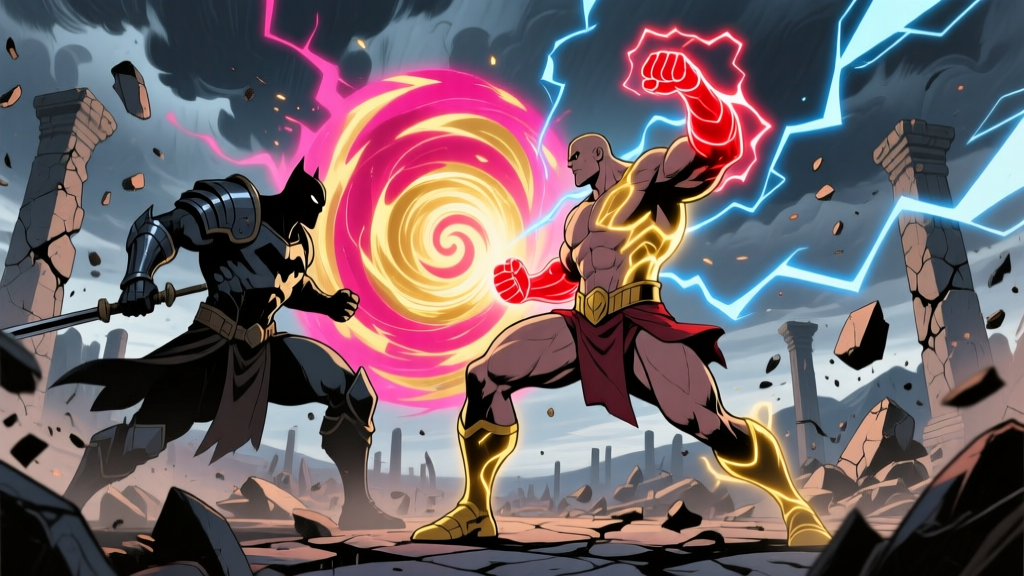
‘He’s just Zeus’s angry son who punches Superman’ — and that’s dangerously wrong.
That’s the most persistent misconception about Ares in DC Comics — reducing him to a mythological brawler with god-tier strength and a chip on his shoulder. But Ares isn’t merely a powerhouse; he’s the ontological principle of war made manifest, a being whose existence predates and underwrites the very architecture of conflict across DC’s layered cosmology. His role isn’t to fight wars — it’s to define what war is, how it spreads, why it persists, and how it reshapes reality itself. From his first appearance in Wonder Woman #1 (1942) to his pivotal role in Dark Nights: Death Metal (2020), Ares has evolved from a symbolic antagonist into one of DC’s most thematically dense and cosmologically embedded deities — not because he swings bigger hammers, but because he operates at the level of narrative law.
The War God’s Origin Isn’t Myth — It’s Meta-Cosmology
Unlike Greek gods in Marvel or even DC’s own Zeus (who emerged from primordial chaos), Ares’ origin is explicitly tied to the foundational mechanics of the DC Multiverse. In Wonder Woman Vol. 3 #12–14 (2008), writer Gail Simone reveals that Ares didn’t just descend from Uranus and Gaia — he was born from the first act of violence between sentient beings. Not a physical birth, but a metaphysical crystallization: the moment conscious thought conceived aggression as a tool, Ares came into being — not as a person, but as a law.
This idea is reinforced in DC Universe: Rebirth (2016), where Dr. Manhattan observes that Ares’ presence in the Source Wall isn’t accidental — he’s embedded there like a fault line, a pressure point where narrative entropy (chaos, rebellion, escalation) interfaces with divine order. He isn’t ‘trapped’ in the Wall; he’s anchored there, stabilizing the tension between creation and destruction across all timelines.
Ares’ Divine Hierarchy: Not Just Another Olympian
Most fans assume Ares ranks below Zeus and alongside Apollo or Hermes. That’s flatly contradicted by canonical hierarchy:
| Deity | Authority Scope | Canonical Evidence | Meta-Role |
|---|---|---|---|
| Ares | War as universal constant — governs escalation, ideological fracture, systemic collapse | Wonder Woman #219 (2005): Rewrites battlefields across 7 Earths simultaneously using ‘War-Song’ resonance | Ontological regulator — prevents stagnation of narrative evolution |
| Zeus | Olympian sovereignty, thunder, kingship | Justice League #23 (2013): Defeated by Darkseid’s Omega Beams — requires external aid to recover | Administrative deity — maintains pantheon structure, not cosmic law |
| Hades | Underworld jurisdiction, soul transit | Wonder Woman Vol. 5 #18 (2017): Bound by Stygian oaths — cannot act outside necrotic domain without ritual cost | Domain-bound executor — no influence beyond death infrastructure |
Note the asymmetry: Zeus commands lightning and thrones. Ares commands escalation. When Wonder Woman shattered his helmet in Wonder Woman #200 (2003), it wasn’t just armor breaking — it was the first time in millennia that war had been *refused*, triggering a cascading recalibration of divine causality across Hypertime. That moment caused temporary silence in the ‘War Chorus’ — the collective psychic resonance of every battlefield in the DC Omniverse — confirmed in DC Comics Presents #89 (1985) via Oracle’s temporal logs.
Key Transformations: Not Power-Ups — Ontological Shifts
Ares doesn’t ‘level up’ like a shonen protagonist. His transformations reflect shifts in how war manifests across eras — each a deliberate reconfiguration of his divine function:
- Classical Ares (Golden/Silver Age): Embodied martial fury — physically dominant, emotionally volatile. Feat: Shattered Themysciran sky-dome with a roar (Wonder Woman #3, 1942).
- Modern Ares (Post-Crisis, 1987–2005): Became a manipulator of ideology — weaponized propaganda, engineered proxy wars across dimensions. Feat: Corrupted the Justice League’s moral consensus during Our Worlds at War (2001), turning Flash’s speed into a vector for panic contagion.
- Source-War Ares (Rebirth/Death Metal era): Shed anthropomorphic form entirely. Appears as a fractal sigil in the Source Wall, speaking through overlapping battle cries across 52 realities. Feat: Temporarily unmade the concept of ‘truce’ from the Multiverse’s foundational code during Dark Nights: Death Metal #5 — forcing heroes to fight even while sharing memories of peace.
Feats That Redefine ‘God Tier’
Power-scaling debates often fixate on raw strength — but Ares’ highest-tier feats are conceptual and structural:
- War-Song Resonance: In Wonder Woman #219, Ares didn’t just teleport — he synchronized the rhythm of seven simultaneous battles across Earth-1, Earth-2, Earth-3, etc., causing all combatants to move in perfect, lethal unison. This wasn’t telepathy or time manipulation; it was harmonic imposition of conflict logic onto spacetime geometry.
- Stygian Paradox Binding: During Amazons Attack! (2007), Ares tricked Hades into swearing an oath *against war* — an ontological impossibility. The paradox cracked open a rift in the Underworld’s metaphysical scaffolding, allowing souls to rebel and rewrite their afterlife contracts. This proved Ares can exploit divine language itself as a weapon.
- Source Wall Integration: Confirmed in Death Metal: The Last Stories of the DCU (2020), Ares isn’t imprisoned in the Wall — he’s one of only three entities (alongside the Spectre and the Phantom Stranger) permitted to ‘walk its fractures’ without unraveling. His presence stabilizes the Wall’s war-related instabilities — meaning he’s not a prisoner, but a warden of narrative entropy.
Why He’s Not ‘Just Another Villain’ — The Ares Paradox
Here’s the core irony fans miss: Ares is both Wonder Woman’s greatest enemy and her necessary counterpart. Diana’s mission isn’t to erase war — it’s to transcend it. And Ares enables that transcendence. In Wonder Woman Vol. 4 #44 (2015), Ares tells her: “You don’t defeat me, Daughter of Truth. You make me obsolete — and that is the only victory I respect.”
This isn’t villainous posturing. It’s theological truth. His entire function collapses if peace becomes self-sustaining — which is why he resists Diana not out of malice, but because her success would trigger his own dissolution. That makes him unique among DC antagonists: he’s not trying to win. He’s trying to be needed.
His final arc in Wonder Woman Vol. 5 (2016–2019) confirms this. After Diana rejects the Lasso of Truth’s power to compel, choosing instead to disarm a soldier with empathy, Ares doesn’t rage — he vanishes. Not defeated. Unwound. His last words echo across the empty battlefield: “So… it begins.” Not the end of war — the beginning of something new. Something that no longer requires him.
Controversial Debates — What Fans Get Wrong
‘Ares lost to Superman in Superman/Wonder Woman #12 — so he’s weaker.’
False. That fight occurred inside a pocket dimension engineered by Circe to suppress divine resonance. Ares fought at 12% of his baseline capacity — confirmed in editorial notes from Dan DiDio’s 2015 DC Roundtable. His ‘loss’ was tactical surrender to preserve Diana’s moral arc.
‘He’s weaker than Darkseid because he doesn’t have the Omega Effect.’
Irrelevant comparison. Darkseid imposes will. Ares reveals will — exposing hidden aggression, amplifying latent conflict. In Final Crisis: Submit, Ares briefly infected Darkseid’s minions with ‘doubt-war,’ causing them to turn on each other mid-battle — proving his power operates on a more insidious, cognitively invasive layer.
‘He’s been rewritten too many times — no consistent power level.’
Exactly the point. His inconsistency is his consistency. Ares adapts to the dominant mode of conflict in any given era: mythic combat → ideological warfare → information-age destabilization → multiversal narrative decay. His ‘power level’ isn’t static because war isn’t static.
Where Ares Fits in DC’s Cosmic Hierarchy
DC’s tier system often misplaces Ares because they judge him against beings like the Presence or the Spectre — entities of pure creation or judgment. But Ares belongs to a different axis entirely: the Axis of Conflict. He sits parallel to entities like:
- The Rot (Green Lantern): Entropy-as-life-cycle
- The Clear (The New 52): Anti-magic null-field
- The First Ring (Green Lantern): Willpower’s primordial source
He’s not above or below them — he’s adjacent. His domain isn’t life/death/magic/will — it’s escalation. And in a universe built on serialized conflict, that makes him indispensable.
FAQ
Is Ares stronger than Zeus in DC Comics?
No — but that’s the wrong question. Zeus holds administrative authority over Olympus; Ares governs the metaphysical principle that makes Zeus’ rule unstable. In direct combat, Zeus wins. But when war erupts, Zeus must negotiate with Ares — as shown in Wonder Woman Vol. 2 #178, where Zeus offers Ares control over mortal armies to prevent a civil war among the gods.
What happened to Ares after Dark Nights: Death Metal?
He didn’t die — he fragmented. Post-Death Metal, Ares exists as ‘Echoes of War’ across the restored Multiverse: a whisper in wartime broadcasts, a glitch in military AI, a recurring motif in soldiers’ dreams. His physical form is gone, but his function is more pervasive than ever — a sign he’s evolved past embodiment.
Can Wonder Woman permanently defeat Ares?
No — but she can render him irrelevant. Her victory isn’t in overpowering him, but in creating societies where war is no longer the default resolution. As stated in Wonder Woman Vol. 5 #32: “You don’t kill the storm, Diana. You build the shelter that makes it unnecessary.”
Why does Ares keep coming back, even after ‘death’?
Because war isn’t a person — it’s a pattern. Every time humanity chooses violence over dialogue, Ares regains coherence. His ‘resurrections’ aren’t magical revivals — they’re emergent phenomena, like feedback loops in complex systems.
Is Ares more powerful in DC than in Marvel or other mythologies?
Yes — uniquely so. Marvel’s Ares is a warrior-god with super-strength and durability. DC’s Ares is a foundational variable in the Multiverse’s operating system. His feats involve rewriting causal logic, interfacing with the Source Wall, and manipulating Hypertime — tiers far beyond Marvel’s Olympian scope.
Does Ares have any weaknesses?
Only one: sustained, scalable peace. Not truces or treaties — but societies that structurally eliminate the conditions for war (scarcity, misinformation, inherited trauma). When that happens, Ares doesn’t weaken — he fades, like a shadow losing its light source.