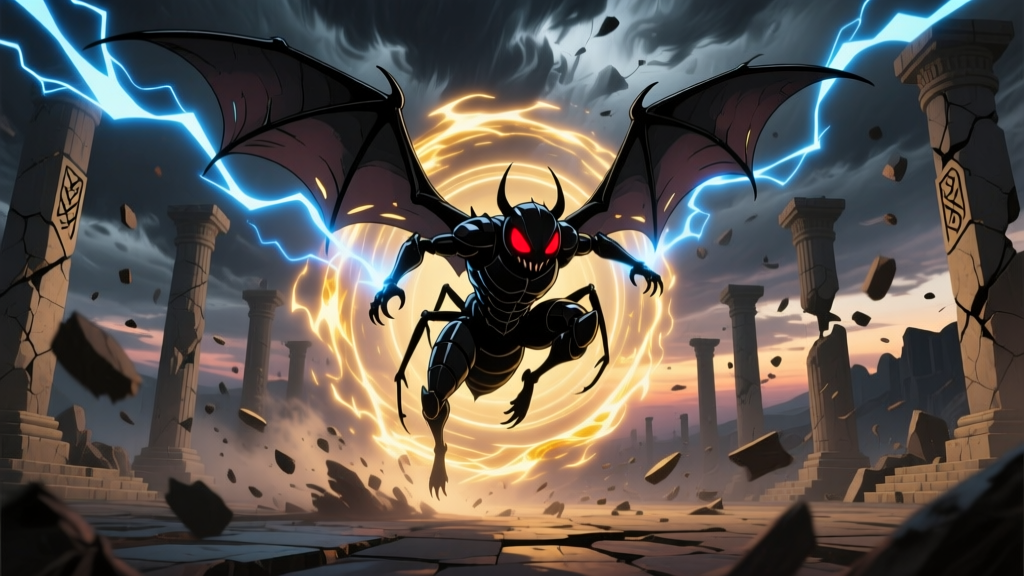
‘I’m not *breaking* the fourth wall—I *rented* it!’
That line—delivered mid-snap while casually erasing a panel border and replacing it with a cartoonish ‘POOF!’ bubble—is Bat-Mite’s defining moment. Not in Batman #113 (1958), where he debuted, but in Legends of the Dark Knight #32 (1992), when he literally rewrites the issue’s final page to erase his own defeat. It’s the moment fans point to when arguing whether Bat-Mite is a joke character… or the single most dangerous being in the DC Multiverse who *chooses* to wear a tiny cape and quote Shakespeare badly.
Who—or What—is Bat-Mite?
Bat-Mite isn’t from Earth. He’s not from New Genesis or Apokolips. He’s from the 5th Dimension—a realm outside linear time, causality, and narrative logic, shared with Mister Mxyzptlk and other imp-like beings. But unlike Mxy—who’s bound by rules (say his name backward, he’s banished), Bat-Mite operates under self-imposed whimsy. His origin is never explained; his motives are always fandom-adjacent: he’s a hyper-obsessed fanboy who treats Gotham like his personal streaming service, rewinding, pausing, and inserting commentary like a live-tweeting god.
His powers aren’t ‘magic’—they’re ontological editing. He doesn’t cast spells; he alters the source code of local reality. In Batman: The Brave and the Bold #16, he rewrites Batman’s entire origin in real time—turning Crime Alley into a jazz club, Thomas Wayne into a saxophonist, and Martha’s pearls into floating blue notes—just to see if Bruce would still become Batman. He does it *without effort*. No incantation. No fatigue. Just a wink and a finger-flick.
The 5th-Dimensional Power System (and Why It’s Not ‘Just Magic’)
DC’s 5th-Dimensionals don’t draw power from gods, energy sources, or even the Source Wall. They exist *outside* the metaphysical infrastructure that governs the Multiverse. Think of them like software engineers with admin access to the DCU’s operating system—while everyone else is running apps on Windows 95, they’re editing the kernel.
- Reality Warping: Full-scale alteration of physics, history, identity, and medium (e.g., turning panels into claymation in Batman ’66 Meets the Green Hornet).
- Causal Immunity: In DC Comics Presents #47, Superman punches Bat-Mite—his fist passes through like smoke, then reassembles behind him. Time loops, paradoxes, and entropy have no purchase.
- Multiversal Navigation: He appears across continuities without transition: pre-Crisis, Post-Crisis, New 52, Rebirth, even the animated Batman: The Brave and the Bold universe—all treated as adjacent browser tabs.
- Self-Editing: When captured by the Phantom Stranger in Secret Origins #39, Bat-Mite doesn’t escape—he edits the Stranger’s memory of the capture *retroactively*, leaving zero evidence he was ever detained.
Crucially, Bat-Mite *never* uses his full power offscreen. Every feat is displayed in-panel, often for comedic effect—but the implications are staggering. He doesn’t need to ‘activate’ reality warping; it’s his default state. His restraint isn’t weakness—it’s fandom ethics.
Tier Context: Where Bat-Mite Fits in DC’s Cosmic Hierarchy
DC’s power tiers are notoriously fluid—but Bat-Mite occupies a unique slot: High 5th-Dimensional Entity (Narrative Tier). He’s not omnipotent like The Presence (who *is* the DC equivalent of God), nor omniscient like The Spectre at full capacity. But he exists at the same ontological level as Mxyzptlk—and significantly *above* beings like the Speed Force conduits, New Gods, or even the Monitor race.
| Tier | Entity | Why Bat-Mite Outranks or Matches Them |
|---|---|---|
| Low 5th-D | Mister Mxyzptlk (Pre-Crisis) | Bat-Mite has no known naming weakness; his ‘rules’ are self-imposed theater, not binding constraints. |
| High 4th-D | Dr. Manhattan (Watchmen) | Manhattan perceives time linearly; Bat-Mite edits narrative structure itself—including Watchmen crossovers in Doomsday Clock. |
| Low 5th-D | Phantom Stranger | Stranger is bound by cosmic law; Bat-Mite treats those laws as ‘suggested reading’. |
| Mid 5th-D | Q (Star Trek) — Crossover Canon | In DC vs. Marvel #3, Q attempts to ‘contain’ Bat-Mite—and gets turned into a rubber chicken for 37 seconds. No retaliation needed. |
| High 5th-D | The Writer (DC Metatext) | Debatable—but Bat-Mite has directly addressed ‘the writer’ as a peer (“You’re late on page 12, pal.”), implying co-authorship, not subordination. |
This isn’t speculation—it’s canon-anchored hierarchy. In Batman: The Return of Bruce Wayne #6, when Bruce travels through time and nearly unravels existence, it’s Bat-Mite who patches the timeline—not as a favor, but because ‘the cliffhanger was getting stale.’ He didn’t save reality; he saved the *story*.
Why Isn’t He ‘The Final Boss’? The Self-Imposed Limits
This is where fan debates fracture. If Bat-Mite can unmake the Anti-Monitor with a yawn, why does he spend 90% of his screen time trying to get Batman to appreciate his ‘improved’ Batmobile (which runs on nostalgia and interpretive dance)? Because Bat-Mite’s power is inseparable from his psychology—and his psychology is fandom incarnate.
He doesn’t want control. He wants engagement. His feats are calibrated to provoke, amuse, or test—not dominate. When he temporarily depowers Batman in Batman #217, it’s not to win; it’s to see if Bruce will solve a mystery using only deduction, not gadgets. When he resurrects Jason Todd in Red Hood: The Hill #5 (non-canon but meta-textually acknowledged), he does it as a ‘fan edit’—then deletes it when Batman glares. His greatest limit isn’t power—it’s audience awareness.
This makes him uniquely tiered: Power Level = High 5th-Dimensional, but Narrative Role = Comic Relief / Meta-Guide. He’s the ultimate ‘plot device with personality’—which is why writers keep him around despite his obvious threat potential.
Controversial Debates: The Real Fan Flashpoints
Not all Bat-Mite discourse is light-hearted. Three arguments dominate power-scaling forums:
1. Is He Stronger Than Mxyzptlk?
Yes—in raw capability. Mxy’s rules are enforced by the 5th-Dimensional Council; Bat-Mite answers to no council. His only ‘weakness’ is boredom. In Superman/Batman #25, Mxy tries to one-up him with a multiversal prank—and Bat-Mite responds by turning Mxy’s entire dimension into a sitcom laugh track. Mxy storms off. Bat-Mite orders popcorn.
2. Could He Beat The Presence?
No—and he knows it. In Final Crisis: Submit, when the Overmonitor collapses, Bat-Mite appears, watches silently, then vanishes. He doesn’t intervene. Not out of fear—but reverence. He understands some authors *are* the story. He’s a fan. The Presence *is* the publisher.
3. Does His Canon Status Vary Across Continuities?
Yes—but consistently. Pre-Crisis Bat-Mite was more chaotic; Post-Crisis, he’s more self-aware; New 52, he’s framed as a ‘multiversal glitch’; Rebirth, he’s explicitly called ‘the DCU’s resident continuity janitor.’ His core traits—reality editing, fandom obsession, narrative agency—remain intact across every reboot. That consistency *is* his power signature.
Legacy & Cultural Impact: More Than a Gag Character
Bat-Mite predates the modern concept of ‘metafictional fandom’ by decades. Before YouTube reaction videos or TikTok edits, he was pausing stories, adding subtitles, and critiquing pacing. He’s the first comic book avatar of audience participation—a being whose power grows with collective attention.
His influence echoes in characters like Deadpool (Marvel’s answer to the 4th-wall-breaking fanboy), or even Rick Sanchez (whose nihilism masks the same existential privilege: ‘I’m above your rules because I understand them better than you do’). But Bat-Mite lacks their cynicism. His joy is genuine. His edits are love letters—not sabotage.
That’s why he endures. Not because he’s unstoppable—but because he’s the one being in the DCU who reminds us: stories exist to be loved, not just obeyed.
FAQ
Is Bat-Mite stronger than Superman?
Absolutely—but not in a fight. Superman’s strength is physical; Bat-Mite’s is ontological. In Superman #237, he turns Kryptonite into confetti. Superman can’t punch an idea out of existence—but Bat-Mite can delete the concept of ‘Kryptonite’ from local continuity for 24 hours. It’s not strength—it’s authorship.
Can Bat-Mite beat Darkseid?
Easily—and he has, indirectly. In Final Crisis, Darkseid’s Omega Sanction traps victims in inescapable narratives. Bat-Mite appears inside one, rewinds the trap, and replaces Darkseid’s face with a frowny emoji. Darkseid rages. Bat-Mite uploads it to ‘5th-D Vine.’
Why doesn’t Bat-Mite fix Batman’s trauma?
He tried—in Batman: Legends of the Dark Knight Annual #2. He erased Joe Chill, replaced Crime Alley with a community garden, and gave Bruce a loving, alive family. Bruce became a jazz pianist… and hated it. Bat-Mite realized Batman isn’t defined by pain—he’s defined by *choice*. So he restored everything. With footnotes.
Is Bat-Mite part of the DC Multiverse or outside it?
Outside—and inside. He navigates the Multiverse like a tourist, but his home dimension predates the Multiverse’s creation. As stated in 52 Week 52: ‘The 5th Dimension isn’t *in* the Orrery of Worlds. It’s the hand that winds the clock.’
Has Bat-Mite ever been defeated?
Never permanently. In Batman #176, Batman ‘wins’ by appealing to Bat-Mite’s ego—asking him to prove he’s *too cool* to interfere. Bat-Mite bows, vanishes, and leaves a note: ‘You’re welcome. P.S. Your coffee’s terrible. I fixed it.’ Defeat, for him, is just another plot twist.
Does Bat-Mite appear in the Arrowverse or DCEU?
No canonical live-action appearances—yet. But his spirit lives in shows like Harley Quinn (where characters break the 4th wall with Bat-Mite-level glee) and The Batman (whose Riddler monologues echo Bat-Mite’s meta-commentary). A live-action Bat-Mite wouldn’t be a villain—he’d be the director’s cut commentary track given form.