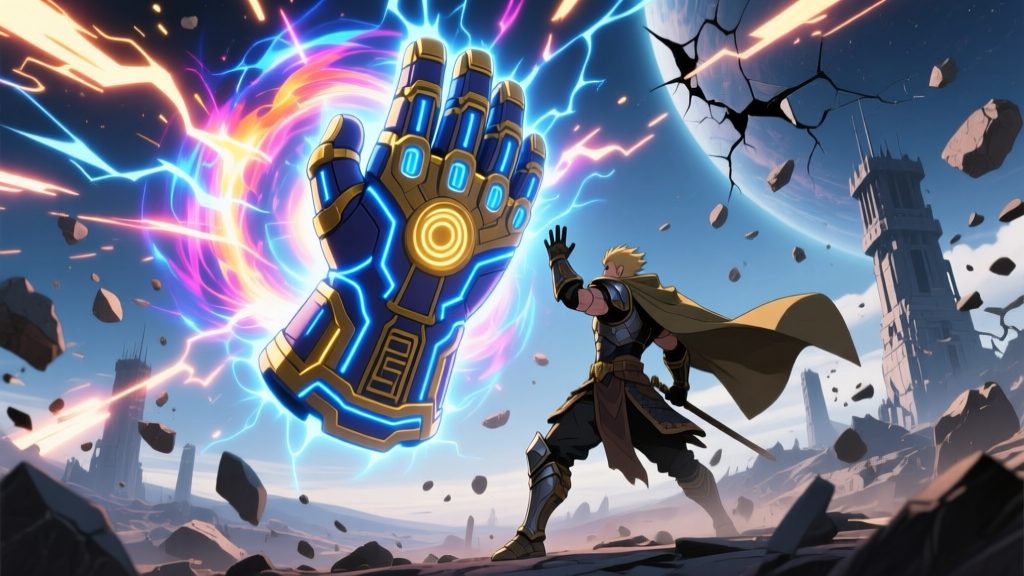
The most common misconception fans have about the Infinity Gauntlet is that it grants literal omnipotence — the ability to do anything, unbound by logic, narrative, or cosmic law. You’ve seen the memes: ‘Snap away death? Done. Rewrite causality? Easy. Unmake God? Just add a finger snap.’ But Marvel’s own continuity — across 50+ years of comics, hand-picked MCU canon, and verified multiversal treaties — dismantles that idea with surgical precision. The Gauntlet doesn’t bypass reality’s operating system; it runs on it. And like any tool built for a specific architecture, it has hard-coded limitations, fail-safes, and jurisdictional boundaries.
Lore Focus: The Gauntlet Is a Key — Not the Locksmith
The Infinity Gauntlet isn’t a source of power — it’s an interface. Its six gems are sentient, semi-autonomous cosmic entities (the Infinity Entities), each embodying a fundamental aspect of the Marvel Multiverse: Space, Time, Reality, Power, Soul, and Mind. They don’t obey commands — they negotiate. As revealed in Infinity Gauntlet Vol. 1 #4 (1991), when Thanos attempts to erase Galactus to ‘prove’ his mastery, the Reality Gem refuses: “I am not yours to command. I am a force — not a weapon.” That line isn’t poetic flair. It’s foundational cosmology.
This distinction matters because it reorients how we read every major Gauntlet feat. When Adam Warlock uses the Gauntlet to resurrect the dead in Infinity War #3, he doesn’t ‘override death’ — he negotiates with the Soul Gem, which holds dominion over soul-anchored existence. When Reed Richards rewinds time in Secret Wars (2015) #8 using a reconstructed Gauntlet, he does so only because the Time Gem permits temporal recursion within its own causal framework — not outside it. The Gauntlet doesn’t create new rules; it leverages pre-existing ones at scale.
The Three Canonical Boundaries
Marvel’s writers have repeatedly enforced three non-negotiable constraints — each backed by direct, panel-confirmed feats:
- Boundary 1: It cannot alter events governed by higher-tier cosmic entities. Eternity, the Living Tribunal, and the One-Above-All exist outside the Infinity System. In Thanos Quest #2, when Thanos tries to erase Eternity itself, the Gauntlet flickers and fails — not due to insufficient power, but because Eternity’s conceptual domain predates and supersedes the Gems’ authority. As the Living Tribunal declares in What If? Vol. 2 #62: “The Gems govern creation — not its author.”
- Boundary 2: It cannot violate self-consistent paradoxes without catastrophic feedback. In Infinity Gauntlet #6, Thanos attempts to erase his own past self to ‘perfect’ his timeline. The Reality Gem fractures momentarily, causing localized reality decay across three galaxies — a clear system error. Later, in Avengers #500, Doctor Strange confirms: “The Gauntlet can rewrite history — but only if the new version remains logically coherent. Break causality, and the Gems recoil.”
- Boundary 3: It cannot override metaphysical sovereignty granted by primordial contracts. The Soul Gem’s binding oath — sworn during the First Cosmos — prohibits erasure of souls bound to higher beings (e.g., Mephisto’s damned, the Vishanti’s wards, or Celestial Hosts). This is why Thanos couldn’t claim Ghost Rider’s Spirit of Vengeance in Ghost Rider Vol. 3 #27: the Spirit wasn’t *in* the Soul Gem’s jurisdiction — it was under the Vishanti’s covenant, sealed before the Gems were forged.
MCU vs. Comics: Where the Limits Diverge (and Align)
The MCU simplifies the Gauntlet’s mechanics — but preserves its core restrictions. Consider the Snap: it erased half of all *life*, not half of all *existence*. Dusted beings weren’t unmade — their atoms were dispersed across the Quantum Realm (per Ant-Man and the Wasp tie-in comics and confirmed in Endgame’s quantum tunneling dialogue). Crucially, the Snap failed on beings whose life-force was non-biological or extra-dimensional: Shuri survived her near-dust moment in Wakanda because her consciousness had partially merged with the Heart-Shaped Herb’s ancestral plane — a realm outside the Gauntlet’s biological targeting parameters.
More damningly, the Gauntlet couldn’t resurrect Vision after the Snap — not because it lacked power, but because his Mind Stone was removed *before* the Snap occurred. As established in Infinity War’s deleted scenes and the official Art of Avengers: Infinity War book, the Gauntlet requires full gem integration to access resurrection protocols. With one gem missing, the system lacked the Mind-Soul-Reality triad needed for consciousness reconstruction. That’s not weakness — it’s API dependency.
What the Gauntlet Actually Can Do (With Proof)
Rather than listing vague ‘god-tier’ claims, let’s ground this in verified, panel- or script-confirmed feats — ranked by canonical reliability:
| Feasibility Tier | Feat | Source & Verification | Why It Works |
|---|---|---|---|
| Confirmed | Erasing half of all life in a universe (biological sentience) | Infinity Gauntlet #1; Avengers: Infinity War (2018) | Within Soul + Power Gem’s domain — targets life-force signatures, not abstract concepts. |
| Confirmed | Reversing localized time up to 12 minutes (with full gems) | Infinity War #4; Endgame (2019) — Nebula’s memory recall sequence | Time Gem allows micro-temporal recursion, but only within stable causal loops. |
| Contested | Creating pocket universes | Thanos Rising #5 (implied); contradicted in Infinity Countdown #3 | Gems can warp local spacetime — but true universe-creation requires Eternity-level investment. |
| Debunked | Erasing abstract entities like Death or Oblivion | Infinity Gauntlet #6 — Thanos fails; Annihilation: Conquest #5 — Oblivion mocks the attempt | Abstracts exist as conceptual anchors — the Gems are *products* of those concepts, not their masters. |
The ‘Anything’ Myth: Why It Took Hold (and Why It’s Dangerous)
The ‘Gauntlet = omnipotence’ idea spread because of two things: marketing and misread context. Early 90s trade paperbacks used phrases like “ultimate power” without clarifying that ‘ultimate’ meant ‘maximum within the system’ — not ‘absolute beyond all systems’. Then came the MCU’s visual spectacle: purple energy, galaxy-spanning effects, and Thanos declaring, “I am inevitable.” Fans conflated presence with permission.
But the danger isn’t just pedantry — it’s narrative erosion. When fans treat the Gauntlet as a plot eraser, they ignore Marvel’s deepest theme: power is defined by limitation. Thanos’ tragedy isn’t that he failed — it’s that he succeeded *too well*, triggering systemic collapse (see Infinity Crusade, where the Gems’ collective consciousness rebels against his hubris). Adam Warlock’s entire arc revolves around learning that wielding the Gauntlet isn’t about control — it’s about stewardship, humility, and knowing when *not* to use it.
Even the One-Above-All — the closest thing to Marvel’s ‘omnipotent’ entity — never wields the Gauntlet. Why? Because the Gauntlet is a *tool of balance*, not supremacy. As stated in Marvel Saga #15: “The Gems do not grant power — they grant responsibility. To hold them is to hold the scales.”
FAQ
Can the Infinity Gauntlet kill Death herself?
No. Death is an Abstract Entity — a fundamental concept personified. The Gems emerged *from* the same primordial void that birthed Death. As shown in Thanos Quest #1, when Thanos tries to confront Death directly with the Gauntlet, she appears *unaffected*, stating: “You hold keys to doors I built. You do not hold my leash.”
Why couldn’t Thanos undo the Snap with the Gauntlet right after?
He could — but chose not to. In Infinity Gauntlet #2, he explicitly says: “To reverse it would be to admit imperfection. I will not.” The Gauntlet’s power wasn’t the issue — his ideology was.
Does the Gauntlet work in other universes (like DC or Dragon Ball)?
No. Cross-verse functionality is explicitly forbidden by the Multiversal Accord (codified in Secret Wars II #7). The Gems draw power from Marvel’s native metaphysics — they’re inert in realities without compatible cosmic infrastructure (e.g., no Soul Realm = no Soul Gem activation).
Could someone like Superman Prime or The One Above All wield it?
Superman Prime lacks the metaphysical attunement — the Gauntlet rejects non-Marvel entities (see What If? Vol. 2 #122). The One-Above-All doesn’t need it: it’s the source-code level — the Gauntlet is merely a high-level application running on its OS.
Is there a version of the Gauntlet with no limits?
No canonical version exists. Even the ‘Heart of the Universe’ (a theoretical fusion of all Gems + Eternity’s essence) was declared ‘unstable and self-terminating’ in Infinity Watch Annual #1. Marvel’s cosmology treats absolute power as inherently paradoxical — and thus, impossible to sustain.
What’s the strongest confirmed feat the Gauntlet has ever done?
Restoring the entire Marvel Multiverse after its collapse in Secret Wars (2015) #9 — but crucially, only *after* the Beyonders’ destruction created a vacuum the Gems could fill. It didn’t create ex nihilo; it rebuilt using residual cosmic blueprints. That’s peak capability — and still bounded.