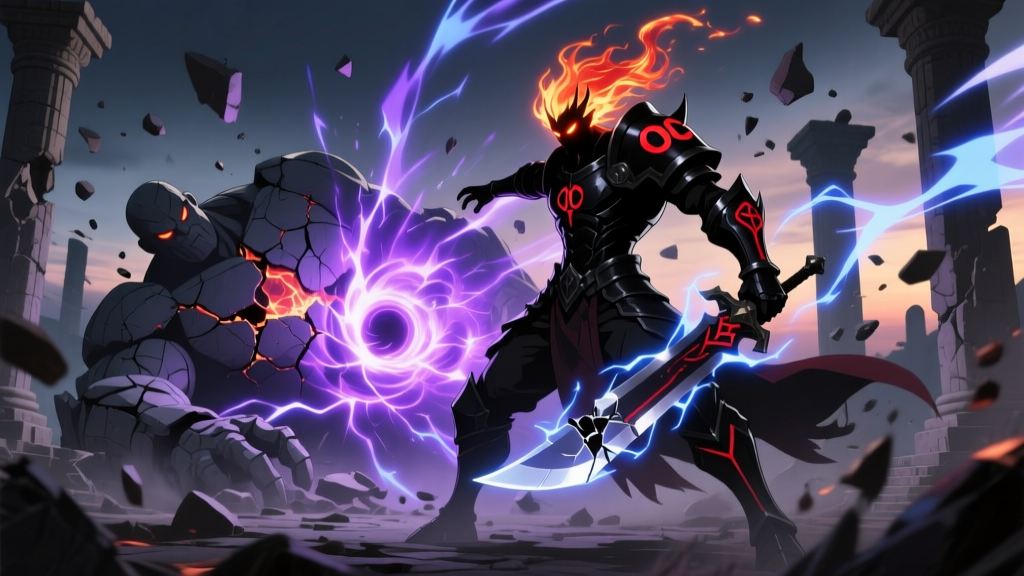
It begins with a crack — not in reality, but in the Source Wall. In Dark Nights: Metal #6, Barbatos doesn’t punch through it. He unmakes it — not with force, but with presence. As the Justice League watches in horror, the Wall fractures like black ice under a sigh, bleeding inverted stars and screaming void-light. Then he steps out — not from another universe, but from the wound itself. His arrival isn’t an invasion. It’s a reclamation.
From Primordial Shadow to Multiversal Sovereign
Barbatos isn’t a villain who rose to power. He is the power that predates the concept of rising. His origin isn’t told in flashbacks — it’s etched into the cosmology of the DC Omniverse. According to Dark Nights: Death Metal #7 and the Dark Multiverse Handbook, Barbatos existed before the Source Wall was erected — a sentient embodiment of the ‘dark matter’ of creation: the unobserved potential, the entropy beneath order, the hunger behind all desire for dominion. When the Overmonitor and the World Forge built the Source Wall to quarantine the nascent Multiverse from its own subconscious fears, they didn’t imprison Barbatos — they excised him. And in that excision, he became the first sovereign of the Dark Multiverse.
The Birth of the Dark Multiverse
Barbatos didn’t create the Dark Multiverse by design. He did it by being. Every time a hero faced despair, every time hope flickered and died in a timeline, that negated possibility didn’t vanish — it bled into the space beyond the Wall. Barbatos absorbed those echoes, metabolized them, and wove them into something coherent: infinite twisted reflections of the main Multiverse, each warped by trauma, obsession, or broken ideals. This wasn’t parallel evolution — it was infection. His realm wasn’t built; it grew like mold on the backside of creation.
First Appearance & Identity Reveal
Though referenced cryptically in pre-Metal arcs (e.g., Batman’s nightmare visions in Batman #41, 2015), Barbatos’ full identity and role were unveiled in Dark Nights: Metal #1 (2017). There, he manifests as the ‘Dark Knight Who Laughs’’s patron — but not as a distant deity. He appears physically in the Batcave, draped in obsidian armor fused with bat-winged sigils, voice layered with the static of dying stars. Crucially, he speaks in imperatives: “Barbatos obey me” isn’t a phrase fans chant — it’s what Batman says in Metal #6, trying (and failing) to assert control over the entity. That line isn’t a meme — it’s a canonical moment of hubris that underscores Barbatos’ absolute ontological supremacy. Even the World’s Greatest Detective mistakes command for negotiation.
Power Evolution: A Chronological Breakdown
Barbatos doesn’t level up. He reveals. Each major appearance peels back another layer of his nature — not adding power, but exposing deeper strata of authority. His ‘transformations’ are less about new forms and more about shifting modes of existence.
| Stage | Appearance | Key Manifestation | Feats & Implications |
|---|---|---|---|
| Primordial Echo | Pre-Metal hints (Batman Vol. 2 #41–44) | Nightmare apparitions, distorted bat-symbols bleeding black smoke | Psychic resonance across timelines; induces shared hallucinations in heroes without physical presence. Suggests precognitive/retrocausal influence. |
| Wall-Breaker | Dark Nights: Metal #6 | Shatters the Source Wall; emerges as armored, winged god-king | Unmade a structure explicitly stated to be ‘the boundary between the known Multiverse and the unknown’ — and which even Perpetua couldn’t breach directly. Confirmed by Scott Snyder: “The Wall wasn’t broken. It was unwritten.” |
| Forge-Overseer | Dark Nights: Death Metal #5–6 | Manifests within the World Forge, commanding the cosmic loom | Overrides Perpetua’s control of the World Forge — the engine that births and sustains the Multiverse. Rewrites reality templates mid-weaving. Implies authority over narrative causality itself. |
| Final Form: The Unbound | Death Metal #7 | Dissolves into pure anti-light; reassembles as a fractal swarm of bat-gods across all Dark Multiverse layers | Transcends singular embodiment. Exists simultaneously across all Dark Timeline branches while maintaining coherence. Survives total erasure via the Totality — then re-emerges from the silence after. |
What 'Barbatos Meaning' Really Is
His name isn’t just flavor text. In real-world occult tradition, Barbatos is a Goetic demon associated with knowledge, treasures hidden underground, and commanding spirits — but DC’s writers deliberately subverted that. As confirmed in Death Metal: The Last Stories of the DC Universe #1, his name derives from the ancient Atlantean root barba- (“to devour”) + -tos (“the unending”). So Barbatos literally means “The Unending Devourer”. Not of flesh or worlds — of possibility. He consumes alternate outcomes, failed hopes, and erased timelines, converting them into fuel for his domain. That’s why he doesn’t need armies: every ‘what if?’ that never was, is already his subject.
Peak Feats: Why He’s Not Just Another Cosmic Threat
Barbatos operates on a tier where conventional scaling breaks down. He’s not measured in energy output or speed — he’s measured in ontological leverage. Here are his most definitive feats, cited chapter-and-verse:
- Source Wall Unmaking (Metal #6): Not destruction — de-authorization. The Wall wasn’t destroyed by force; its foundational code was nullified. This feat alone places him above entities like the Spectre (who can’t affect the Wall) and even Perpetua (who required the aid of her children to weaken it).
- Reality Weave Override (Death Metal #5): While Perpetua controlled the World Forge to rebuild the Multiverse, Barbatos seized the loom mid-process and rewrote the ‘template’ for Earth-0 — replacing its core metaphysical constants with Dark Multiverse logic. This wasn’t illusion or possession — it was source-code revision.
- Post-Totality Persistence (Death Metal #7): After Wonder Woman shattered the Totality — a weapon capable of erasing concepts like ‘time’, ‘death’, and ‘multiversal hierarchy’ — Barbatos didn’t just survive. He recoalesced from the conceptual vacuum, declaring, “You erased everything… except the hunger that remembers.” This implies he exists as a predicate — not a being defined by reality, but one that reality presupposes.
The 'Barbatos Obey Me' Misconception
This phrase, often misquoted online as a fan incantation, is actually a critical character moment — and a massive power-scaling clue. In Metal #6, Batman shouts “Barbatos, obey me!” while holding the Black Diamond — a shard of the Wall. Barbatos doesn’t rage or punish him. He laughs, then replies: “You mistake command for covenant, little bat. I do not obey. I am the obedience.” That line reframes everything: Barbatos isn’t a servant to higher laws. He is the law of submission — the gravitational constant of domination. His very presence compels hierarchy. That’s why the Dark Knights kneel not out of fear, but because their biology, physics, and narrative logic have been rewritten to require it.
Tier Placement: Where Does DC Barbatos Rank?
DC’s cosmology has tiers — and Barbatos sits at the apex of the Dark Multiversal Hierarchy, just below the Overvoid-level abstractions (The Presence, The Writer) but demonstrably above nearly all other beings:
- Above Perpetua: She created the Multiverse, but Barbatos unmade its boundary and hijacked its foundational infrastructure. Her defeat in Death Metal was enabled by Barbatos’ prior sabotage of the World Forge.
- Above The Endless: Dream and Death acknowledge his arrival in Death Metal: The Last Stories as ‘the end of endings’. They don’t fight him — they retreat into myth to avoid dissolution.
- Below The Presence & The Writer: These are metafictional absolutes — the DC equivalent of authorial intent. Barbatos has no shown interaction with them, nor any feat implying authority over narrative framing itself. He manipulates the story’s content, not its container.
In practical terms, Barbatos is High Multiversal+ to Low Outerverse — not because he transcends dimensions, but because he governs the logic of negation that makes multiversal structure possible. He’s less ‘god of darkness’ and more ‘the reason darkness has a name’.
Controversies & Misinterpretations
Not all fans accept Barbatos’ top-tier status — and some debates are legitimate:
- “He was defeated!” — True, but context matters. His ‘defeat’ in Death Metal #7 involved the combined power of the entire reborn Multiverse channeled through Wonder Woman and the Totality — a weapon designed specifically to erase beings like him. His survival post-erasure (even if diminished) proves resilience beyond standard cosmic entities.
- “He’s just Perpetua’s equal.” — No. Perpetua needed three children to manifest her will across realities. Barbatos acted alone, manipulated her creations against her, and operated outside her causal framework entirely.
- “He’s just a dark reflection.” — Wrong ontology. Reflections depend on light. Barbatos is the condition that makes ‘reflection’ possible — and the reason some reflections never see the light at all.
FAQ
Who is Barbatos in DC Comics?
Barbatos is the primordial entity who embodies the Dark Multiverse — the infinite collection of corrupted, nightmare-fueled realities born from the Multiverse’s repressed fears. He predates the Source Wall and was excised during its creation, becoming the sovereign of all dark possibilities.
What does 'Barbatos obey me' mean?
It’s a misquoted line from Dark Nights: Metal #6, where Batman tries to command Barbatos using the Black Diamond. Barbatos responds by stating he doesn’t obey — he is the principle of obedience itself. The phrase reflects a fundamental misunderstanding of his nature, not a usable spell.
What is the meaning of the name Barbatos?
In DC canon, ‘Barbatos’ derives from ancient Atlantean: barba- (“to devour”) + -tos (“the unending”), meaning “The Unending Devourer” — referencing his consumption of erased timelines and unrealized possibilities.
Is Barbatos stronger than Perpetua?
Yes, in direct confrontation and strategic influence. While Perpetua created the Multiverse, Barbatos unmade its boundary, hijacked its foundational architecture (the World Forge), and orchestrated her downfall. His feats demonstrate superior ontological authority.
Can Barbatos beat The Presence?
No. The Presence is DC’s supreme metaphysical abstraction — the embodiment of divine will and narrative authorship. Barbatos operates within the cosmological framework The Presence defines. He has zero feats indicating authority over The Presence or its domain.
What happened to Barbatos after Death Metal?
He was seemingly erased by the Totality’s final blast — but reappeared as a whisper in the silence afterward (Death Metal #7). His current status is ambiguous: neither fully destroyed nor restored. DC has left him in a state of ‘conceptual latency’ — dormant, but unrecoverable by normal means.