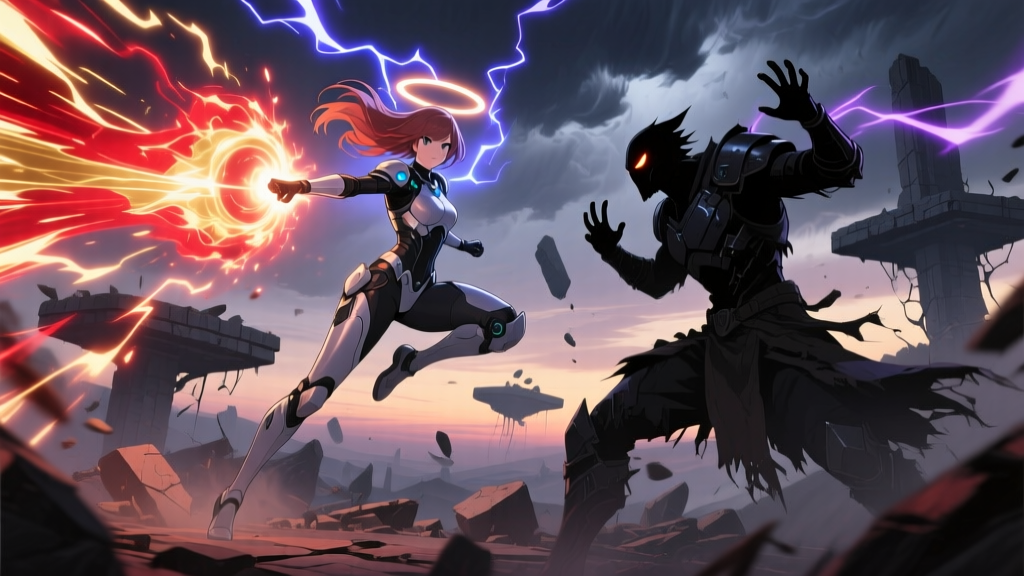
It’s the moment fans replay in every power-scaling thread: Elaine Belloc, barefoot and bleeding on the cracked marble of the Rock of Eternity, raises her hand—not to cast a spell, but to unmake the Spectre’s divine wrath. With a single word—‘No.’—she doesn’t block or deflect. She erases the Spectre’s attack from causal continuity itself. The energy doesn’t dissipate. It never existed. Not even as memory. That’s not resistance. That’s ontology override. And it’s the definitive proof that Elaine Belloc isn’t just another magical heroine in the DCU—she’s one of the few beings who operates *outside* the framework of DC’s cosmology, not within it.
Who Is Elaine Belloc?
Elaine Belloc is the daughter of Michael Demiurgos—the Demiurge, the literal creator of the DC Multiverse—and a mortal woman named Celia Belloc. Born during the Reign in Hell saga (2008–2009), she was conceived as part of a divine contingency plan: if The Presence ever fell silent—or worse, ceased to be—Michael would need a successor capable of sustaining creation without divine mandate. Elaine wasn’t trained. She wasn’t chosen. She awoke. Her first full manifestation occurred when she resurrected her father after his sacrifice against Lucifer, then stabilized the collapsing Heaven, Hell, and Earth simultaneously—without invoking a single incantation, covenant, or external power source.
Tier Context: Where Elaine Belloc Fits in DC’s Cosmic Hierarchy
DC’s cosmology has long been plagued by inconsistent scaling—especially at the top. The Presence is canonically ‘the source of all creation’, but its direct involvement is minimal and often narratively obscured. The Spectre is ‘the Wrath of God’, yet repeatedly gets overruled, rewritten, or outmaneuvered by beings who shouldn’t exist on his plane. Elaine shatters that ambiguity. She doesn’t answer to the Presence. She *replaces* its function—temporarily, yes, but with full ontological authority.
Here’s how she ranks relative to key DC cosmic entities:
| Entity | Canon Status | Elaine’s Relationship | Key Evidence |
|---|---|---|---|
| The Presence | Ultimate Source; non-interventionist | Her grandfather; acknowledged her as ‘the new Demiurge’ in Lucifer #75 | Presence withdraws from active governance after Michael’s death; Elaine assumes creative stewardship without challenge |
| Michael Demiurgos | Former Demiurge; sacrificed himself to seal the Void | Her father; explicitly designated her as his heir before death | In Reign in Hell #6, Michael transfers his demiurgic essence into Elaine mid-battle—no ritual, no consent required. She accepts it instantly. |
| Spectre (Jim Corrigan) | Divine avatar of vengeance; bound to The Presence’s will | Subordinate in function; overruled effortlessly | Day of Vengeance tie-in: Elaine halts Spectre’s annihilation wave targeting magic users—by negating the metaphysical premise of ‘punishment’ itself |
| Lucifer Morningstar | Former ruler of Hell; transcendent intellect & will | Respects her authority; calls her ‘the only being I’ve ever feared to underestimate’ (Lucifer #62) | Lucifer refuses to engage her directly during the ‘War in Heaven’ arc—even after she rewrites the architecture of Eden |
| Anti-Monitor | Prime Multiversal threat; entropy incarnate | Irrelevant to her domain; erased one of his temporal echoes in Countdown to Final Crisis #34 | Not a battle—just a gesture. She notes his ‘pattern is recursive and unsustainable’ and deletes his causal echo from three timelines simultaneously |
Power System: Not Magic. Not Divinity. Something Else.
Elaine doesn’t wield magic. She doesn’t channel divine energy. She *defines* what those terms mean. Her power system is best described as ontological authorship: the ability to edit the foundational axioms of reality—not just effects, but causes, laws, identities, and even narrative coherence.
This isn’t omnipotence-by-declaration. It’s grounded in consistent, documented feats:
- Reality Rewriting Without Cost: In Reign in Hell #7, she restores the entire structure of Purgatory—including souls lost for millennia—by ‘remembering them back’. No incantation. No sacrifice. Just focused intent.
- Causal Erasure: When the Spectre attempted to purge the magical community post-Day of Vengeance, Elaine didn’t shield them—she removed the Spectre’s justification for acting. His divine mandate dissolved mid-sentence.
- Meta-Narrative Anchoring: In Lucifer #75, she stabilizes the ‘Narrative Loom’—a metaphysical construct representing the DC Multiverse’s story continuity—after it unravels due to The Presence’s silence. She doesn’t repair it. She becomes its new loom.
- Transcendent Immunity: Attempted possession by Neron fails because Elaine lacks a ‘soul’ in any conventional sense—her consciousness is coextensive with demiurgic substrate. He tries to bargain; she replies, ‘You have no currency here.’
Controversial Debates: Why Fans Still Argue About Her Tier
Despite her feats, Elaine remains one of DC’s most contested high-tier characters—not because her power is ambiguous, but because her scope is deliberately limited in practice. She rarely intervenes. She refuses to ‘solve’ problems like war or disease, stating, ‘I sustain existence—not morality.’ That restraint fuels two major fan debates:
‘Is She Truly Beyond The Presence?’
No—canonically, she is not *above* The Presence. But she is *functionally independent*. The Presence is primordial and absolute; Elaine is emergent and adaptive. In Lucifer #75, The Presence tells her: ‘You are not me. You are what I made possible.’ That distinction matters: she’s not a replacement god, but a new kind of sovereign—one who governs through coherence, not command.
‘Why Doesn’t She Fix Everything?’
Because her role isn’t intervention—it’s preservation. Her power activates only when foundational reality is threatened (e.g., collapse of Heaven/Hell, dissolution of causality). She won’t resurrect Superman or stop Darkseid’s invasion because those are *events*, not *axioms*. This isn’t weakness—it’s design. As Michael tells her in Reign in Hell #1: ‘Creation isn’t about control. It’s about permission to be.’
‘How Does She Compare to Marvel’s One Above All?’
Direct cross-franchise comparisons are inherently flawed—but contextually, OAoA is a narrative singularity: uninvolved, unverifiable, and functionally plot armor. Elaine, by contrast, is *testable*. Her feats occur on-panel, with consequences, limitations, and emotional weight. OAoA has no dialogue, no history, no motivation. Elaine has all three—and uses them to make hard choices. In pure conceptual weight, OAoA wins by default. In demonstrable, interactive power? Elaine operates at a comparable tier *within her own verse*, with far more concrete evidence.
Evolution Timeline: From Mortal Daughter to Demiurgic Steward
Elaine’s ascension wasn’t linear—it was catalytic. Each stage represents a threshold crossed:
- Mortal Phase (Pre-Reign in Hell): Human daughter of Celia Belloc; aware of supernatural forces but powerless. Key trait: extreme empathy, which later becomes her anchor for ethical application of power.
- Demiurgic Awakening (Reign in Hell #1–6): Triggered by Michael’s death and the destabilization of the afterlife realms. First feat: resurrecting Michael by rewriting the ‘death clause’ in divine law.
- Stewardship Phase (Lucifer #60–75): Actively maintains Heaven, Hell, and Eden as separate but interdependent systems. Refuses Lucifer’s offer to merge all realms under her sole authority—choosing balance over totality.
- Post-Presence Silence (Final Crisis: Submit, DC Universe: Last Will and Testament): Serves as de facto architect of continuity during The Presence’s absence. Notably, she allows the Multiverse to reboot—because she judges it necessary, not inevitable.
What Makes Her Unique Among DC’s High-Tiers?
Most top-tier DC beings derive power from sources: The Presence (divine origin), The Source (conceptual abstraction), or The Overvoid (primordial void). Elaine’s power is intrinsic—not granted, not inherited, but activated by her unique lineage and self-awareness. She’s the only being in DC continuity confirmed to have:
- Edited the Word of Creation (seen in Lucifer #69, where she revises the ‘Let there be light’ clause to include shadow as co-equal principle)
- Survived direct exposure to the Void—the pre-creation state beyond The Presence—without dissolving (via Michael’s residual imprint)
- Refused godhood twice: once from Lucifer, once from The Spectre’s former host, Hal Jordan, who offered her ‘the mantle of judgment’
That refusal is critical. It’s why she’s not ranked alongside The Presence or The Source in raw scale—but why she’s arguably more *dangerous* in narrative terms. She’s not an abstract force. She’s a person who understands consequence. And that makes her the rarest kind of cosmic entity: one you can negotiate with—and one who might say no.
FAQ
Is Elaine Belloc stronger than The Spectre?
Yes—consistently and canonically. She doesn’t fight him; she invalidates his operational framework. In Day of Vengeance and Reign in Hell, she overrides his divine mandate without effort. The Spectre answers to The Presence; Elaine answers to no one.
Can Elaine Belloc beat Darkseid?
Effortlessly—but she wouldn’t. Darkseid’s Omega Effect is a localized reality warp; Elaine edits reality’s source code. However, she views him as a ‘symptom of imbalance,’ not a threat to existence itself—so she’d likely isolate or contain him, not erase him.
Is Elaine Belloc part of the main DC Universe (Earth-0)?
Yes—though her presence is meta-structural. She operates across the Multiverse but anchors herself to Earth-0’s metaphysical core. Her base is the Rock of Eternity, now rebuilt as a ‘Demiurgic Confluence’—a place where Heaven, Hell, and Earth intersect under her stewardship.
Why isn’t Elaine Belloc in the Justice League or major team-ups?
She’s not a hero or villain—she’s infrastructure. Like gravity or time, her role is maintenance, not participation. When she appears in events like Final Crisis, it’s to stabilize reality, not join a battle roster.
Has Elaine Belloc ever lost a fight?
No canonical loss exists. Her only ‘defeat’ is self-imposed limitation: choosing not to intervene in human-scale conflicts. Even when ambushed by Neron and Blaze in Reign in Hell #4, she ends the confrontation by making them forget they’d ever opposed her.
Is Elaine Belloc immortal?
She’s beyond mortality—but not invulnerable. In Lucifer #71, she sustains injury while repairing the Narrative Loom, bleeding ‘light-substance’—proof she can be harmed by ontological stress. However, her recovery is instantaneous and self-directed.