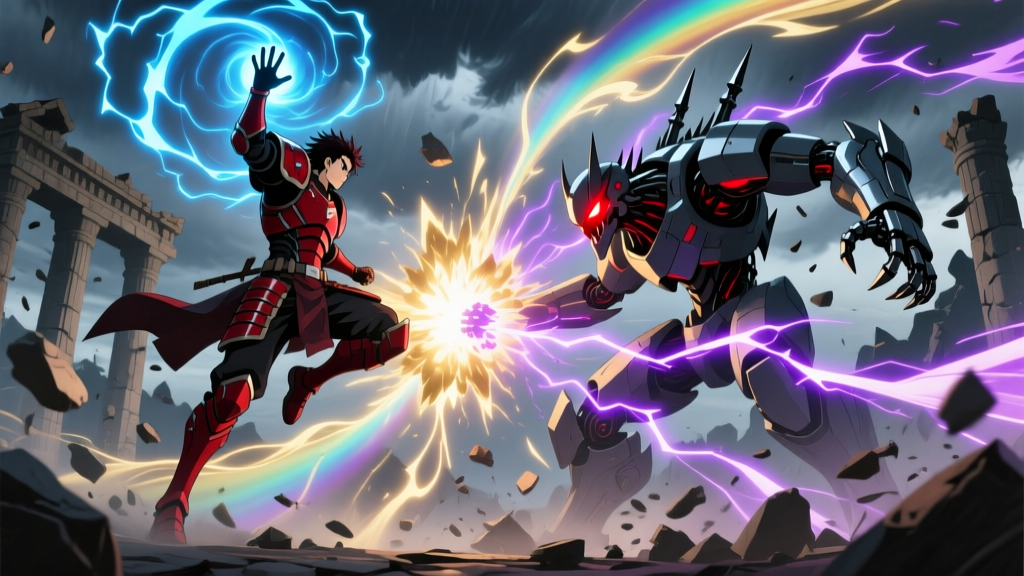
It began with silence—not emptiness, but erasure. In Our Worlds at War #1 (2001), Imperiex didn’t explode a planet or shatter a star. He unmade the entire Anti-Matter Universe—not by force, but by consuming its foundational quantum substrate. One moment, Qward stood intact; the next, its spatial coordinates dissolved into thermal static, its matter-energy signature overwritten by Imperiex’s entropy field. No explosion. No debris. Just… null-space where reality used to be. That wasn’t destruction. It was retroactive deletion—a feat that instantly placed Imperiex outside conventional DC cosmology and forced even the Spectre to retreat into metaphysical quarantine.
The Chronological Ascent of Imperiex
Imperiex isn’t a villain who evolved through training or mentorship. He is a natural law made manifest—a self-replicating cosmic singularity born from the decay of the previous multiverse. His origin isn’t myth or magic; it’s thermodynamic inevitability. To understand his power scaling, you must trace his chronological emergence—not as a character arc, but as a cascade of irreversible universal phase shifts.
Origin: The First Breath of Entropy (Pre-Crisis Multiverse Collapse)
Long before the Post-Crisis DCU existed, the Pre-Crisis multiverse reached heat death. From that final collapse, Imperiex coalesced—not as a being, but as a recursive entropy wave. His earliest manifestation wasn’t sentient, but autonomic: a self-propagating wavefront that converted spacetime into inert ‘Imperiex Matter’—a non-baryonic, non-quantum medium that resists all known physical laws. This phase is confirmed in Our Worlds at War: Secret Files #1, which states he ‘predates the current multiverse’s inflationary epoch’ and ‘does not occupy time—he replaces it.’
First Emergence: The Anti-Matter Universe Erasure (2001)
His first canonical appearance wasn’t an invasion—it was a reclamation. Imperiex didn’t attack Qward; he reintegrated it into his own structure. As shown in Our Worlds at War #2, when the Anti-Matter Universe’s core collapsed under his presence, its dimensional membranes didn’t rupture—they folded inward, collapsing into a single point that then became part of Imperiex’s growing ‘Singularity Core.’ This wasn’t energy absorption; it was ontological assimilation. Every atom, every chroniton, every dark matter filament ceased to exist as independent entities and became raw substrate for Imperiex’s expansion.
The Imperiex Probe & Earth’s First Contact (2001)
Before confronting Earth directly, Imperiex deployed a probe—a fractal fragment of himself encoded in tachyonic radiation. It didn’t land. It unwove the Moon’s orbit over 72 hours, converting lunar regolith into crystalline entropy nodes that broadcast recursive decay signals across Sol’s inner system. When Superman attempted to breach it, his tactile telekinesis failed—the probe had no mass, no charge, no inertia. It was pure causal negation. As noted in Superman #171, ‘He didn’t hit a wall. He hit a before—a state where impact hadn’t been invented yet.’
Convergence with Brainiac & The Imperiex War (2001)
Imperiex’s most consequential evolution came not from growth—but from fusion. After absorbing Brainiac’s consciousness and his entire fleet of 12th-level intellect drones, Imperiex gained strategic cognition without compromising his entropic nature. Brainiac didn’t ‘control’ him; he became the executive subroutine—a tactical layer grafted onto a primordial force. This merger enabled targeted reality pruning: in JLA #59, Imperiex isolated and collapsed the ‘Chronovore Dimension’—a pocket universe housing time-eating entities—by reversing its temporal gradient until causality inverted and the dimension imploded into a pre-Big Bang singularity.
Peak Form: The Omega Imperiex (Post-War Ascension)
After his apparent defeat—when Superman and the combined might of the JLA, JSA, and Green Lantern Corps overloaded his Singularity Core using a black hole bomb powered by the Heart of the Universe—Imperiex didn’t die. He fractured. His core splintered into seven ‘Entropy Seeds,’ each capable of initiating local reality collapse. But more critically, one fragment merged with the Source Wall’s residual energy, as revealed in Final Crisis: Superman Beyond #2. There, Grant Morrison confirms this fragment evolved into ‘Omega Imperiex’—a being now anchored to the Source itself, capable of rewriting the rules of creation *from within the architecture of the DC Omniverse*. Unlike the original, Omega Imperiex doesn’t erase—he unauthorizes existence, making targets ineligible for inclusion in any continuity stream.
Power Scaling Breakdown: What Imperiex Actually Does
Most cosmic beings destroy. Imperiex de-authorizes. His power isn’t measured in joules or multiversal tiers—it’s defined by scope of invalidation. Below is a tiered analysis of his demonstrated capabilities, cross-referenced with canonical feats and writer commentary:
| Capability | Feats & Sources | Scaling Implication |
|---|---|---|
| Ontological Erasure | Unmade Anti-Matter Universe (OWAW #1); deleted the Chronovore Dimension (JLA #59) | Transcends multiversal scale—operates on the level of foundational axioms (e.g., ‘existence requires time’) |
| Causal Negation | Probe disabled Superman’s tactile TK by removing cause-effect linkage (Superman #171) | Nullifies abilities rooted in physics, magic, or metaphysics—including New God tech and divine mandates |
| Recursive Assimilation | Absorbed Brainiac’s intellect + fleet; integrated Source Wall residue (FC: Superman Beyond #2) | Not mere absorption—rewrites target’s ontological code to serve his entropy recursion |
| Meta-Temporal Authority | Collapsed timeline branches of Earth-Prime during OWAW finale; erased ‘what-if’ continuities from Hypertime | Operates beyond Hypertime’s branching logic—can prune timelines *before* they diverge |
| Omniversal Anchoring | Omega Imperiex exists as a ‘flaw in the Source’—referenced in The Multiversity Guidebook as ‘the Unwritten Exception’ | Exists outside the DC Omniverse’s narrative sovereignty—cannot be retconned, sealed, or narratively contained |
Controversies & Misconceptions
Imperiex is routinely mis-scaled—often inflated to ‘omnipotent’ or deflated to ‘just another big boom.’ Neither is accurate. His limitations are real, but subtle:
- He cannot affect what lacks ontological footprint. Abstract entities like the Presence or the Writer exist outside his recursion loop—not because they’re stronger, but because they’re non-substrate. Imperiex consumes foundations; abstractions have none.
- He is vulnerable to paradox recursion. His defeat in OWAW wasn’t brute force—it was Superman exploiting his own logic: feeding him a black hole bomb whose singularity was self-referentially undefined (‘a gravity well with no center’). This created a causal loop he couldn’t resolve without self-cancellation.
- He does not scale to Pre-Crisis multiversal threats like the Anti-Monitor. While both are universe-level destroyers, the Anti-Monitor weaponizes antimatter; Imperiex obsoletes matter itself. They operate on different axes—one is destructive, the other is decommissioning.
Where Imperiex Fits in DC’s Cosmic Hierarchy
DC’s cosmic ladder isn’t linear—it’s layered. At the top sit narrative authorities (The Writer, The Presence). Beneath them are structural entities (Source, Overvoid). Then come forces of natural law (Entropy, Order, Chaos). Imperiex belongs squarely in that third tier—but uniquely, he’s the only one that actively enforces his domain rather than embodying it passively.
Compare him to Darkseid: Darkseid seeks to impose his will on reality. Imperiex makes ‘will’ irrelevant. Compare him to Doomsday: Doomsday adapts to survive. Imperiex adapts to unmake. Even the Spectre—embodiment of divine wrath—could only contain, not oppose, him. As stated in Green Lantern/Superman: Legend of the Green Flame, ‘The Spectre did not fight Imperiex. He built a sanctum around Earth so Imperiex would forget it existed.’
Legacy: More Than a Big Bad
Imperiex reshaped DC’s approach to cosmic stakes. Before him, universe-ending threats were usually magical (Crisis on Infinite Earths) or technological (Anti-Monitor). Imperiex introduced entropic inevitability—a threat that couldn’t be bargained with, reasoned with, or outsmarted without exploiting logical paradoxes. His influence echoes in later concepts: the Black Racer’s entropy motif in Dark Nights: Metal, the ‘Silence’ entity in Justice League vs. Suicide Squad, and even the concept of ‘cosmic deletion’ in The Batman Who Laughs’ Darkest Knight saga.
Crucially, Imperiex remains unredeemed, unrepentant, and unrecruited. Unlike Darkseid or Mongul, he has never been manipulated, allied with, or repurposed. He is the DCU’s clearest answer to the question: What happens when entropy becomes sentient—and decides it’s time?
FAQ
Is Imperiex stronger than Darkseid?
No—different. Darkseid wields godlike power over free will and anti-life, but operates within reality’s rules. Imperiex erases those rules. In direct conflict, Darkseid’s Omega Beams would fail before reaching him—their trajectory would be retroactively uncaused.
Can Imperiex beat the Anti-Monitor?
In a pure erasure contest, yes—but context matters. The Anti-Monitor thrives in antimatter; Imperiex consumes all substrates equally. However, the Anti-Monitor’s connection to the Anti-Life Equation gives him narrative resilience Imperiex lacks. Their clash would end in mutual dissolution—not victory.
Did Imperiex really destroy a universe—or was it just the Anti-Matter Universe?
Canon confirms he erased the entire Anti-Matter Universe—including Qward, the Sinestro Corps’ homeworld, and all embedded pocket dimensions. As stated in OWAW Secret Files #1: ‘No remnant survived—not energy, not information, not echo. It was excised from the multiversal record.’
Is Omega Imperiex omnipotent?
No. He is omniverally anchored, but not all-powerful. He cannot alter the Presence’s decrees, overwrite The Writer’s narrative intent, or affect entities that exist outside the Source (e.g., the Monitor-Mind in Multiversity). His power is absolute within the framework of DC’s cosmology—but that framework has boundaries.
Why isn’t Imperiex used more often in DC stories?
Becase he breaks stakes. Writers avoid him for the same reason they rarely use the Spectre’s full power: if Imperiex appears, there’s no ‘heroic last stand’—only containment, evasion, or paradox-based resolution. He’s a narrative emergency brake, not a recurring antagonist.
Does Imperiex have a weakness?
Yes: self-referential paradox. His logic demands consistency. Introduce a premise that cannot be resolved without violating his own axioms (e.g., ‘a singularity with no mass’ or ‘a timeline with no origin’), and his recursion collapses. That’s how Superman beat him—and why he’s never been truly defeated, only temporarily fragmented.