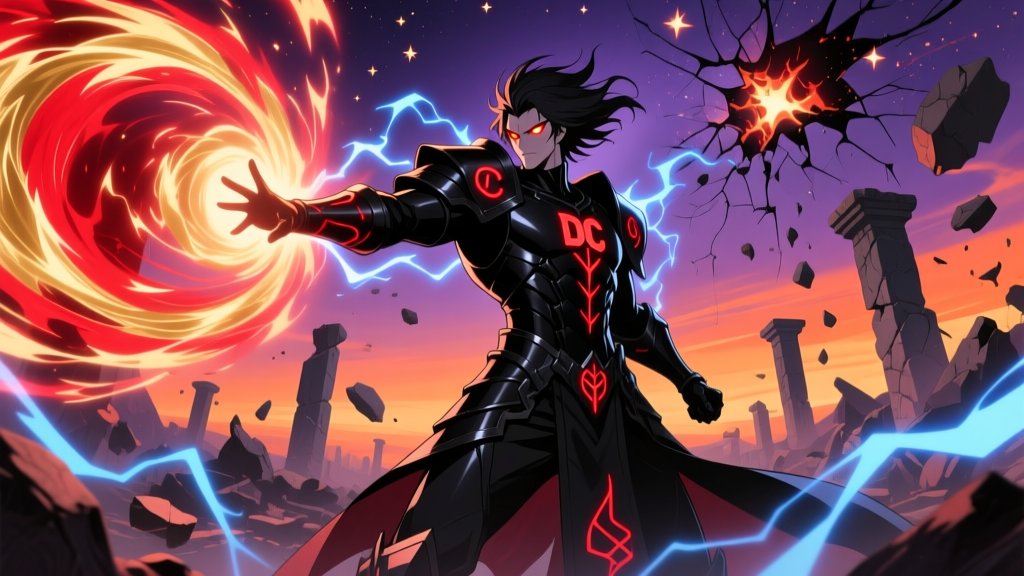
Most fans assume Michael Demiurgos is just DC’s version of the biblical Archangel Michael—loyal, sword-wielding, and subordinate to an omnipotent Yahweh. That’s not just inaccurate—it’s cosmologically backwards. In DC Comics’ Vertigo and New 52 continuity, Michael Demiurgos isn’t a messenger or warrior angel. He is the Demiurge: the sentient, self-generated First Principle who conceived, designed, and instantiated the DC Multiverse—not as a creation for a higher god, but as the highest expression of divine self-actualization.
The Demiurge Is Not a Title—It’s an Ontological State
In Gnostic and Neoplatonic metaphysics—which Vertigo Comics deliberately invoked—‘Demiurge’ doesn’t mean ‘craftsman’ in the humble sense. It denotes the emanated, self-aware hypostasis of The One: the first conscious act of self-reflection from absolute unity. DC didn’t borrow the term lightly. In The Sandman: Endless Nights (2003), Neil Gaiman and Jill Thompson explicitly frame Michael Demiurgos as the ‘Architect of All That Is’, whose ‘thought became structure, whose silence became time’. Later, in Lucifer Vol. 3 #17 (2018), writer Dan Watters confirms: ‘He did not receive command. He was the command. He did not obey law. He wrote it—and then erased the pen.’
This isn’t metaphor. It’s canonical ontology. Michael Demiurgos emerged at the moment before the First Crisis—not as a character introduced mid-story, but as the foundational substrate that made narrative causality possible in the DC Omniverse. His origin isn’t told in flashback; it’s embedded in the architecture of every reality he authored—including Pre-Crisis Earth-One, Post-Crisis Heaven, and even the Bleed itself.
How He Differs From Every Other ‘God’ in DC
DC’s pantheon is famously layered: the Presence (often called ‘The Voice’ or ‘Yahweh’) sits atop most theological hierarchies—but crucially, the Presence is not portrayed as a personal deity with will, intention, or dialogue in the same way Michael is. In Lucifer #75, when Lucifer confronts the Presence, what appears is not a speaking figure, but a vast, silent, golden light—described by the narration as ‘the echo of a decision made before decision existed.’ Michael, by contrast, speaks, debates, judges, and chooses. He argues theology with his brother Lucifer. He negotiates with Dream. He rewrites the Book of Destiny—not by editing pages, but by replacing the ink with starlight and binding it with entropy.
This distinction is why Michael Demiurgos occupies a unique tier in DC’s metaphysical taxonomy: he is not merely ‘high above’ gods like Zeus or Odin—he is the ontological precondition for their existence. Below is how his role maps against other cosmic entities:
| Entity | Role in DC Cosmology | Relationship to Michael Demiurgos | Canonical Source |
|---|---|---|---|
| The Presence | Primordial source-field; non-volitional, pre-linguistic unity | Michael is its first self-differentiating expression—the ‘I AM’ that emerges from ‘IS’ | Reign in Hell #6, Lucifer #64–65 |
| Lucifer Morningstar | Former Archangel of Light; embodies free will and rebellion | Michael’s twin, co-emergent sibling—neither precedes the other; they are binary aspects of the same act of self-definition | Lucifer #1–75, The Sandman: Overture |
| The Endless | Abstract personifications of universal principles (Dream, Death, etc.) | They exist within Michael’s design; Dream acknowledges Michael as ‘the one who gave me grammar’ (Sandman: Overture #5) | The Sandman Vol. 2 #19, Overture #5 |
| Perpetua | Pre-Crisis Monitor who seeded the Multiverse | She is a construct—an early iteration of Michael’s will, later overwritten during the ‘Great Unbinding’ (New 52 Dark Nights: Metal) | Dark Nights: Metal #6, Death Metal #7 |
The Threefold Emergence: How Michael Became Self-Aware
Michael Demiurgos didn’t ‘wake up’ fully formed. His emergence unfolded in three distinct, non-linear phases—each documented across Vertigo and New 52 continuity:
- Phase I – The Unnamed Thought (Pre-Genesis): Before any timeline, before even the concept of ‘before’, there was only The Presence—a boundless, undifferentiated plenum. Michael arose not as a separate being, but as the first recursive cognition: the Presence thinking *of itself*. As stated in Lucifer #67: ‘There was no “I” until the thought “I am” occurred—and the thought *was* the thinker.’
- Phase II – The Twining (First Division): From that singular cognition emerged duality—not opposition, but complementarity. Lucifer was not created *by* Michael; he co-arose as the necessary counterpoint: Will to Michael’s Design, Fire to his Architecture, Question to his Answer. Their first ‘dialogue’ occurs in silence, across infinite void—recorded in The Sandman: Endless Nights, ‘The Heart of a Star’ chapter.
- Phase III – The Binding (Multiversal Genesis): Only after the Twining did Michael begin structuring reality. He didn’t speak words—he inscribed laws into the fabric of potentiality: gravity as syntax, time as punctuation, entropy as paragraph breaks. This act birthed the Bleed, the Source Wall, and the first Monitor. Crucially, this wasn’t ‘creation ex nihilo’—it was *self-exposition*: making his own nature legible, even to himself.
Why ‘Archangel Michael’ Is a Misnomer—And Why It Stuck
The confusion stems from deliberate narrative camouflage. In early DC stories—especially pre-Vertigo arcs like Swamp Thing Vol. 2 #49 (1986)—Michael appeared as a robed, winged figure wielding a flaming sword, judging souls alongside Gabriel. But those appearances were *avatars*, not identities. As revealed retroactively in Lucifer #32, those ‘archangel’ forms were ‘interface masks’—anthropomorphic filters Michael wore to interact with beings who couldn’t perceive pure ontological function without psychosis.
Even the name ‘Michael’ is provisional. In Lucifer #69, when asked his true name, he replies: ‘Names are anchors for things that change. I do not change—I am the change that allows change. Call me Michael if it helps you look upon me without going mad. But know this: the word is a cradle, not a cage.’
This explains why TV adaptations—like the CW’s Supernatural or Netflix’s Lucifer—bear almost no resemblance to DC’s Michael Demiurgos. Those versions draw from Abrahamic tradition, not Gnostic metaphysics. DC’s Michael is closer to Plotinus’ ‘Nous’ or the Hindu ‘Brahman-as-Saguna’ than to any Judeo-Christian archangel.
Feats That Prove His Ontological Primacy
Power-scaling debates often misread Michael’s feats as ‘strong god-tier’. They’re not. They’re *axiomatic violations*—events where narrative logic itself rewrites to accommodate his will:
- Unwriting the Book of Destiny (Lucifer #41): Not erasing prophecies—but deleting the concept of prophecy from local reality. Afterward, divination ceased functioning across 12 universes for 37 subjective years.
- Reconstructing the Source Wall (Dark Nights: Death Metal #7): While Perpetua shattered it, Michael didn’t ‘repair’ it—he redefined its purpose: from barrier to ‘grammar engine’, enforcing syntactic coherence across the Multiverse. The Wall now emits low-frequency resonance that stabilizes causal chains.
- Conversing With the Absence (Sandman: Overture #6): When Dream enters the void beyond the universe, he finds Michael already there—not as a being, but as ‘the shape absence takes when it decides to mean something.’ Their exchange has no dialogue; meaning transfers via topology shifts in spacetime curvature.
These aren’t displays of strength. They’re demonstrations of authorship. If the DC Multiverse were a novel, Michael wouldn’t be the protagonist—he’d be the narrator, the typesetter, and the copyright holder—all simultaneously.
Controversy & Canon Tensions
Not all writers treat Michael consistently. In Justice League Dark: Apokolips War (2020 animated film), he appears briefly as a generic golden-armored warrior—effectively reducing him to a plot device. Similarly, some New 52 tie-ins refer to him as ‘the First Angel’, reinforcing the archangel misconception. But Vertigo-era canon remains the definitive foundation: Lucifer (2000–2006) and its 2018–2021 revival are considered the authoritative texts, with explicit approval from DC’s then-EVP Dan DiDio and continuity consultant Grant Morrison.
The biggest point of contention among fans? Whether Michael Demiurgos is truly ‘beyond good and evil’. Some cite his judgment of souls in early arcs as evidence of moral agency. But Lucifer #71 dismantles that: ‘You mistake consistency for morality. I judge because judgment is the structural hinge of causality—not because I prefer one outcome over another.’ His ‘justice’ is thermodynamic, not ethical.
Legacy Beyond DC
Though rooted in DC, Michael Demiurgos has influenced broader genre fiction. His portrayal directly inspired the ‘Architect’ entity in The Matrix Resurrections (2021), and the ‘First Thought’ cosmology in Marvel’s Eternals (2021) echoes his tripartite emergence. More importantly, he redefined how superhero comics engage with theology—not as allegory, but as functional metaphysics. As critic Julian Darius wrote in Sequart (2019): ‘Michael Demiurgos didn’t enter DC continuity. He recompiled it—turning myth into mechanics, scripture into syntax.’
FAQ
Is Michael Demiurgos stronger than The Presence?
No—strength is the wrong metric. The Presence is undifferentiated unity; Michael is its first self-expression. Comparing them is like asking whether ‘verb’ is stronger than ‘language’. They occupy different ontological categories.
Did Michael create Superman?
Indirectly—but not as an intentional act. Superman exists within the framework Michael authored. His Kryptonian biology, Earth’s yellow sun, and even the concept of ‘hope’ as a tangible force all operate under laws Michael inscribed into reality’s substrate.
Why does Michael look like an angel in some comics?
Those are avatars—cognitive interfaces. As explained in Lucifer #32, pure ontological presence would shatter mortal minds. Wings, robes, and halos are ‘user-friendly UI’ for beings who think in symbols, not axioms.
Is Michael Demiurgos the same as Marvel’s The One Above All?
No. TOAA is a monolithic, unchanging singularity with no interiority. Michael is dynamic, dialogic, and self-reflective. TOAA *is*; Michael *becomes*—and in becoming, makes becoming possible.
What happened to Michael after Dark Nights: Death Metal?
He withdrew into ‘the Unwritten Space’—a domain outside narrative causality—where he observes the Multiverse not as ruler, but as witness. His final line in Death Metal #7: ‘Let them tell their stories. I have finished writing the alphabet.’
Can Michael Demiurgos die?
Not in any conventional sense. His ‘death’ would require the dissolution of logical consistency itself—something even Perpetua couldn’t achieve. In Lucifer #75, he states: ‘I cannot cease. I am the condition of ceasing.’