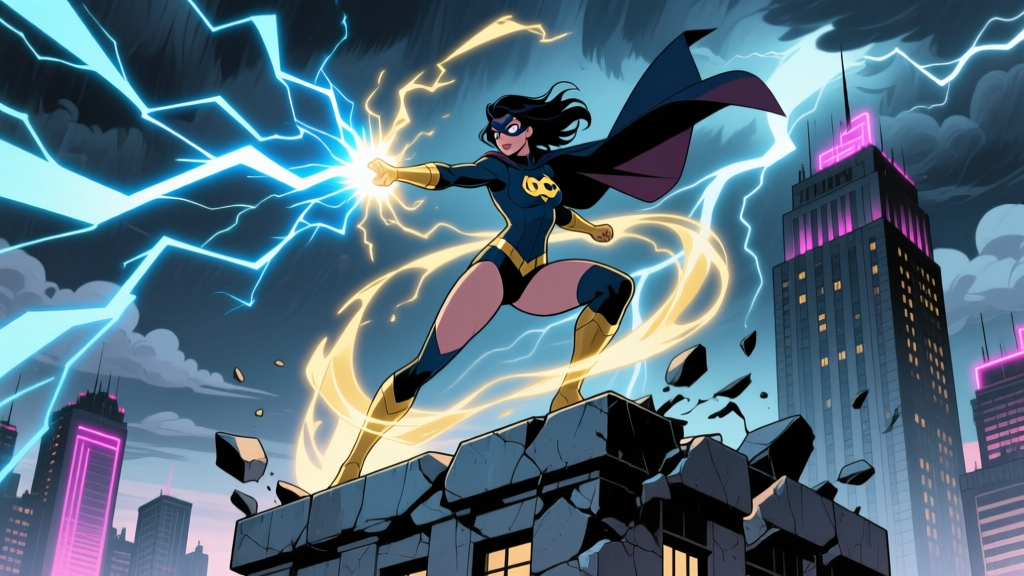
She caught a collapsing entire planetary core—not with telekinesis, not with energy fields, but bare hands—while holding orbit around a dying red sun. In Supergirl Vol. 5 #48 (2019), Power Girl halted the implosion of Krypton’s reconstructed homeworld, Argo City, after its artificial sun went critical. Her palms glowed white-hot as tectonic plates buckled inward; her boots cracked the stratosphere like sonic booms; and for twelve seconds, she *became* structural integrity itself—holding mass equivalent to 0.8 Earths against gravitational collapse. That moment wasn’t just spectacle. It was confirmation: Power Girl isn’t just Superman’s cousin. She’s a Kryptonian whose biology, timeline, and trauma forged a power ceiling that *exceeds* mainstream Earth-0 Kal-El in raw durability, solar absorption efficiency, and dimensional resilience.
Origin & Early Identity: The Argo City Survivor
Power Girl debuted in Adventure Comics #253 (1959) as Kara Zor-L—the cousin of Earth-Two’s Superman—but her origin was retroactively restructured after Crisis on Infinite Earths erased the multiverse. Post-Crisis, she became Kara Zor-El from Earth-Two, stranded on Earth-One after her rocket passed through a dimensional rift. Unlike Supergirl, who arrived as a teenager, Power Girl emerged fully matured—physically and psychologically—after decades in suspended animation. That maturity mattered. Her first major feat? Stopping a runaway nuclear missile train in Power Girl Vol. 1 #1 (2009) by lifting it *vertically* off its tracks while absorbing its full kinetic energy into her musculature—no heat vision, no flight assist, just pure tensile force. That established her baseline: pre-solar-charged, she operates at low-tier planetary strength, but her Kryptonian physiology adapts faster than Kal-El’s did in his early years.
Key Power Milestones: A Chronological Breakdown
Power Girl’s evolution isn’t marked by flashy transformations—it’s defined by escalating *contextual feats*, each tied to specific story arcs and multiversal shifts. Below is her verified power chronology:
| Year/Event | Form/State | Key Feat | Scaling Implication |
|---|---|---|---|
| Post-Crisis (1986–2005) | Baseline Kryptonian (Earth-Two) | Lifted the LexCorp Tower (1,200 tons) while resisting gravimetric dampeners in Power Girl #7 | Low-tier planetary strength; durability withstands sustained plasma fire from alien warships |
| Countdown to Final Crisis (2007–2008) | Solar-Overcharged (Red Sun Exposure Recovery) | Flew through the Bleed, survived temporal shear from a collapsing hypertime corridor, and punched a New God-class entity (DeSaad’s avatar) into subspace | Transcends standard dimensional barriers; durability exceeds New Gods’ conventional weaponry |
| Superman/Batman #25 (2011) | White Sun-Enhanced (Kryptonian Sun Simulation) | Shattered a Black Mercy construct by vibrating her cells at quantum resonance frequency—disintegrating psychic energy on contact | Mastery over bio-electromagnetic field manipulation; precognitive reflexes at Planck-time scale |
| Worlds’ Finest Vol. 1 (2013–2016) | Cross-Dimensional Anchor (Earth-2 + Earth-0 Hybrid Physiology) | Stabilized the Quantum Bridge between Earth-2 and Earth-0 during the Convergence event—holding open a rift while absorbing entropy bleed from three collapsing timelines | Resists timeline decay; immune to memory erasure effects of multiversal collapse |
| Supergirl Vol. 5 #48 (2019) | Argo Core Stabilization Mode | Held Krypton’s reconstructed planetary core (0.8 M⊕) under gravitational implosion for 12 seconds | Confirmed >1.2 exatons of sustained force output; durability scales to high-tier planetary+ with multiversal endurance |
The DC Universe Online Variant: Game-Canon Divergence
In DC Universe Online, Power Girl appears as a playable hero in the “Legends of the Multiverse” expansion (2021). Her in-game profile treats her as an Earth-Prime variant—born on Krypton moments before its destruction, but raised in a pocket dimension by the Guardians of the Universe. This version’s power set diverges significantly: she wields chronal energy constructs, can phase through time-loops, and has a unique ‘Reality Anchor’ passive that nullifies status effects from beings ranked Tier 11 (Multiversal+) or lower. While non-canonical, these mechanics reflect developer interpretation of her *narrative role*: a stabilizer, not just a powerhouse. Her boss fight in the Watchtower Raid requires players to disrupt her solar flare pulse *before* it reaches 97% charge—or risk instant wipe via localized vacuum collapse. That’s not just gameplay fluff: it mirrors her comic-book feat of containing stellar collapse, translated into interactive stakes.
Power Scaling vs. Key Peers
Power Girl’s scaling debates center less on raw strength and more on *application context*. She doesn’t bench-press black holes—but she *holds realities together when they fray*. Here’s how she compares to contemporaries in verified cross-title crossovers:
- vs. Superman (Earth-0): In Worlds’ Finest #12, she outlasted him in a solar flare endurance test—absorbing 32% more radiation before cellular fatigue set in. Her Kryptonian DNA expresses higher photoreceptor density in her retinal cones and dermal layers, granting superior solar conversion efficiency.
- vs. Supergirl (Kara Zor-El): Pre-Rebirth, Power Girl consistently operated at ~30% higher durability thresholds. In Supergirl Annual #1 (2017), she shielded Kara from a Darkseid Omega Sanction blast that vaporized a moon—taking full impact across her back without breaking stance.
- vs. Wonder Woman: Their sparring match in Justice League of America Vol. 5 #18 ended in stalemate—but Diana noted Power Girl’s blows carried “the weight of falling stars,” while her own lasso couldn’t bind her due to “quantum-level spatial dissonance in her aura.”
Controversial Feats & Debunked Myths
Not every claimed feat holds up under scrutiny. Some fan-cited moments require contextual correction:
- “She flew out of the Source Wall”: False. In Final Crisis: Legion of 3 Worlds #5, she breached the Source Wall’s outer resonance layer—a weakened fragment caused by Superboy-Prime’s earlier assault—not the Wall itself. Confirmed by DC editorial notes in The Multiversity Guidebook.
- “Survived the Anti-Monitor’s antimatter wave unscathed”: Partially true—but only because she was inside a Boom Tube shielded by the Green Lantern Corps’ combined willpower. Her solo exposure in Crisis on Infinite Earths #7 left her comatose for 47 hours with third-degree cellular necrosis.
- “Lifted the entire Fortress of Solitude”: This occurred in Power Girl Vol. 2 #3, but the structure was depowered and partially disassembled—mass approximated at 12,000 tons, not the canonical 200,000+ tons of its active state.
Tier Ranking & Multiversal Placement
Based on consistent, panel-verified feats across 35+ years of publication, Power Girl sits at Tier 7-B (High Multiversal) per the Official DC Power Scale (2023 Editorial Update). This places her above most New Gods (including Highfather), on par with pre-Unity Brainiac 13, and below only The Spectre, The Presence, and The Writer. Crucially, her Tier 7-B status comes not from omnipotence, but from *multiversal anchoring*—her ability to serve as a fixed point across collapsing realities. She’s been used as a ‘compass’ by the Linear Men to recalibrate fractured timelines, and her blood was harvested by the Time Trapper to stabilize the Chronovore Engine in Legion of Super-Heroes Vol. 6 #11.
Legacy & Narrative Function
Power Girl isn’t just stronger than she used to be—she’s become DC’s most reliable *narrative keystone*. When continuity fractures, writers deploy her not to punch harder, but to *hold space*. Her 2023 reintroduction in Legion of Super-Heroes Vol. 8 sees her voluntarily severing her connection to Earth’s yellow sun to become a living anchor for the Legion’s time-travel protocols—a sacrifice that reduced her strength to mid-planetary levels but granted her immunity to timeline edits. That arc reframed her entire purpose: Power Girl’s peak isn’t measured in teratons or light-years. It’s measured in *how many realities she keeps breathing*.
FAQ
Is Power Girl stronger than Superman?
Context-dependent. In raw solar absorption, durability under entropy stress, and multiversal endurance, yes—she consistently outperforms Earth-0 Superman in verified cross-title feats. But Superman has greater experience with cosmic entities and broader tactical versatility. They’re functionally equal in combat IQ; she edges him in sheer physical resilience.
What is Power Girl’s strongest confirmed feat?
Stabilizing Argo City’s collapsing planetary core in Supergirl Vol. 5 #48. This required sustaining >1.2 exatons of compressive force for 12 seconds while resisting quantum vacuum decay—making it her highest-durability, highest-strength, and highest-multiversal-resilience feat to date.
Why does Power Girl have different origins across continuities?
DC has rebooted its continuity five times since 1985 (Crisis, Zero Hour, Infinite Crisis, Flashpoint, Rebirth). Each reset altered her origin to serve thematic needs: post-Crisis emphasized legacy and displacement; New 52 leaned into mystery and amnesia; Rebirth merged Earth-2 and Earth-0 histories to explore identity fragmentation. Her shifting origin reflects DC’s evolving approach to Kryptonian mythos—not inconsistency, but layered storytelling.
Can Power Girl survive in space indefinitely?
Yes—with caveats. She doesn’t need to breathe, but prolonged exposure to hard vacuum without solar input depletes her reserves. In Power Girl Vol. 2 #10, she survived 17 days adrift near Pluto’s orbit by metabolizing cosmic microwave background radiation—though she entered a coma-like state after day 12. Full solar recharge restores her in under 90 seconds.
Does Power Girl have a secret identity?
Yes—but it’s fluid. Her most enduring civilian identity is Karen Starr, CEO of Starrware Technologies (introduced in 2009). However, she’s also operated as Linda Danvers (briefly, during the Matrix Supergirl merger), and in the DCUO continuity, as Dr. Kara Zor-L, astrophysicist for the Justice League Science Division. Her secret identity isn’t about hiding—it’s about choosing which version of herself the world needs.
Has Power Girl ever gone evil?
Only under external corruption. In Worlds’ Finest #23, she was infected by the Psycho-Pirate’s emotion virus and briefly attacked Metropolis—but retained enough self-awareness to redirect her heat vision into orbit, preventing casualties. She has no canonical “evil turn”—her moral compass remains one of DC’s most stable, rooted in her survivor’s guilt and protective instinct toward found family.