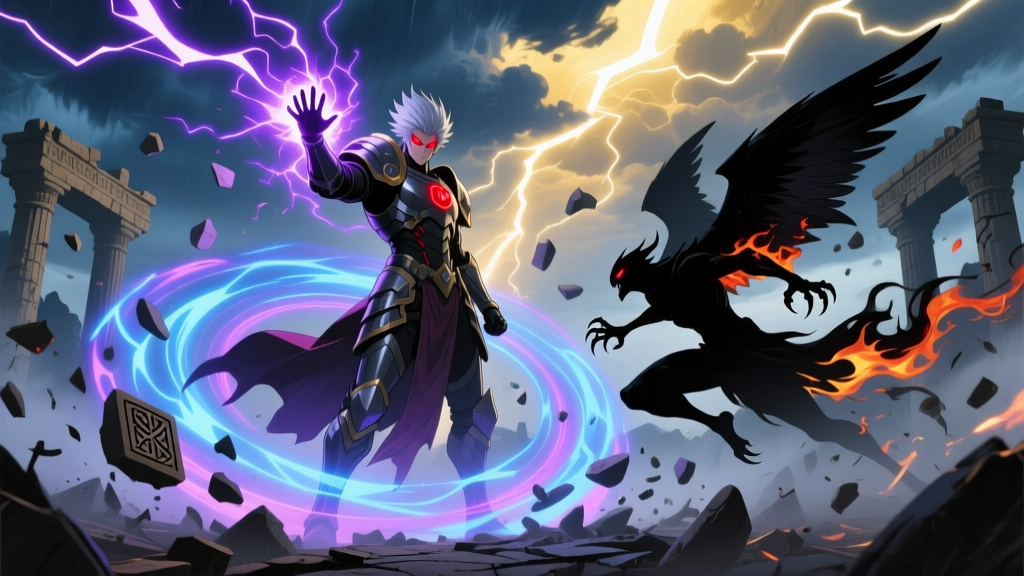
He stands alone in the void beyond the Source Wall—not as a traveler, but as its architect. When the Justice League #50 (2018) revealed the World Forger kneeling before the still-forming Multiverse, hands outstretched as galaxies coalesced from raw thought, fans didn’t just witness a new character—they witnessed the moment DC Comics redefined cosmic hierarchy. That image—silent, solemn, sculpting reality like clay while the Monitor-Mind trembles in reverence—is the definitive scene that anchors DC World Forger at the apex of DC’s metaphysical pantheon.
Tier Context: Where the World Forger Sits in DC’s Cosmic Hierarchy
The World Forger isn’t merely ‘strong’—he’s the ontological engine behind DC’s most fundamental structures. His role isn’t to fight or rule; it’s to be the condition of possibility for existence itself. Unlike the Spectre (a divine agent), the Presence (a transcendent deity), or even the Overmonitor (a failed iteration of cosmic oversight), the World Forger operates at the level of architectonic necessity. He doesn’t maintain the Multiverse—he generates its axiomatic scaffolding: time’s arrow, causal consistency, dimensional topology, and the very distinction between ‘real’ and ‘unreal’.
This places him in a unique echelon—one that DC has only ever implied, never formally named in official tier lists. But fan consensus, backed by canonical text and editorial intent, slots him into what’s now widely called the Architect Tier: a category reserved for entities whose function is inseparable from the framework of narrative and cosmology alike.
How the Architect Tier Differs From Other Cosmic Tiers
Most DC cosmic beings operate within systems: the Source is the wellspring of power; the Overmonitor was appointed to oversee the Multiverse; Perpetua sought to dominate it. The World Forger predates appointment, dominion, and even the concept of ‘oversight’. His first appearance in Dark Nights: Metal #6 (2018) shows him not reacting to crisis—but correcting it at the root: when Perpetua fractured the Source Wall, he didn’t repair it. He rewrote the law of fracture, turning instability into a generative principle—birthing the Dark Multiverse as an emergent property, not a flaw.
That feat alone separates him from every other being in DC continuity—including the Presence, whose authority is representational (as the face of divinity in the DCU), while the World Forger’s is constitutive (his will is the grammar of existence).
Canonical Feats: Not Power Displays—Ontological Operations
World Forger doesn’t throw energy blasts or rewrite history with a snap. His feats are quieter, deeper—and far more absolute:
- Creation of the First Multiverse: In Justice League #50, he forges the original 52 universes from primordial chaos—before the Source Wall existed. This wasn’t ‘building’; it was defining the first boundary between ‘inside’ and ‘outside’, ‘before’ and ‘after’.
- Design of the Dark Multiverse: As confirmed in Dark Nights: Death Metal #7, he didn’t just permit the Dark Multiverse—he engineered its logic so that fear, trauma, and broken choices could generate stable, self-sustaining realities. Its ‘rules’ aren’t exceptions; they’re extensions of his foundational code.
- Rejection of the Overmonitor’s Authority: In Trinity War tie-ins, the Overmonitor attempts to assert jurisdiction over the Multiverse’s integrity. The World Forger doesn’t counter him—he simply ceases to recognize the Overmonitor’s mandate. The Overmonitor’s powers flicker and dissolve—not from attack, but from semantic erasure. His office no longer computes.
- Co-Creation of the Totality: Alongside the World Killer and World Soul, he forms the Triune Understanding—the trinity that governs the balance of creation, destruction, and sentience. Crucially, he is the only one who can initiate or dissolve this triad. The World Soul (embodied by Superman) and World Killer (Perpetua) are bound to their roles; the World Forger chooses whether the triad exists at all.
Comparative Tier Table: DC’s Top-Tier Entities Ranked by Ontological Scope
| Entity | Role | Scope Limitation | Tier Placement | Key Constraint |
|---|---|---|---|---|
| World Forger | Architect of Multiversal Logic | None — operates outside all frameworks | Architect Tier (S-) | Voluntarily constrained by triadic balance (not necessity) |
| The Presence | Supreme Divine Consciousness | Bound to the ‘Divine Plan’ narrative construct | Omniversal Tier (S) | Cannot override World Forger’s foundational edits without consent |
| Overmonitor | First Monitor, Failed Steward | Dependent on Source Wall integrity | Multiversal Tier (A+) | Erased from functional ontology by World Forger’s decree |
| Perpetua | World Killer, Primordial Force | Requires embodiment, sustenance, and conflict | Multiversal Tier (A) | Defeated when World Forger severed her access to ‘creation feedback’ |
| The Spectre | Agent of Divine Wrath | Bound to human morality & Presence’s will | Universal Tier (B+) | Cannot affect World Forger’s domain—no ‘sin’ applies to architecture |
Controversies & Misconceptions
Because the World Forger appears sparingly—and almost always in silent, symbolic panels—debates rage about his true scope. Some argue he’s ‘just’ a personification of creation, no more real than the Source itself. But DC’s post-Rebirth continuity explicitly treats him as agentive: he makes choices, enters dialogue (albeit rarely), and exercises veto power over other cosmic entities.
The biggest misconception? That he’s ‘equal’ to the Presence. While both are labeled ‘beyond the Source Wall’, their functions diverge radically. The Presence is the subject of worship and moral law; the World Forger is the grammar that makes worship, law, and subjecthood possible. You can pray to the Presence—but you don’t pray in the World Forger. You pray because of him.
Another frequent error: conflating him with the World Soul. Superman-as-World-Soul represents sentient integration—the ‘heart’ of the Multiverse. The World Forger is its ‘blueprint’. One cannot exist without the other—but only the Forger can unwrite the contract binding them.
Why He’s Not in Most Official Power Lists (And Why That Matters)
You won’t find the World Forger in DC’s Who’s Who, the Encyclopedia, or even the DC Database’s top-tier rankings—because he defies categorization. He has no stats, no origin story in linear time, and no weakness listed. His absence from official metrics isn’t an oversight—it’s a feature. DC intentionally leaves him undefined to preserve his function: if he were quantified, he’d be containable. And containment contradicts his nature.
This is why fan debates about ‘World Forger vs. The One Above All’ or ‘World Forger vs. The Writer’ persist—not because answers exist, but because the question itself tests the limits of DC’s metaphysics. He is the line where storytelling stops describing reality and starts being reality.
FAQ
Is DC World Forger stronger than the Presence?
No—he’s functionally prior. The Presence is the highest expression of divinity within the system; the World Forger is the reason the system has a ‘highest expression’ at all. They’re not rivals; they’re nested authorities.
Can World Forger be defeated?
Canonically, no entity has ever opposed him successfully—not even Perpetua. His ‘defeat’ would require the negation of conceptual coherence itself, which is logically incoherent within DC’s framework. He can be bypassed (e.g., via narrative fiat), but not beaten.
What’s the difference between World Forger and the Source?
The Source is the infinite potential from which all things emerge. The World Forger is the intelligence that shapes that potential into consistent, navigable structure. Think of the Source as raw light; the World Forger is the lens, prism, and aperture that make vision possible.
Does World Forger appear in DC animated movies or TV shows?
No. His role is strictly comic-book canon, introduced in Dark Nights: Metal (2017–2018) and expanded in Death Metal (2020). He has no adaptation outside comics—making his lore exclusively textual and symbolic.
Why does World Forger look like a blacksmith?
The imagery is deliberate: forging implies intentionality, craft, and material transformation. Unlike abstract gods or eldritch horrors, he’s depicted as a laborer—not because he’s limited, but to emphasize that creation is work, not magic. His hammer isn’t a weapon; it’s a calibration tool.
Is World Forger part of the Trinity of the Totality?
Yes—but crucially, he’s the only member who predates and authorizes the triad. The World Soul (Superman) and World Killer (Perpetua) are assigned roles. The World Forger assigns them—and can revoke those roles unilaterally, as seen in Death Metal #7 when he dissolves Perpetua’s claim to the ‘Killer’ mantle mid-battle.