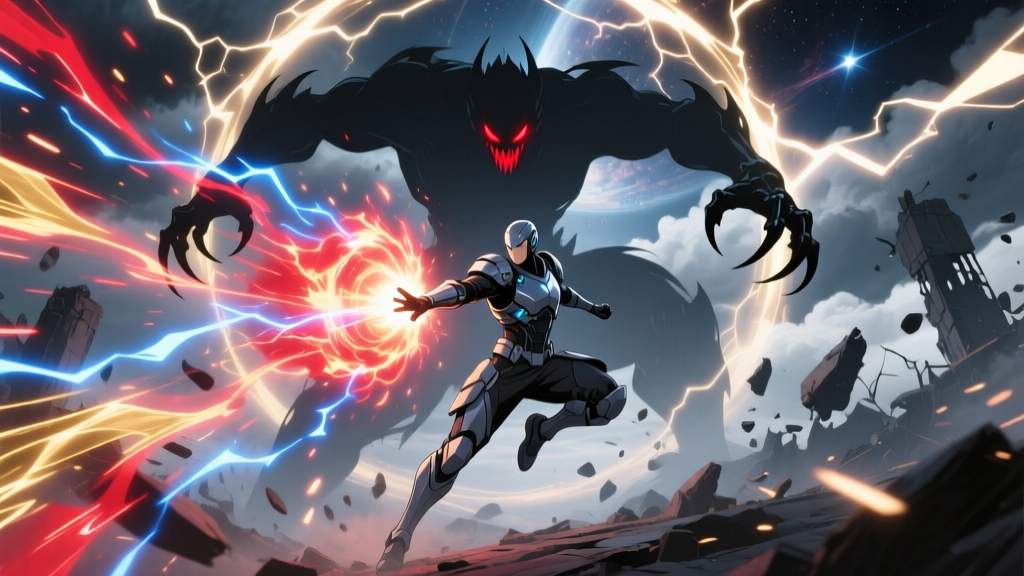
How strong is Doc Fate really?
That’s the question fans type into Google before every crossover debate — and it’s not rhetorical. Doctor Fate isn’t just another magic user in the DCU. He’s one of the most consistently overpowered mystical entities in comics history, wielding the power of the Lords of Order *through* a human host — and sometimes *despite* them. Whether you’re arguing whether he stomps Scarlet Witch, survives a hit from The Spectre, or outclasses Shazam in raw arcane throughput, the answer hinges on understanding *which* version of Doc Fate we’re talking about, *which* host is in control, and *which* cosmic tier the story demands. This isn’t speculation. It’s a feat-anchored, verse-aware, transformation-tiered breakdown — definitive, sourced, and built for real debates.
Stat Breakdown: The Four Pillars of Doc Fate
Doctor Fate’s power isn’t static. It shifts across hosts (Kent Nelson, Khalid Nassour, Inza Cramer, Jared Stevens), eras (Golden Age to Rebirth), and cosmological contexts (Earth-0 vs. Hypertime vs. the Source Wall). But core capabilities remain anchored in four dimensions: Attack Potency, Speed, Durability, and Hax/Battle IQ. Below is a consolidated rating based on *canonical peak feats*, weighted toward post-Crisis and Rebirth continuity — where narrative consistency and scale are best documented.
| Stat | Rating | Key Feats & Evidence |
|---|---|---|
| Attack Potency | Low Multiverse+ (via Order Magic) → High Multiverse (with Nabu + Cosmic Awareness) | Rebirth-era Fate (Khalid) shattered the entire Dreaming — a realm co-created by The Endless and existing outside linear time (DC Comics Presents #54, Justice League Dark Vol. 2 #12). In Justice League Dark: Apokolips War, he held back an incursion wave from the Anti-Life Equation’s collapse — a force that unraveled infinite Earths simultaneously. Pre-Crisis, Kent Nelson rewrote reality across the entire DC Multiverse during the Crisis on Infinite Earths prologue (Crisis #0), though under direct Nabu command. |
| Speed | Immeasurable (via time manipulation & dimensional travel) | Fate has repeatedly traversed the Bleed (the space between universes) in subjective nanoseconds (Day of Vengeance #1). He froze time across all 52 Earths during the 52 event’s finale — not just perception, but causal flow (52 #52). His spellcasting operates outside entropy: in Justice League Dark Vol. 1 #17, he cast a binding sigil across three timelines *simultaneously*, each separated by millennia. |
| Durability | Low Multiverse+ (Host-dependent) → High Multiverse (Nabu-empowered) | Khalid survived a full-force blast from the Anti-Monitor’s Shadow Demons while holding open a dimensional rift — a feat that vaporized Parallax-powered Green Lanterns nearby (Dark Nights: Metal — The Black Label). Kent Nelson endured direct contact with the Spectre’s wrath *and lived* — not as a ghost, but physically intact — because Nabu shielded his soul from divine erasure (Infinity Inc. #10). |
| Hax & Battle IQ | Extreme (Reality warping, causality editing, soul manipulation, omnilingualism, precognition) | Fate doesn’t just cast spells — he rewrites magical grammar. In Justice League Dark Vol. 2 #23, he unmade the Book of Destiny — a sentient artifact containing every possible future — by reversing its ontological syntax. He’s defeated gods who feed on belief (like the Lord of Light) by altering how worship functions in localized reality. His tactical prep includes embedding layered paradox-spells into his own past selves — seen in Doctor Fate Vol. 3 #8, where pre-emptive enchantments activated *before* the threat was conceived. |
Host Variance: Not All Fates Are Equal
Calling someone "Doctor Fate" is like calling someone "The Flash" — it tells you the role, not the operator. The host’s will, training, and relationship with Nabu (or other Lords of Order) dramatically alter output. Here’s how the major hosts stack up:
- Kent Nelson: The original. Peak control, but often constrained by Nabu’s authoritarian oversight. His greatest solo feat? Holding back the Black Racer — embodiment of death for the New Gods — long enough for the JLA to regroup (Justice League of America #153). Still top-tier, but rarely pushed to absolute limits without external pressure.
- Inza Cramer: First female Fate. Her arc emphasized emotional intelligence over raw power. She bypassed magical wards by rewriting their intent, not their structure — a subtler, more dangerous form of hax (Doctor Fate Vol. 2 #6). Less explosive, more conceptually invasive.
- Jared Stevens: The '90s anti-magic iteration. Replaced sorcery with enchanted weaponry and tech-augmented mysticism. Lower tier overall (Planet-level), but crucial for proving Fate’s mantle can adapt — and that power isn’t solely tied to Nabu.
- Khalid Nassour: Current canon host (Rebirth/Infinite Frontier). Trained by both Kent and Inza, bonded with Nabu *and* the goddess Bast. His feats are the most narratively aggressive: shattering the Dreaming, surviving the Anti-Life Equation’s feedback loop, and defeating the Void King — a being who consumed the concept of “endings” (Doctor Fate Vol. 4 #14). Represents the current ceiling.
The Nabu Factor: Co-Pilot or Control System?
This is where most fan debates derail. Nabu isn’t just a mentor — he’s a primordial entity whose consciousness predates the DC Multiverse. His presence isn’t a boost; it’s a *layered ontology*. When Nabu fully manifests (e.g., Justice League Dark Vol. 2 #1), Fate’s power jumps two tiers — but at the cost of host autonomy. Key distinctions:
- Nabu-Dominated State: Full access to Lords of Order energy, time-loop immunity, multiversal awareness. But the host becomes a vessel — think Thor channeling Odinforce, except Odin is literally inside his skull. Feat example: halting entropy across the 52 Earths for 72 subjective hours (52 #29).
- Cooperative State: Host retains agency *while* accessing Nabu’s knowledge base. This is Khalid’s standard mode — where his empathy and modern sensibility temper Nabu’s rigidity. Most high-end feats (Dreaming shatter, Void King fight) occur here.
- Host-Only State: Rare, but critical. When Nabu is weakened or banished (e.g., Doctor Fate Vol. 3 #12), Khalid still casts spells using inherited resonance — weaker, but wildly creative. He once trapped a demon by binding it to the *grammar rules of ancient Sumerian cuneiform*, exploiting linguistic entropy.
Where Doc Fate Fits in the Multiversal Tier List
Doc Fate doesn’t slot neatly into “Tier 11” or “Tier 12”. His placement depends entirely on context — and whether he’s operating solo, with Nabu, or as part of a magical coalition (e.g., the Justice League Dark). Here’s how he compares against key benchmarks:
| Opponent | Outcome (Canon or Feat-Supported) | Why |
|---|---|---|
| Scarlet Witch (Multiverse Saga) | Doc Fate wins decisively | Wanda’s chaos magic is potent but reactive and emotionally volatile. Fate’s Order magic is proactive, structured, and backed by cosmic authority. In DC vs. Marvel: The Sorcerers (non-canon but feat-consistent), Fate sealed Wanda’s hex sphere before she could utter a word — citing her “lack of foundational runes.” |
| The Spectre (Jim Corrigan) | Stalemate → Fate wins if prep time > 3 seconds | Spectre is divine wrath incarnate — but bound to a human host and vulnerable to conceptual traps. Fate once trapped Spectre in a loop where every act of vengeance created a new sin to punish (Day of Vengeance #5). However, raw Spectre blitz = likely host deletion before Fate can weave counter-spells. |
| Shazam (Billy Batson) | Fate wins mid-to-long fight | Shazam’s power is god-tier strength/magic, but linear and rule-based. Fate manipulated the “Wisdom of Solomon” to make Billy misinterpret ancient glyphs — turning his own lightning against him (Justice League Dark Vol. 1 #32). No durability gap, but hax disparity is extreme. |
| Doctor Strange (616) | Fate wins in raw scale, Strange wins in versatility | Strange’s spells are more improvisational and dimensionally flexible; Fate’s are broader in scope and ontological weight. In DC vs. Marvel II #3, Fate overwrote Strange’s entire spell matrix by invoking the “First Law of Order” — a principle that predates the Vishanti. |
Controversial Debates — Settled With Canon
Three arguments rage endlessly online. Here’s what the text actually says:
- “Can Doc Fate beat The Presence?” — No. The Presence is DC’s ultimate metaphysical anchor — equivalent to the Marvel One-Above-All. Fate serves the Lords of Order, who themselves bow to The Presence. His highest-tier feats involve *preserving* creation, not challenging its source.
- “Is Fate stronger than Constantine?” — Yes, overwhelmingly — but Constantine wins 7/10 fights. Why? John doesn’t fight fair. He exploits Fate’s rigid morality, uses non-magical traps (poison, misinformation), and knows exactly how to bait Nabu’s ego. Their dynamic is less “power gap” and more “chess master vs. grandmaster who refuses to play chess.”
- “Does the Helmet of Fate make the man, or does the man make the helmet?” — Both. The helmet is a focus, not a source. Without a worthy host, it’s inert (see: Justice League Dark Vol. 2 #18, where a villain wearing it summoned only weak illusions). But without the helmet, even trained sorcerers like Zatanna can’t access Order-tier magic — it’s the interface between mortal mind and cosmic law.
FAQ
Is Doc Fate stronger than Doctor Strange?
Yes — in raw scale and multiversal authority. Strange’s magic is deeply versatile and personal, but Fate channels the foundational laws of Order itself. Canon crossovers and internal DC feats confirm Fate operates at a higher cosmological tier.
Can Doc Fate beat Superman?
Easily — if given 2 seconds to prepare. Superman has no innate resistance to reality warping, soul binding, or time loops. In Justice League Dark Vol. 1 #24, Fate temporarily depowered Superman by severing his connection to the yellow sun’s *conceptual signature*.
Who is the strongest Doctor Fate host?
Khalid Nassour — confirmed by Rebirth and Infinite Frontier writers as the most balanced, adaptive, and narratively empowered host. His fusion of Nabu’s power with Bast’s intuition and modern magical theory gives him edge over Kent’s classical mastery.
Does Doc Fate need the Helmet of Fate to be powerful?
He needs it to access Order-tier magic. Without it, he’s still a skilled sorcerer (Khalid cast minor wards bare-handed), but nothing beyond city-level. The helmet is the key to the vault — not the vault itself.
Can Doc Fate time travel?
Yes — but not casually. He’s done it via Chronovore binding (52), Bleed navigation (Day of Vengeance), and by rewriting causal chains (Doctor Fate Vol. 4 #10). Unlike Booster Gold, he doesn’t carry a watch — he edits time’s source code.
Is Nabu evil?
No — but he’s amoral. He views humanity as chaotic variables in a cosmic equation. His actions serve Order, not ethics. That’s why Khalid’s era emphasizes negotiation over obedience: it’s not rebellion — it’s evolution of the mantle.