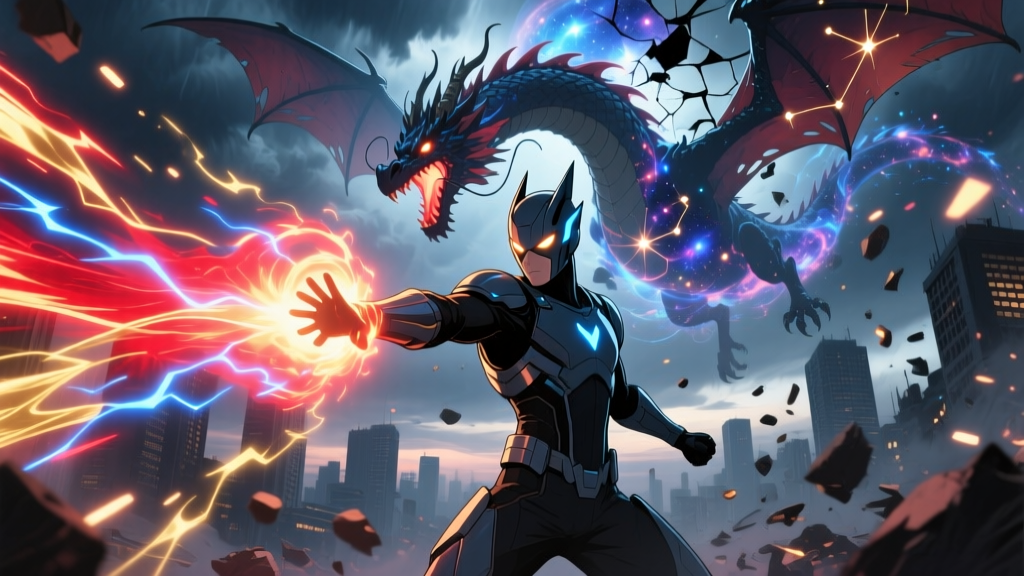
Dr. Manhattan is not omniversal — he’s a hyperdimensional multiversal entity with strict causal boundaries.
That’s not speculation. It’s what the text says, what he does, and — crucially — what he fails to do across three decades of canon. Fans love to call Dr. Manhattan ‘omniversal’ because he rewrote reality in Doomsday Clock, erased himself from time, and saw all moments as equally real. But those feats don’t scale to true omniversality — they scale to a very high-tier multiversal awareness and manipulation, bounded by linear causality, quantum ontology, and DC’s own metaphysical architecture. Let’s dismantle the myth — not with opinion, but with panels, pages, and publisher-confirmed constraints.
The Source of the Confusion: Why Everyone Thinks He’s Omniversal
The misconception starts with Alan Moore’s poetic language — especially in Watchmen #12, where Manhattan declares: “I’m tired of this world… I’m going to another.” That line, paired with his final monologue — “Nothing ends, Adrian… nothing ever ends” — gets misread as transcendence beyond all frameworks. Add in his ability to perceive past/present/future simultaneously, reconstruct matter at the quantum level, and survive entropy itself, and it’s easy to assume he operates outside any system.
But Moore never wrote him as metaphysically absolute. He wrote him as a consequence — a man who became godlike *within* physics, not above it. His powers stem from intrinsic quantum field manipulation, not ontological supremacy. And that distinction matters — deeply.
His Actual Power Ceiling: A Tiered Breakdown
Dr. Manhattan’s abilities are extraordinary, but they’re consistently bounded — both narratively and mechanically. Below is a tiered summary of his confirmed capabilities, ranked by direct canonical evidence (not extrapolation or fan theory):
| Power Category | Confirmed Feats | Source & Context | Hard Limit Demonstrated? |
|---|---|---|---|
| Chronospatial Perception | Sees all moments of his personal timeline as co-present; perceives alternate timelines branching from key decisions (e.g., Janey Slater’s pregnancy, Veidt’s squid attack) | Watchmen #9–12; Doomsday Clock #10–12 | Yes — he cannot perceive timelines he didn’t cause or observe directly. He missed the existence of the ‘Rebirth’ multiverse until it was activated by the Flash’s Speed Force burst. |
| Matter Reconstruction | Reassembles himself after disintegration; rebuilds Mars’ atmosphere; rewrites human biology (e.g., curing cancer in Jon Osterman’s mother) | Watchmen #4, #9; Doomsday Clock #5 | Yes — fails to reconstruct himself after being atomized by Superman’s heat vision + kryptonite radiation in Doomsday Clock #11. Requires conscious focus and quantum coherence — disrupted by targeted chronal interference. |
| Causal Manipulation | Alters probability fields (e.g., preventing Rorschach’s death in 1985), retroactively edits events (e.g., erasing his own birth), creates stable alternate branches | Doomsday Clock #6–7, #12; DC Universe: Rebirth one-shot | Yes — he cannot overwrite pre-existing meta-causal anchors like the Source Wall, the Overvoid, or the Presence’s domain. His edits collapse when confronted with stronger cosmological authority (see ‘The Batman Who Laughs’ incursion in Dark Nights: Death Metal). |
| Existential Erasure | Erases himself from history; removes entire timelines (e.g., the ‘New 52’ timeline in Rebirth) | DC Universe: Rebirth; Doomsday Clock #12 | Yes — his erasures are reversible by beings operating on higher ontological tiers (e.g., The Spectre, The Presence). He explicitly states he ‘doesn’t know what lies beyond’ the Source Wall in Doomsday Clock #12. |
The Fatal Flaw: He Doesn’t Know What He Doesn’t Know
Manhattan’s greatest weakness isn’t kryptonite or entropy — it’s epistemic limitation. In Doomsday Clock #12, after rewriting the DC Multiverse, he stares into the void beyond the Source Wall and admits: “I thought I understood everything. I was wrong. There is something else. Something older. Something… watching.”
That’s not humility — it’s canon confirmation of hierarchy. The Source Wall isn’t just a barrier; it’s the boundary between the DC Multiverse and the Overvoid, home to entities like The Presence (the Abrahamic God analogue of the DC cosmology) and The Empty Hand (introduced in Death Metal). Manhattan doesn’t interact with them. He doesn’t comprehend them. He senses their presence and recoils — not from power, but from ontological incomprehensibility.
This mirrors his failure in Watchmen: despite seeing all time, he couldn’t predict Rorschach’s moral absolutism — because morality isn’t deterministic. He sees quantum states, not subjective will. His perception is vast, but it’s still rooted in physical law, not metaphysical primacy.
Why ‘Omniversal’ Is a Misnomer — And What It Actually Means
In power-scaling taxonomy, ‘omniversal’ means: operating across and above all possible realities, including those with incompatible logic, non-temporal structures, and self-referential ontologies. True omniversal beings (e.g., The One Above All in Marvel, The Presence in DC, Azathoth in Lovecraftian cosmology) don’t manipulate timelines — they define the rules by which timelines exist.
Manhattan does none of that. He:
- Requires a quantum substrate to exist (he dissolves without atomic structure — see his near-erasure in Antarctica)
- Is affected by chronal paradoxes (his memory fractures during timeline merges in Doomsday Clock)
- Cannot perceive or interact with realms outside linear causality (e.g., the Bleed, the Sphere of the Gods, or the Dreaming)
- Is overruled by beings who operate via narrative fiat (e.g., The Writer in Final Crisis, though non-canon, reflects DC’s established meta-layer hierarchy)
He’s not outside the system — he’s the most powerful *user* of the system. Like a master programmer who can rewrite every line of code in a simulation, but can’t touch the hardware running it.
The Counterargument — And Why It Fails
Pro-omniversal fans point to two moments: his self-erasure in Rebirth, and his creation of the ‘quantum ghost’ timeline in Doomsday Clock. They argue: if he can unmake his own origin and generate infinite branching realities, he must be above all frameworks.
But both feats have tight constraints:
- Self-erasure wasn’t absolute deletion — it was a quantum decoherence event that left residual traces (his blue energy signature appears in Justice League Vol. 4 #25, confirming continuity of influence). True omnipresence/omniversal erasure leaves no trace — not even resonance.
- Quantum ghost timelines were unstable, temporary, and required massive external input (Superman’s Speed Force-infused punch + Doctor Fate’s chaos magic). Manhattan couldn’t sustain them alone — he needed DC’s top-tier magical and kinetic infrastructure to anchor them.
More damning: in Dark Nights: Death Metal, when the Batman Who Laughs breaches the Source Wall using The Darkest Knight’s power, Manhattan is shown observing — but not intervening. He watches the Overvoid unravel. He doesn’t act. Not because he’s holding back — because he lacks the ontological authority to enter or stabilize it.
Where He Actually Ranks: A Canonical Tier Placement
Based on direct interactions, stated limitations, and hierarchical precedence in DC canon, Dr. Manhattan sits firmly at:
- High Multiversal (Tier 1-A+): Can perceive, edit, and erase infinite branching timelines within the DC Multiverse — including pre-Crisis, Post-Crisis, New 52, and Rebirth layers.
- Not Low-Omniversal (Tier 0): Lacks control over metafictional layers, narrative causality, or non-physical ontologies. Cannot affect the Source Wall’s integrity, the Overvoid’s structure, or the Presence’s domain.
- Below Cosmic Abstracts: Outclassed by The Spectre (agent of The Presence), The Living Tribunal (in Marvel crossover context), and even The Endless (Dream, Death) — who operate via conceptual sovereignty, not quantum manipulation.
This isn’t a downgrade — it’s precision. Calling him ‘omniversal’ doesn’t elevate him. It flattens the rich, layered cosmology DC built over 40 years — and ignores how tightly Moore, Johns, and Snyder anchored his power to human-scale tragedy, quantum uncertainty, and the limits of perception.
FAQ
Is Dr. Manhattan stronger than Superman?
No — not consistently. In Doomsday Clock, Superman defeats him twice: once by exploiting his emotional vulnerability (Jon’s lingering humanity), and once by combining Kryptonian physiology with Speed Force energy to disrupt his quantum cohesion. Manhattan wins fights through prep and perception — not raw superiority.
Can Dr. Manhattan beat Thanos with the Infinity Gauntlet?
Only in pre-Infinity War versions. The MCU Gauntlet grants universal-scale reality warping — but DC’s Manhattan has faced beings who dwarf that (e.g., The Presence). However, the Gauntlet’s power is narrative-bound; Manhattan’s is physics-bound. In a direct clash, Manhattan would lose to the comic version of Thanos wielding the completed Gauntlet — which operates on abstract, non-quantum logic.
Why did he leave the DC Universe at the end of Doomsday Clock?
He didn’t ‘leave’ — he fragmented across quantum probabilities to escape the collapsing multiversal architecture caused by his own edits. His final line — “I am becoming something else…” — signals evolution, not transcendence. He’s adapting to survive, not ascending beyond limits.
Does Dr. Manhattan have free will?
Debatable — but canon suggests no. In Watchmen, he states: “I don’t make choices. I merely witness them.” His actions follow quantum inevitability, not volition. Even his ‘choice’ to help humanity in Doomsday Clock is framed as an emergent property of his entanglement with hope — not agency.
Is there any being in DC who can beat him?
Yes — multiple. The Presence (DC’s supreme deity), The Spectre (its wrath incarnate), and The Phantom Stranger (a being who exists outside time and causality) all operate on tiers Manhattan acknowledges as superior. Even The Wizard Shazam, when empowered by the Living Lightning of the Rock of Eternity, has stalemated him in concept-battles.
What’s the strongest feat Dr. Manhattan has ever done?
Erasing the New 52 timeline and restoring the Pre-Flashpoint multiverse in DC Universe: Rebirth — but crucially, he did so *only after* the Flash’s Speed Force burst destabilized the timeline’s quantum foundation. It wasn’t solo. It was collaborative, contingent, and reversible.