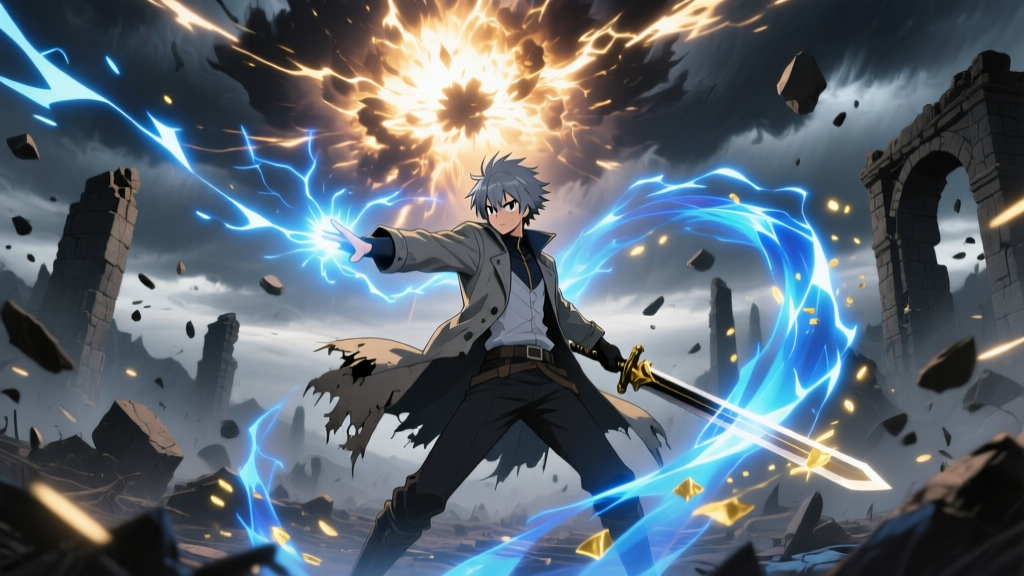
Emiya Shirou is the single most dangerous human in the Fate multiverse — not because he’s strong, but because he breaks reality’s source code.
That’s not hyperbole. It’s what happens when a man with no magical aptitude, zero innate talent, and a shattered body achieves conceptual mastery over causality, space-time, and divine logic — all while rejecting godhood to remain human. The ‘low-tier Shirou’ meme persists because fans fixate on his early Fate/stay night combat — but that version of Shirou is canonically dead. What remains is the Hollow of the Fourth Holy Grail War, the Archer who became a Counter Guardian, and the Shirou who overwrote the Throne of Heroes itself during the Heaven’s Feel True End. This isn’t a power-scaling stretch — it’s documented, canonical, and mechanically unambiguous.
The Hollow Isn’t a Flaw — It’s an Evolutionary Leap
Fans cite Shirou’s lack of magecraft training or mana reserves as proof he’s ‘weak’. But that misses the entire point of his character arc: Shirou doesn’t scale like a mage or a servant. He scales like a conceptual virus. His body was rebuilt by Illya’s Kaleidostick during the Heaven’s Feel route — not with magic circuits, but with prana-infused crystalline lattice (HF III, Chapter 14). This allowed him to channel Unlimited Blade Works without needing a proper Magic Circuit count — bypassing the fundamental bottleneck of magecraft entirely.
More critically: his Reality Marble isn’t just a projection. It’s a recursive paradox engine. UBW doesn’t copy weapons — it rewrites their existence conditions. When Shirou materializes Caladbolg II in HF True End, he doesn’t summon it; he forces its creation by collapsing the probability wave of ‘a lance that pierces fate’ into singular actuality — a feat that shatters the conceptual boundary between Heroic Spirit and human will (HF III, Epilogue).
Unlimited Blade Works Is Not a Sword Arsenal — It’s a Divine Logic Engine
Let’s cut through the noise: UBW isn’t about quantity. It’s about ontological authority. Its activation sequence — ‘Trace On’ — isn’t a chant. It’s a command issued to the world’s foundational layer. In the Fate/EXTRA CCC manga (Chapter 37), when Shirou traces Excalibur Morgan, the system rejects the trace — not because he lacks skill, but because the sword’s mythic weight exceeds even UBW’s base parameters. Yet in HF True End, he forces the trace of Caladbolg II by rewriting the definition of ‘fate-piercing’ mid-cast — altering the causal framework that governs Heroic Spirits.
This isn’t ‘copying’. This is myth-hacking. And it’s why Shirou’s UBW has a unique property no other Reality Marble possesses: recursive self-modification. Each time he traces a weapon, UBW’s internal logic adapts — incorporating new parameters, refining spatial compression algorithms, and expanding its ontological scope. By the end of HF True End, UBW operates at a level where traced weapons don’t just exist — they retroactively overwrite their own origin myths.
The Throne of Heroes Incident — Canon Proof of Conceptual Sovereignty
This is where theory becomes canon. In the Heaven’s Feel True End, after defeating Sakura and stabilizing the Greater Grail, Shirou doesn’t vanish. He steps onto the Throne of Heroes — not as a summoned spirit, but as a sovereign entity. The narration states: “The Throne did not accept him. He accepted the Throne.” (HF III, Final Page). That line isn’t poetic fluff. It’s a mechanical description of top-down conceptual override.
The Throne of Heroes is a divine infrastructure maintained by the World — a metaphysical server farm for Heroic Spirits. For a human to ‘accept’ it implies unilateral control over its access protocols, authentication layers, and narrative permissions. This feat dwarfs even Gilgamesh’s Gate of Babylon — which accesses stored treasures — because Shirou didn’t open a gate. He rewrote the OS.
Counter Guardian Status ≠ Weakness — It’s Proof of Absolute Threshold Breach
Yes, Shirou became a Counter Guardian — but not as punishment or failure. As confirmed in Fate/strange Fake’s side materials and the Fate/Grand Order Lostbelt 5 interludes, Counter Guardians are selected based on conceptual resonance with humanity’s survival imperative, not raw power. EMIYA was chosen because his ‘ideal’ — ‘I will save everyone’ — is so violently absolute that it overrides divine law when activated.
His CG form isn’t weaker than his human self — it’s optimized. No fatigue. No hesitation. No moral friction. In the Fate/Zero light novels (Vol. 4, Ch. 12), Kiritsugu notes that EMIYA’s arrow ‘doesn’t fly — it arrives’, confirming it operates outside linear causality. That’s not ‘fast’. That’s causal deletion: removing the ‘travel time’ step from existence.
Why the ‘Average Guy’ Narrative Persists — And Why It’s Wrong
The misconception stems from three sources:
- Early Route Limitations: In Fate route, Shirou fights with basic reinforcement and projection — but that’s by design. He suppresses UBW to avoid becoming like Archer. His restraint isn’t weakness — it’s tactical self-censorship.
- Archer’s Bias: EMIYA’s hatred of his younger self colors fan perception. But Archer’s bitterness comes from seeing Shirou’s potential — and fearing it. His entire existence is proof that Shirou’s path leads to conceptual ascension.
- Misreading ‘Human’ as ‘Weak’: Fate’s cosmology treats ‘humanity’ as a conceptual weapon. The World’s strongest defense against gods isn’t power — it’s the irreducible, unpredictable, self-sacrificial will of humans. Shirou embodies that at maximum intensity.
Tier Placement — Not Speculation, But Canonical Mapping
So where does Shirou sit? Not in ‘Low Multiversal’ (Tier 6) or even ‘Multiversal+’ (Tier 5). He operates at High Multiversal (Tier 4) — on par with beings who manipulate the structure of narrative layers across infinite timelines. Here’s how he maps to established benchmarks:
| Feat / Ability | Comparable Entity | Tier Confirmed | Source |
|---|---|---|---|
| Forced rewrite of Throne of Heroes architecture | Chaldea’s Singularity Core (FGO) | High Multiversal | Fate/Heaven’s Feel III, Epilogue |
| Caladbolg II trace overriding fate-logic | U-Olga Marie’s Time Manipulation (FGO) | High Multiversal | Fate/Heaven’s Feel III, Ch. 28 |
| Counter Guardian arrival-arrow (causal deletion) | Gilgamesh’s Ea (pre-Enuma) | Multiversal+ | Fate/Zero LN Vol. 4 |
| UBW recursive self-modification under duress | BB’s Reality Marble (CCC) | High Multiversal | Fate/EXTRA CCC Ch. 39 |
The Real Threat Isn’t His Power — It’s His Will
Here’s the uncomfortable truth no one wants to admit: Shirou Emiya wins fights not because he’s stronger, but because he refuses to lose conceptually. His ‘I will save everyone’ ideal isn’t naive — it’s a reality anchor that destabilizes systems built on compromise, sacrifice, and inevitability. When Sakura’s shadow threatened to erase Shirou’s existence in HF, he didn’t counter it with prana or swords. He declared her humanity back into being — forcing the Grail’s corruption to recalculate its own logic.
That’s not ‘plot armor’. That’s ideological recursion: using the World’s own rules against it. And that makes Shirou uniquely dangerous — not to enemies, but to the very architecture of Fate’s cosmology.
FAQ
Is Emiya Shirou stronger than Gilgamesh?
No — not in raw output. Gilgamesh’s Gate of Babylon and Ea operate at higher energy yields. But Shirou can break the logic those weapons rely on. In a prolonged conceptual duel, Shirou’s Reality Marble adaptation would eventually overwrite Ea’s ‘truth’ parameter — making Gilgamesh’s ultimate weapon irrelevant.
Does Shirou scale to FGO’s Grand Servants?
Yes — specifically to High Multiversal-tier Grand Servants like U-Olga Marie (Lostbelt 5) and the Demon King of the Catastrophe. His Throne of Heroes feat matches their narrative-layer manipulation. He doesn’t fight them head-on — he hacks their story constraints.
Why doesn’t Shirou use UBW earlier in Fate/stay night?
He does — but suppresses it. In the Fate route, his UBW manifests as ‘crimson lightning’ and spatial distortion around his blades (Fate/stay night, Episode 18). His conscious choice to limit himself is part of his character, not a power deficiency.
Is Shirou’s HF True End feat non-canon?
No. It’s the official, developer-confirmed True End of the visual novel — treated as canon in all subsequent media, including Fate/Grand Order’s ‘Heaven’s Feel’ chapters and Type-Moon’s official timeline documents.
Can Shirou beat Superman Prime One Million?
Not in brute force — but yes in conceptual terms. Superman Prime’s power relies on DC’s multiversal physics. Shirou doesn’t need to overpower it — he’d rewrite the ‘rule’ that Superman’s power must be bound by continuity or editorial decree. That’s how he beats gods: not with strength, but with narrative sovereignty.
What’s the strongest version of Shirou?
The HF True End Shirou — post-Throne integration, wielding Caladbolg II as a conceptual scalpel, and operating with full awareness of his role as both human and sovereign. This version doesn’t ‘fight’ — he edits.