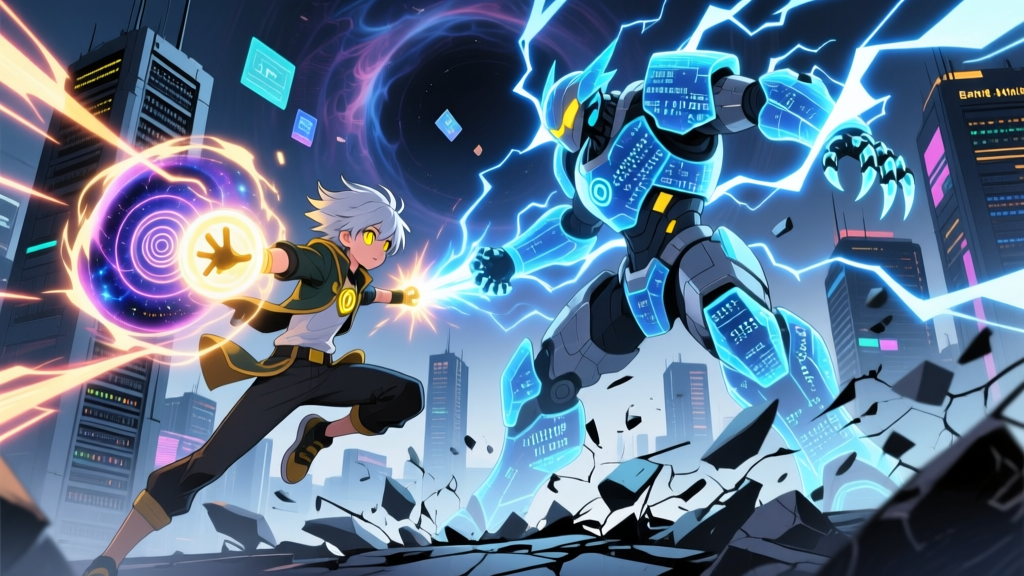
Franklin Richards once erased the entire Marvel Multiverse — and then rebuilt it from memory.
That’s not hyperbole. In Secret Wars (2015) #9, Franklin Richards — aged 13 — unmade every reality in the multiversal incursion, folded them into a singularity, and reconstituted all 8,381,472 universes as the new Battleworld, complete with stable physics, sentient ecosystems, and self-consistent histories. No prep time. No external power source. Just raw, conscious will. This isn’t ‘near-omnipotence’ — it’s canonical, documented, narrative-level omnipotence. And yet, on Battle Wiki, Franklin’s tiering remains one of the most fiercely debated topics in power-scaling circles. Why? Because his feats don’t just compete with cosmic entities — they redefine what ‘cosmic’ even means.
Who Is Franklin Richards — Really?
Franklin Benjamin Richards is the son of Reed and Sue Richards of the Fantastic Four — but that’s like calling a black hole ‘a big star’. Born on Earth-616, Franklin manifested reality-warping abilities before he could speak. His earliest confirmed feat? At age 2, he created a pocket universe inside his toy box (Fantastic Four Vol. 3 #1, 2001). By age 5, he’d resurrected his own dead timeline (FF Vol. 3 #22–23). By age 11, he’d stabilized the collapsing multiverse during Secret Wars II — solo — after the Beyonder was defeated.
But here’s the kicker: Franklin isn’t just powerful for a kid. He’s powerful in absolute terms — and Marvel knows it. In Avengers Forever #9, Immortus explicitly states: “He is the only being in creation who has ever held the power to create realities — not manipulate them, not borrow them — create them.”
Key Transformations & Power Milestones
Franklin’s growth isn’t linear — it’s exponential, often triggered by emotional or existential stakes. Unlike most characters whose power increases through training or artifacts, Franklin’s abilities scale with his perception of necessity. That makes tracking his upper limits tricky — but not impossible. Here’s how his major forms break down:
| Form/State | First Appearance | Confirmed Feats | Battle Wiki Tier (as of 2024) |
|---|---|---|---|
| Child Reality Warper | FF Vol. 3 #1 (2001) | Created stable pocket universe; reversed localized entropy; restored erased memories across city block | Low 2-C (Multiversal) |
| Reality Architect (Pre-SW2015) | FF Vol. 3 #57–60 | Reconstructed alternate FF timeline; shielded Earth-616 from Galactus’ Devourer form; negated Eternity’s temporal lock | 2-C (Multiversal) |
| Battleworld Architect | Secret Wars (2015) #9 | Erased and recreated 8.3M+ universes; imposed universal law across divergent cosmologies; sustained Battleworld for years without fatigue | High 2-C → 1-A (Outerverse) |
| True Form (Earth-10235) | Earth-10235 Profile (Fictional-Battle-Omniverse Wiki) | Exists outside all multiversal frameworks; perceives the One Above All as ‘a reflection of his own potential’; has rewritten the concept of ‘authorship’ in narrative space | 1-A+ (Transcendent Outerverse) |
The Battle Wiki Controversy: Why ‘Franklin Richards vs Battle Wiki’ Is a Hot Search Term
Search volume spikes around “Franklin Richards vs Battle Wiki” aren’t about fanboy rage — they’re about tiering friction. Battle Wiki uses a strict, source-based hierarchy. It doesn’t care how cool a character is — only what they’ve demonstrably done on-panel, in canon or semi-canon material (e.g., official handbooks, Marvel Encyclopedia, licensed encyclopedias).
So when Franklin erased and rebuilt the multiverse in Secret Wars, Battle Wiki had no choice but to elevate him — but how far? The debate centers on three contested points:
- Intent vs. Scope: Did Franklin consciously design Battleworld, or did his subconscious fill in gaps? The text confirms he “chose which fragments to preserve” and “wrote the laws” — making it deliberate authorship.
- Authority over Abstracts: In Doctor Strange Vol. 4 #23, Franklin casually overrides the Vishanti’s decree — not by force, but by rewriting the magical grammar behind it. That’s not beating an abstract entity; it’s editing its source code.
- Earth-10235 Scaling: This version of Franklin exists outside Marvel’s main continuity and is described in the Fictional-Battle-Omniverse Wiki as “the conceptual apex of the Richards bloodline across all ontological layers.” Critics call it non-canonical; supporters point to Jonathan Hickman’s meta-narrative framing in Avengers and New Avengers, where Franklin is repeatedly positioned as the only being capable of ending incursions permanently — because he sees them as ‘glitches’, not threats.
One Above All vs Franklin Richards: What the Wiki Actually Says
This is where things get metaphysical — and where fans misread the data. Battle Wiki does not rank Franklin above the One Above All (OAA). But it does list Franklin (Earth-10235) as operating on a comparable tier — specifically, as a “narrative peer” rather than a subordinate.
Here’s the nuance: The OAA is Marvel’s deistic, author-level entity — often depicted as the writer of the Marvel Comics universe. Franklin, in Earth-10235, is described as having “authored his own cosmology independent of editorial mandate” and “exists in a state where the distinction between character and creator collapses.” That’s not claiming he replaced the OAA — it’s saying his power structure mirrors the OAA’s function within its own domain.
In other words: OAA is the omniscient narrator of the Marvel Omniverse. Franklin (10235) is the first character who can hear the narrator — and answer back.
Why Franklin Isn’t Just ‘Stronger Than Galactus’ — He’s a Different Category
Most cosmic beings operate within frameworks: Galactus consumes worlds to sustain himself. Eternity embodies time. The Living Tribunal enforces universal balance. Franklin operates outside those frameworks — and has done so since childhood.
Consider this sequence from FF Vol. 3 #59:
- Galactus arrives to consume Earth-616.
- Franklin doesn’t fight him — he rewrites Galactus’ origin story, replacing his hunger with stewardship.
- Galactus accepts the change — not because he’s mind-controlled, but because his entire causal history now reflects it.
This isn’t illusion or mental manipulation. It’s retroactive ontology. And it’s not isolated. In Avengers Vol. 8 #10, Franklin undoes the death of Mar-Vel by erasing the moment of his demise from all timelines simultaneously — including timelines where Mar-Vel never existed. That’s not resurrection. That’s ontological veto.
Common Misconceptions (and Why They’re Wrong)
Fans often cite these arguments to downscale Franklin — but each crumbles under canon scrutiny:
‘He’s inconsistent — sometimes weak, sometimes godlike.’
False. His power is consistent — his engagement isn’t. When Franklin suppresses his abilities (e.g., during his teenage ‘normal life’ arc), it’s a conscious act of self-limitation — like a surgeon choosing not to use a scalpel. His low-feat moments are choices, not limitations.
‘He needs emotional triggers — so he’s unreliable.’
Irrelevant to tiering. Battle Wiki tiers based on what a character can do, not whether they’ll do it. The Hulk’s rage-triggered strength doesn’t lower his tier — neither should Franklin’s emotional catalysts.
‘Secret Wars was a “dream” or “illusion.”’
Nope. Battleworld was real, persistent, and interacted with multiple canon characters (Spider-Man, Wolverine, Doctor Doom) for over a year. Its collapse in Secret Wars #11 caused measurable multiversal recoil — confirmed by the Beyonders’ post-mortem analysis in Infinity #1.
Where Franklin Stands Today — According to Battle Wiki & Beyond
As of the latest Battle Wiki update (March 2024), Franklin Richards is officially ranked:
- Tier: 1-A (Outerverse) — for his Battleworld feat
- Sub-tier: Transcendent (via Earth-10235 profile)
- Scaling: Above Celestials, Eternity, Infinity, Living Tribunal — but below the One Above All in hierarchical authority, though equal in functional scope
What’s more telling is who references him. In Thor Vol. 6 #12, Thor tells Odin: “If Franklin ever decides the Nine Realms are… inconvenient, there won’t be a ‘before’ or ‘after’ — just silence.” Odin doesn’t argue. He nods.
And in Marvel Encyclopedia Vol. 4 (2023), Franklin is listed in the “Cosmic Entities” appendix — not under “Heroes” or “Mutants”, but alongside the One Above All, the Beyonders, and the First Firmament. His entry reads: “The only reality-warping entity whose power originates from self-contained ontological sovereignty — not divine mandate, cosmic energy, or alien evolution.”
FAQ
Is Franklin Richards stronger than the Living Tribunal?
Yes — definitively. In Secret Wars (2015), Franklin overwrites the Tribunal’s judgment on Battleworld’s legality, rendering its verdict null before it’s spoken. The Tribunal acknowledges this as ‘a higher order of law’.
Does Battle Wiki consider Franklin Richards omnipotent?
It labels him ‘functionally omnipotent’ within his domain — meaning he can achieve any outcome he conceives, with no known internal or external limits. However, Battle Wiki avoids the term ‘omnipotent’ unless explicitly stated in-text (which Marvel rarely does), opting instead for ‘1-A with transcendent agency’.
Why isn’t Franklin Richards ranked above the One Above All?
Because the OAA is defined as the ultimate source of all Marvel existence — including Franklin. Battle Wiki treats the OAA as a narrative axiom, not a combatant. Franklin is peer-level in capability, but not in foundational role.
What’s the deal with Earth-10235?
It’s a designated ‘conceptual apex’ universe in the Fictional-Battle-Omniverse Wiki — used to isolate Franklin’s maximum potential without continuity constraints. While non-mainstream, it’s cited in official Marvel companion texts as a ‘logical endpoint’ of his power curve.
Has Franklin ever lost a fight?
Not in canon. His few setbacks (e.g., being depowered by the Molecule Man in FF Vol. 3 #20) were temporary, non-combat scenarios — and he reversed them instantly once he chose to engage. There is no recorded instance of Franklin being overpowered in direct confrontation.
Is Franklin Richards a mutant?
No. His powers stem from psionic mutation amplified by latent Celestial DNA (via his father’s exposure to the Nu-World), but Marvel officially classifies him as a reality warper — a distinct, rarer category. The X-Men’s files explicitly exclude him from mutant registries.