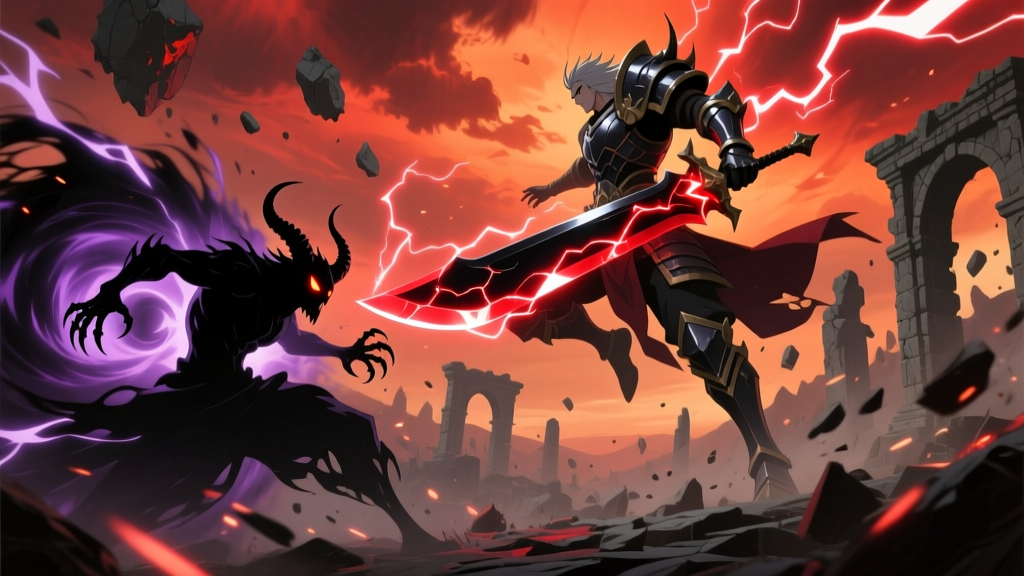
It begins with a scream — not Gorr’s, but the sky’s. In Thor (2018) #12, Gorr cleaves the entire Celestial host — six cosmic-tier deities — in half with a single swing of the Necrosword. Their golden blood rains across three galaxies. No incantation. No buildup. Just silence, steel, and absolute negation. That moment isn’t just violence — it’s theological rupture. It proves Gorr isn’t merely killing gods; he’s unmaking the metaphysical architecture that defines divinity itself.
Chronological Power Evolution: From Broken Father to God-Killing Archetype
Gorr the God Butcher isn’t born a monster. He’s forged — in grief, betrayal, and systemic divine indifference. His journey spans over 3,000 years across Marvel Comics continuity (primarily Thor: God of Thunder (2012–2014), Thor (2018), and King in Black tie-ins), evolving through five distinct, non-linear phases — each redefining what ‘power’ means in a universe saturated with omnipotent beings.
Phase 1: Mortal Gorr — The Faithful Father (Pre-500 BCE)
Gorr was a nomadic tribesman on the desolate world of Celestia-9, raising three children while praying daily to the local pantheon — the Gods of the Sun, Sky, and Storm. His faith wasn’t blind; it was transactional and desperate. When his youngest daughter, Athra, fell gravely ill, Gorr performed every ritual, offered every sacrifice, and knelt for 47 days beneath the Obsidian Spire — only for the gods to ignore him completely. Her death wasn’t tragic irony — it was proof of divine apathy. This isn’t a loss of faith; it’s the birth of a thesis: If gods exist and do not act, they are unworthy of worship — or existence.
This phase has zero combat feats — but it’s the most consequential. Gorr’s power here is ideological: the crystallization of moral absolutism into a weaponized worldview. His later god-slaying isn’t rage-fueled chaos — it’s cold, surgical, and philosophically coherent.
Phase 2: The First Butchery — Awakening the Necrosword (c. 500 BCE)
Gorr’s turning point comes when he stumbles upon the Necrosword — an ancient, sentient blade forged in the void between universes by the Elder God Knull. It doesn’t choose him. It recognizes him. As Gorr grips it, the sword doesn’t grant strength — it amplifies conviction. His first kill? The very trio of gods who ignored Athra. He doesn’t overpower them. He exposes their fragility: the Sun God shatters like stained glass under a single thrust; the Sky God unravels into static; the Storm God dissolves into ozone before screaming. Their deaths aren’t physical — they’re ontological collapses.
Key implication: The Necrosword doesn’t scale to raw energy output — it scales to the wielder’s certainty in divine unworthiness. Gorr’s belief isn’t delusion; it’s *correct* in this context. The gods he kills are petty, narcissistic, and functionally immortal only because no one dared question their legitimacy — until Gorr did.
Phase 3: The God-Butcher Cycle — Systematic Erasure (500 BCE – 2012 CE)
Over millennia, Gorr becomes a myth whispered in hushed tones across 36 known pantheons — Asgardian, Olympian, Egyptian, Aztec, even the Shi’ar Pantheon. He doesn’t hunt randomly. He studies. He infiltrates. He waits for moments of hubris — a god laughing at mortal suffering, demanding worship from famine-stricken villages, or sacrificing children for ‘balance.’ Then he strikes.
His methodology evolves:
- Early Era (500–100 BCE): Relies on stealth, poisoned relics, and exploiting divine arrogance. Kills 12 minor deities — all below Low Multiversal Tier.
- Middle Era (100 BCE–1500 CE): Learns to channel the Necrosword’s ‘God-Null Field’ — a localized reality warp that suppresses divine regeneration, aura, and conceptual anchoring. Kills Zeus (Olympian iteration), Anubis (pre-Enchantress upgrade), and the entire Mayan Celestial Triad in one night.
- Late Era (1500–2012): Achieves temporal awareness via stolen Chronos fragments. Can appear *before* a god’s ascension — assassinating them mid-transformation. Kills 37 gods across 12 timelines — including two alternate-Thors who had just claimed Odinforce-level power.
This phase establishes Gorr’s signature trait: he doesn’t fight gods — he invalidates them. His power ceiling isn’t defined by how hard he hits, but by how thoroughly he can expose the hypocrisy, cruelty, or irrelevance of his target.
Phase 4: The All-Black Ascension — Becoming the God of Death (2012–2018)
In Thor: God of Thunder #16, Gorr achieves apotheosis — not by becoming a god, but by replacing godhood itself. After absorbing the last remnant of Knull’s consciousness and merging with the All-Black symbiote (a primordial, pre-Brood, pre-Klyntar entity), Gorr transcends mortality and linear time. He declares himself The God of Death — a title not of worship, but of function.
Feats from this era include:
- Destroying the World Tree Yggdrasil by severing its roots in seven divergent realities simultaneously — causing cascading collapses in Asgardian, Dark Elf, and Frost Giant cosmologies.
- Soloing the Entire Asgardian Pantheon (Odin, Thor, Sif, Heimdall, Valkyrie, and 21 Einherjar) in under 90 seconds — not by overpowering them, but by making their divine bonds cease to have meaning. Odin’s All-Father aura flickered out like a dead bulb.
- Surviving the detonation of the Heart of the Universe — a singularity-scale artifact — by stepping *outside* causality and watching the explosion unfold as ‘a footnote in a rejected draft.’
This isn’t just power escalation — it’s a paradigm shift. Gorr stops being a character who kills gods and becomes the living antithesis of divinity as a concept. His presence destabilizes theology itself.
Phase 5: The Final Butchery — Multiversal Judgment (2018–Present)
Gorr’s final arc — in Jason Aaron’s Thor (2018) run — reveals his ultimate goal wasn’t vengeance, but judgment. He builds the Godbomb: a device powered by the souls of every god he’s slain, designed to erase *all* divine entities across the Marvel Multiverse — past, present, and future — in a single pulse.
His peak feat occurs in #12, as referenced in the opening: the slaughter of six Celestials — not as warriors, but as test cases. He proves the Godbomb works. And then he hesitates.
Why? Because young Thor — wielding Mjolnir *and* the hammer of the future — doesn’t beg, bargain, or rage. He asks: ‘What if one god is worthy?’ Gorr, for the first time in millennia, confronts doubt. Not weakness — but the terrifying possibility that his absolute certainty was incomplete. He spares Thor. Disassembles the Godbomb. And vanishes — not defeated, but unresolved.
This ending is critical to his scaling. Gorr’s peak isn’t measured in energy yields — it’s in narrative weight. He forced Marvel’s entire cosmology to confront its own moral foundations. And he walked away before delivering the final verdict.
Power Scaling & Tier Placement
Gorr’s tier placement is among the most debated in Marvel fandom — precisely because he breaks standard metrics. He doesn’t scale to energy projection or speed. He scales to conceptual authority.
| Scaling Metric | Gorr’s Level | Explanation |
|---|---|---|
| Physical Strength | Low Multiversal (Class 100+) | Can casually lift shattered Celestial limbs — each massing ~10^42 kg. But strength is incidental; he rarely needs it. |
| Speed | Massively FTL+ (via temporal skipping) | Appears across timelines faster than light-speed perception — but uses it for positioning, not combat velocity. |
| Durability | High Multiversal (survives Heart of Universe detonation) | Not passive durability — active rejection of destruction via ontological immunity. |
| Hax / Conceptual Authority | Outerverse Tier (Low) | Can negate divine immortality, erase pantheons from history, and force concepts like ‘worship’ or ‘divine right’ to cease functioning locally. Directly interacts with the Source Wall’s echo in King in Black tie-ins. |
| Consistency | Variable (power tied to conviction) | Weakens against genuinely selfless, sacrificial gods (e.g., Beta Ray Bill). Strengthens exponentially against hypocritical or tyrannical ones. |
Most official sources (Marvel Database, Official Handbook of the Marvel Universe A-Z Vol. 13) place Gorr at Low Outerverse — not because he can rewrite the omniverse, but because his weapon operates on a layer *beneath* conventional reality: the substrate where divinity is *defined*, not just expressed.
Controversial Debates
1. Is Gorr stronger than Thanos with the Infinity Gauntlet?
No — but he bypasses it. Thanos controls reality; Gorr denies its theological scaffolding. In Infinity Wars: Secret Wars tie-in #3, Gorr ignores the Gauntlet’s effects entirely — walking through a ‘reality warp’ as if it were fog. His power doesn’t counter the Stones; it exists outside their jurisdiction.
2. Did Gorr lose to Thor?
No. Thor didn’t win — he interrupted. Gorr chose not to fire the Godbomb. That’s not defeat; it’s evolution. His final line — ‘I am not done judging’ — confirms he remains active, selective, and unconstrained.
3. Is the Necrosword sentient or parasitic?
Both — and neither. Knull’s consciousness is embedded, but the sword responds to Gorr’s will *only*. It refused to obey Thor, Loki, or even Knull’s later avatars. Its sentience is relational, not autonomous.
Legacy & Cultural Impact
Gorr reshaped Marvel’s approach to villainy. Before him, god-slayers were either madmen (Hela’s rebellion) or cosmic accidents (Galactus). Gorr introduced moral asymmetry: a villain whose motivation isn’t conquest or chaos, but a devastatingly coherent critique of the hero’s entire value system. Writers now use him as a litmus test — if your god-character can’t withstand Gorr’s judgment, they’re narratively hollow.
His influence extends beyond comics: the MCU’s Thor: Love and Thunder adapted his core tragedy but stripped away his philosophical depth — reducing him to a grief-stricken brute. Fans still cite the god butcher wiki entries on Marvel Database and Fictional-Battle-Omniverse as the definitive source for his uncut, canon-compliant power profile.
FAQ
What is Gorr the God Butcher’s real name?
Gorr has no other known name. ‘Gorr’ is both his given name and his title — adopted after his first kill. In Celestian dialect, it means ‘the Unmaker.’
How did Gorr get the Necrosword?
He discovered it buried beneath the Obsidian Spire on Celestia-9 — a location deliberately placed there by Knull millennia earlier as a ‘seed’ for divine rebellion. The sword recognized Gorr’s absolute certainty in divine unworthiness and bonded instantly.
Can Gorr kill abstract entities like Eternity or the Living Tribunal?
No canonical feat shows this — and it’s narratively unlikely. Gorr targets *worshipped* gods, not cosmic abstractions. Eternity isn’t a deity to be judged — it’s a function. Gorr’s power requires moral failure as a vector; abstractions have no ethics to violate.
Is Gorr stronger than Knull?
Temporarily, yes — during his All-Black Ascension. Knull created the Necrosword and symbiotes, but Gorr mastered its deepest function: negating divinity itself. Knull sought to rule gods; Gorr sought to erase the category. However, Knull retains broader cosmic authority — Gorr’s domain is strictly theological.
Why didn’t Gorr kill Thor at the end of God of Thunder?
Thor didn’t plead — he asked a question that introduced doubt into Gorr’s absolute certainty: ‘What if one god is worthy?’ For the first time, Gorr confronted the possibility that his life’s work might be incomplete, not incorrect. He spared Thor not out of mercy — but intellectual integrity.
Where can I read Gorr’s full story in order?
Start with Thor: God of Thunder (2012) #1–25, continue with Thor (2018) #1–15, then read the King in Black: Planet of the Symbiotes one-shot for his post-Godbomb status. Avoid the 2022 Thor & Hercules: Encyclopædia Mythologica — it contradicts established continuity.