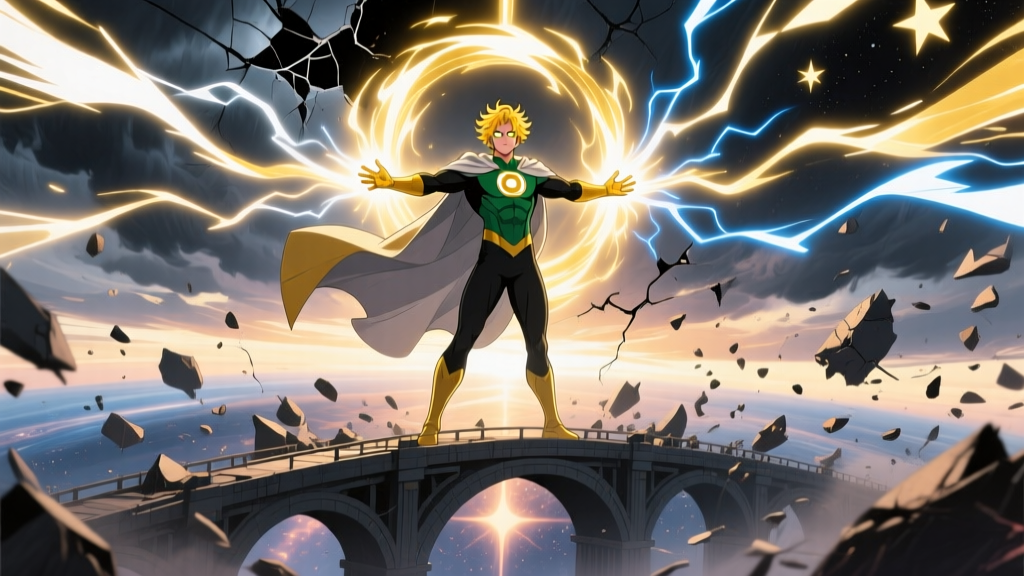
The most common misconception fans have about Hal Jordan is that he’s officially titled or recognized in DC Comics continuity as the ‘God of Light.’ You’ll see it plastered across fan forums, YouTube thumbnails, and even merch—but nowhere in 60+ years of published DC canon does any writer, editor, or in-universe entity bestow that exact title upon him. Not in Green Lantern #1 (1940), not in Emerald Twilight, not in Blackest Night, and certainly not in Geoff Johns’ Green Lantern: Rebirth or Wrath of the First Lantern. It’s a fan-coined epithet—evocative, poetic, and dangerously misleading if taken as literal lore.
Where Did ‘God of Light’ Come From?
The phrase likely originated in the early 2010s as shorthand for Hal’s unprecedented feats during the emotional spectrum saga—especially his role as the living embodiment of willpower, his fusion with the Central Power Battery, and his solo defeat of Parallax *while wearing black rings*. But DC never codified it. In fact, when DC does assign divine titles, they’re precise and loaded: Kyle Rayner is the White Lantern—a title tied to the Life Entity and the White Light of Creation. John Stewart is the Guardian of Earth-23, a designation with multiversal jurisdiction. Hal? He’s consistently called the greatest Green Lantern, the first human Green Lantern, the heart of the Corps—but never ‘God of Light.’
The Real Cosmic Hierarchy: Where Hal Actually Fits
To understand Hal’s true stature, you must map him onto DC’s layered cosmology—not fan-made hierarchies, but the one laid out in The Great Darkness Saga, Final Crisis, Dark Nights: Metal, and Death Metal. DC’s metaphysical ladder doesn’t run from ‘mortal → demigod → god.’ It runs from matter → energy → concept → source.
Hal operates at the conceptual tier—but only as an avatar, not an originator. His power comes from the Central Power Battery on Oa, which draws from the emotional electromagnetic spectrum—a cosmic force shaped by sentient thought across the universe. That spectrum itself was created by the Entities: Ion (Will), Parallax (Fear), Adara (Hope), etc.—primordial beings who predate time and space. Even the Guardians of the Universe are merely custodians, not creators.
| Entity | Emotion Embodied | First Appearance | Hal’s Relationship |
|---|---|---|---|
| Ion | Willpower | Green Lantern Vol. 3 #101 (1998) | Hal became its host twice—temporarily merging with its consciousness, gaining near-omniversal perception, but never controlling or replacing it. |
| Parallax | Fear | Green Lantern Vol. 3 #48 (1994) | Corrupted Hal in Emerald Twilight; later exorcised and imprisoned by Hal himself in Rebirth. |
| Life Entity | Life / White Light | Green Lantern Vol. 4 #50 (2010) | Chose Kyle Rayner as its first White Lantern; Hal stood beside him—but was not selected. |
| Volthoom (The First Lantern) | Entropic Will | Green Lantern Vol. 5 #21 (2013) | Hal defeated him—but only after absorbing the entire emotional spectrum *and* sacrificing his life to reignite the Central Power Battery. |
This table shows something critical: Hal interacts with gods—but he is not one. He’s a conduit. A lightning rod. A soldier who occasionally wields divine-grade weaponry, not a deity who commands the storm.
The ‘God of Light’ Confusion: Why It Stuck
Three key moments fuel the mislabeling—and each has been misinterpreted:
- ‘I am the light!’ (Green Lantern Vol. 3 #176): Hal shouts this while recharging his ring mid-battle against Sinestro. It’s a declaration of identity—not divinity. In context, he’s rejecting fear-based control and reaffirming his will. It’s rhetorical, not theological.
- Hal’s resurrection in Rebirth: After dying in Zero Hour, he returns fused with the green light of will. Fans read ‘reborn as pure will’ as ‘ascended to godhood.’ But the text says he was reintegrated—not transcended. His physiology remained human; his ring just gained new stability.
- The ‘Light of the Universe’ cover motif (2018–2020): DC used radiant halos and solar flares behind Hal on variant covers. Marketing, not mythos. Compare that to actual divine depictions: The Presence appears as infinite golden light *without form*; the Spectre manifests as burning scripture and shattered reality. Hal still casts shadows. He bleeds. He doubts.
What Hal Is: The Living Paradox of Will
DC’s deepest lore treats Hal Jordan not as a god—but as a living paradox. He’s the only being in the DCU who has simultaneously:
• Worn every ring of the emotional spectrum (Green, Yellow, Red, Blue, Indigo, Violet, Orange, Black, White)
• Been possessed by Parallax *and* purified it
• Died and returned without becoming a Black Lantern or Spectre
• Led the Green Lantern Corps *and* disbanded it to save it
• Fought the Anti-Monitor *and* helped rebuild the Multiverse post-Dark Nights: Death Metal
That’s not godhood. That’s narrative gravity—the kind reserved for figures like Superman (the Last Son of Krypton) or Batman (the World’s Greatest Detective). Hal is DC’s archetypal willpower protagonist, engineered to test the limits of choice, consequence, and redemption. His greatest feat isn’t destroying a planet—it’s choosing *not* to when he holds that power.
Comparative Tiering: Hal vs. Actual DC Deities
Lore-focused tiering means ignoring raw power output (which fluctuates wildly) and focusing on ontological authority—their role in the architecture of reality. Here’s how Hal stacks up against beings who are explicitly deified in-text:
| Being | Canon Title/Designation | Authority Over | Hal’s Interaction | Verdict |
|---|---|---|---|---|
| The Presence | “The Creator,” “The Voice of the Source” | Origin of all creation; source of the Speed Force, Emotional Spectrum, and the Source Wall | Never directly encountered; referenced only in Kingdom Come and Final Crisis as background cosmology | Unreachable tier — Hal exists within Its creation |
| The Spectre | “The Wrath of God” | Judgment, vengeance, divine punishment; can unmake souls across dimensions | Fought alongside him in Day of Judgment; Hal needed Spectre’s power to contain Eclipso | Hal requires divine sponsorship to match divine-tier threats |
| Highfather | “Avatar of the New Gods’ Idealism” | Command over the Mother Box, Infinity Horn, and the Source | Collaborated in Justice League: The Darkseid War; Hal deferred to Highfather’s judgment on Omega Sanction use | Hal acknowledges superior metaphysical authority |
| Hal Jordan | “Greatest Green Lantern,” “Heart of the Corps” | None — his authority is delegated, temporary, and revocable (e.g., stripped by Guardians in Green Lantern #1, 2011) | N/A | Peak mortal-conceptual agent — no inherent dominion |
The Legacy That Matters: Why ‘God of Light’ Distracts From Truth
Calling Hal Jordan the ‘God of Light’ flattens his complexity. It erases the trauma of Coast City’s destruction. It ignores his moral failures—killing fellow Lanterns, nearly ending the Corps, bargaining with Nekron. It turns his arc into hagiography instead of tragedy-to-triumph storytelling.
What makes Hal enduring isn’t omnipotence—it’s refusal. Refusal to let fear define him. Refusal to accept final death. Refusal to stop believing in people—even when they’ve given up on him. That’s why writers keep returning to him: he’s the ultimate test subject for DC’s core thesis—that willpower, when rooted in empathy and accountability, can bend reality without breaking it.
In Green Lantern: Lost Army (2023), Hal leads a ragtag unit of rogue Lanterns through the Bleed—not as a god, but as a general who remembers every name, every loss, every vow. That’s his real title. Not ‘God of Light.’ Guardian of Memory.
FAQ
Is Hal Jordan officially called ‘God of Light’ in any DC comic?
No. The phrase appears nowhere in official DC Comics canon—no issue, no handbook, no encyclopedia, no editorial statement. It’s purely fan terminology.
Did Hal Jordan ever become a god-level being like the Spectre or the Presence?
No. Even at his peak—wielding the White Light or defeating the First Lantern—he remained bound by time, mortality, and consequence. He was empowered, not elevated to creator-tier existence.
Why do some animated movies or video games call him ‘God of Light’?
Those adaptations take creative liberties for thematic shorthand. It’s marketing language—not lore. DC’s animated films (e.g., Green Lantern: Beware My Power) refer to him as ‘the greatest Green Lantern,’ not a deity.
Who *is* the actual ‘God of Light’ in DC Comics?
There is no singular ‘God of Light.’ The closest analogues are the Life Entity (White Light), Ion (Green Light/Will), and The Presence (source of all light/creation). None are personified as ‘light gods’—they’re forces or entities beyond anthropomorphism.
Does Hal Jordan’s power make him stronger than Superman?
Context-dependent. Hal can create constructs that bypass Superman’s durability (e.g., psychic cages, time loops, conceptual prisons), but Superman has beaten Hal in direct physical contests (Superman/Batman #22). Their power sets operate on different axes—will vs. biology—and DC deliberately avoids definitive cross-tier rankings.
What’s the most powerful thing Hal Jordan has ever done?
Reigniting the Central Power Battery after the First Lantern’s assault—using his own life force, the last embers of the emotional spectrum, and the collective will of every Lantern who ever lived. It wasn’t godhood. It was sacrifice made visible as light.