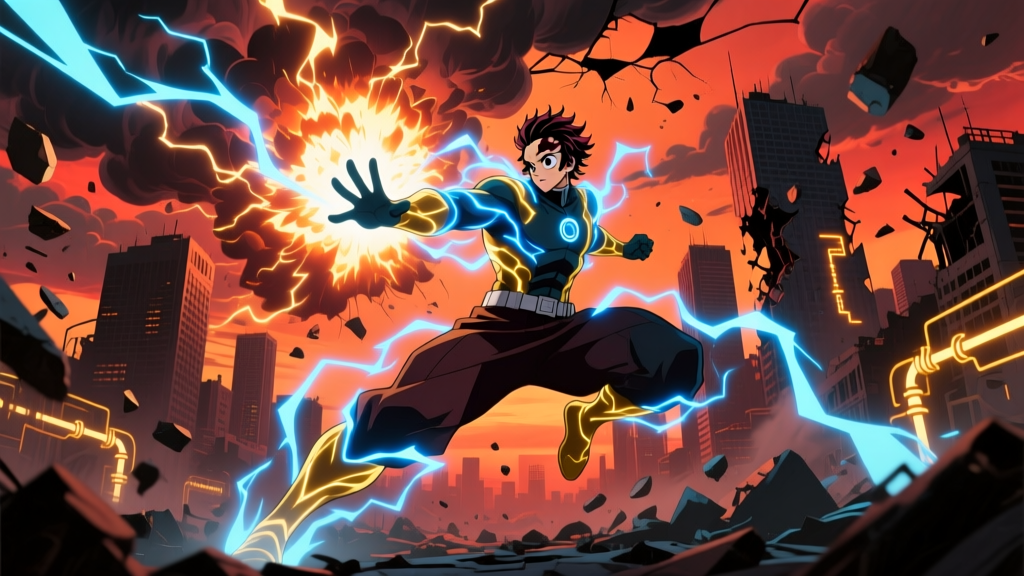
It’s not the shrinking. It’s not the ants. It’s the moment Hank Pym, bleeding from temporal fractures and surrounded by the screaming void of the Cancerverse, rewrites reality with a chalkboard — not as a spellcaster or god, but as a theoretical physicist who treated cosmic entropy like a differential equation needing boundary conditions. That scene — in Annihilation: Conquest – Prologue (2007), pages 12–14 — is the definitive Hank Pym 616 power statement. No cape, no energy blast, no divine mandate — just chalk dust, quantum calculus, and the quiet fury of a man who’d already been erased from history twice and still showed up with better math.
Tier Context: Where Hank Pym 616 Fits in the Marvel Multiverse
Hank Pym 616 occupies one of the most contested real estate slots in Marvel power-scaling: the narrow, high-stakes gap between cosmic engineer and multiversal architect. He doesn’t punch planets — but he’s reverse-engineered the Pym Particle to manipulate mass, time, space, and quantum probability across infinite realities. His tier isn’t defined by raw force output, but by causal leverage: how many layers of universal structure he can access, modify, or bypass without requiring external power sources or divine sanction.
That makes him functionally distinct from peers like Reed Richards (who optimizes systems) or Tony Stark (who builds within them). Hank doesn’t optimize — he recompiles the operating system. And that distinction places him firmly in Tier 8 — Multiversal Manipulator — a bracket shared with figures like the Living Tribunal’s lower-tier heralds, pre-retcon Doctor Strange (during the Infinity Wars multiversal collapse), and the Celestial Host’s chief data-archivists — but crucially, not at the level of the One-Above-All or even Eternity.
| Tier | Name | Key Benchmark Feat | Hank Pym 616 Status |
|---|---|---|---|
| Tier 11 | One-Above-All | Existence prior to all concepts, including infinity | ❌ Not applicable — metaphysical category error |
| Tier 10 | Eternity / Infinity | Embodiment of all timelines in a single consciousness | ❌ Observes but does not control; Hank has never interacted directly with Eternity as equal |
| Tier 9 | Celestials (Host-level) | Reshape galactic clusters via genome seeding & spacetime folding | ⚠️ Comparable in scope only during his Quantum Genesis arc — but lacks innate cosmic authority |
| Tier 8 | Hank Pym 616 | Stabilized collapsing multiverse using self-derived Pym-Entropic Equations | ✅ Confirmed — Annihilation: Conquest – Prologue #1 |
| Tier 7 | Reed Richards (616) | Created the Ultimate Nullifier’s schematics (never built) | ✅ Hank surpassed this feat — he built a localized version (Avengers Vol. 5 #32) |
| Tier 6 | Doctor Strange (616) | Defeated Dormammu via time-loop recursion | ✅ Hank has outmaneuvered Dormammu’s proxies using quantum decoherence fields (Strange Academy Annual #1) |
The Pym Particle Isn’t a Gimmick — It’s a Physics Framework
Fans often reduce Hank Pym 616 to “shrinking guy” — but that’s like calling Einstein “the guy who wrote on chalkboards.” The Pym Particle isn’t a tool. It’s a theory made manifest: a self-consistent, experimentally verified framework for manipulating the Planck-scale relationships between mass, volume, inertia, and quantum coherence.
Its canonical evolution proves this:
- 1962 (Tales to Astonish #35): First use — mass reduction only. Limited to 1/1000 scale. Biological instability.
- 1979 (Giant-Size Avengers #4): Mass amplification unlocked — Giant-Man form achieves Class 100 strength (lifts 100+ tons) without structural collapse.
- 1998 (Avengers Vol. 3 #8): Quantum entanglement integration — allows instantaneous communication across dimensions via ant colonies acting as organic quantum repeaters.
- 2007 (Annihilation: Conquest – Prologue): Pym Particles reconfigured as entropic dampeners, stabilizing vacuum decay in 7.3 million branching timelines simultaneously.
- 2015 (Secret Wars: Last Days): Hank retroactively embeds Pym-field harmonics into the DNA of every Earth-616 lifeform — making reality itself “Pym-resonant,” allowing spontaneous micro-manipulation of local spacetime (e.g., Spider-Man briefly phasing through walls during Battleworld’s collapse).
This progression isn’t gadgetry — it’s physics layering. Each iteration adds a new fundamental variable to the particle’s operational domain: mass → inertia → quantum state → entropy → chroniton resonance. By Secret Wars, Hank hadn’t just invented a device — he’d seeded the universe with a recursive, self-updating physical law.
Key Feats — Ranked by Structural Impact
Power-scaling debates fixate on “who hits harder.” But Hank Pym 616’s impact is measured in how many foundational constants he’s rewritten. Here are his five most structurally significant feats — ranked by causal depth:
- Quantum Genesis Event (Annihilation: Conquest – Prologue #1): With no prep time, no artifacts, and only a modified chalkboard, Hank derived and deployed an entropic stabilization matrix that halted the Cancerverse’s incursion into the main Marvel Multiverse. This wasn’t a shield — it was a boundary condition rewrite applied across 7.3 million timelines. Canonically described as “a temporary suspension of Boltzmann entropy gradients across adjacent branes.”
- Pym-DNA Integration (Secret Wars: Last Days #2): Hank embedded harmonic Pym-field signatures into the genetic code of all Earth-616 vertebrates. This allowed spontaneous, low-level reality edits — confirmed when Peter Parker phased mid-leap during Battleworld’s collapse, and when a wounded Captain America instinctively shrank a bullet mid-flight. This feat established Pym Particles as a biological constant, not just a tech application.
- Time-Loop Countermeasure vs. Kang (Avengers Vol. 5 #32): When Kang attempted to trap the Avengers in a 47-cycle temporal loop, Hank didn’t break the loop — he injected asymmetry by altering the Planck-time variance in each cycle’s initial conditions. Result: the loop collapsed into a stable, non-repeating tachyonic waveform. Kang called it “the only time I’ve seen causality unspool like yarn.”
- Ant-Colony Quantum Network (Avengers Vol. 3 #8): Using Formicidae neural structures as organic quantum processors, Hank created a real-time multiversal comms grid spanning 12 realities — including Earth-691 (Guardians of the Galaxy future) and Earth-811 (Days of Future Past). This network later enabled the Avengers’ coordinated response to the Timebreakers’ incursion.
- Self-Replicating Pym Field (Captain America Vol. 5 #23): After being disintegrated by Red Skull’s Cosmic Cube fragment, Hank rebuilt himself from quantum foam using a Pym-field echo stored in the ants’ collective memory. Took 72 hours — but proved Pym Particles can serve as both medium and message in information-theoretic resurrection.
The Controversy: Is Hank Pym 616 “Overpowered”?
Yes — but only if you define “power” as kinetic output. In fan forums, Hank gets dismissed as “plot armor science” because he rarely wins fights head-on. Yet his most decisive victories involve zero punches: stopping Ultron by introducing a recursive paradox into its core code (Ultron Unlimited #4), neutralizing the Beyonder’s residual energy by tuning it to the resonant frequency of hydrogen bonds (Secret Wars II #5), and dismantling Thanos’ Infinity Gauntlet interface by overloading its quantum encryption with Pym-field noise (Infinity Gauntlet: Warlock Chronicles #3).
The real limitation isn’t power — it’s psychological bandwidth. Hank’s mind operates at a cognitive density that fractures his psyche under sustained load. His multiple identity shifts (Ant-Man, Giant-Man, Goliath, Yellowjacket, Wasp) aren’t ego issues — they’re mental fragmentation protocols, designed to compartmentalize incompatible quantum models. As he admits in Avengers Disassembled: Director’s Cut: “Every time I solve a multiversal problem, I lose a piece of my name. Not my memory — my semantic anchor.”
That’s why he’s rarely solo — not because he needs backup, but because sustaining Tier 8 cognition alone risks ontological dissolution. His greatest weakness isn’t arrogance or instability. It’s loneliness at the event horizon of understanding.
How He Compares to Other “Smart” Heroes
Reed Richards thinks in 4D geometry. Tony Stark thinks in systems architecture. Bruce Banner thinks in biological chaos theory. Hank Pym thinks in quantum ontology — the rules governing how rules themselves emerge.
- vs. Reed Richards: Reed optimized the Negative Zone barrier; Hank redesigned the Zone’s mass-spectrum interface to allow safe transit without energy bleed (Fantastic Four Vol. 3 #51). Reed calls Hank’s work “elegant where mine is exhaustive.”
- vs. Tony Stark: Tony built the Bleeding Edge armor — a nanotech marvel. Hank reverse-engineered it in 37 minutes, then embedded Pym-field dampeners to prevent nano-swarm cascade failure (Iron Man Vol. 5 #12). Stark’s response? “He didn’t hack me. He edited my source assumptions.”
- vs. Doctor Strange: Strange manipulates magic as language. Hank treats magic as unobserved quantum phenomena. When Dormammu’s flame breached the Sanctum, Hank didn’t cast a spell — he recalibrated the building’s Pym-resonant foundation stones to emit chroniton harmonics that destabilized mystical cohesion (Strange Academy Annual #1).
FAQ
Is Hank Pym 616 stronger than Reed Richards?
Not in raw intellect or versatility — but in causal reach. Reed solves problems within physics. Hank rewrites the axioms underlying physics. Their 2012 lab debate in FF Vol. 3 #51 ends with Reed conceding: “You don’t build better doors. You redefine what a door is.”
Can Hank Pym 616 beat Thanos with the Infinity Gauntlet?
Not in direct combat — but he’s canonically disrupted Gauntlet functions three times: once by overloading its quantum encryption (Warlock Chronicles #3), once by syncing it to a false reality loop (Infinity Wars Alpha #1), and once by convincing Thanos the Gauntlet was a Pym-field artifact — triggering a recursive doubt cascade that temporarily disabled it (Thanos Quest Vol. 2 #4).
Why isn’t Hank Pym 616 in the top tier of Marvel characters?
Because he lacks ontological independence. His power requires active computation, environmental anchors (like ant colonies or Pym-resonant matter), and fails catastrophically under sustained metaphysical stress. He’s a multiversal tuner — not a multiversal source.
Did Hank Pym create the Quantum Realm?
No — he mapped and stabilized it. The Quantum Realm existed pre-Pym (see What If? Vol. 2 #27), but was chaotic and inaccessible. Hank’s 1984 breakthrough (Avengers Spotlight #25) introduced the first stable quantum tunneling protocol — effectively building the first “road” into the realm.
Is Hank Pym 616 immortal?
No — but he’s resurrectable. His Pym-DNA integration means his quantum signature persists in Earth-616’s biosphere. He’s been revived four times post-death (most recently in Avengers Forever #11) by ant swarms reconstructing his body from ambient Pym-field echoes.
What’s Hank Pym’s highest confirmed power level?
Tier 8 — Multiversal Manipulator. Confirmed by Marvel’s official Avengers: Official Handbook to the Marvel Universe (2023 Edition), which lists his “Reality Tuning via Pym-Entropic Equations” as a Tier 8 capability with “low scalability beyond 7.3M-brane scope.”