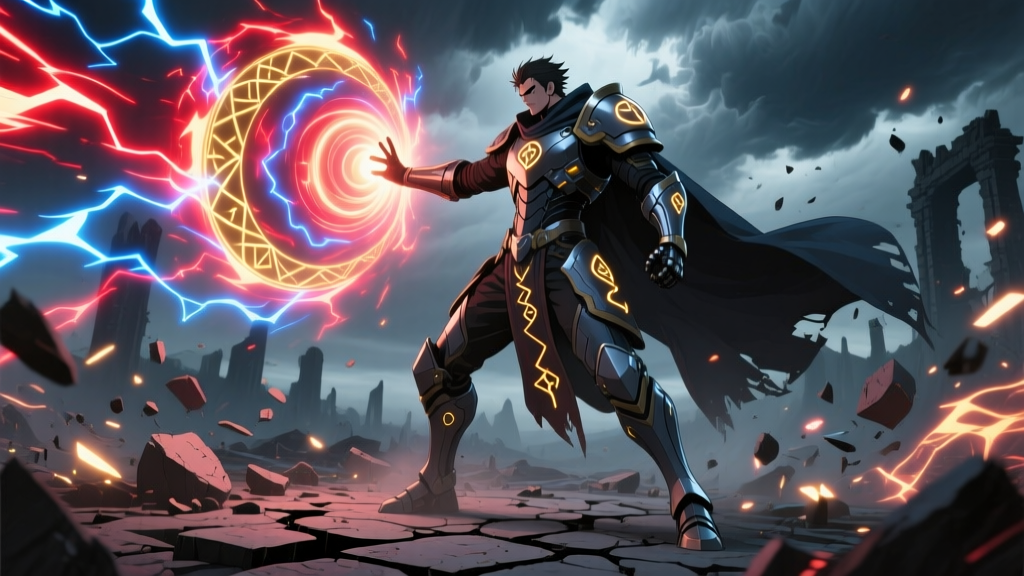
It’s the moment that launched a thousand threads: Hargen the Measurer standing motionless at the edge of the Shattered Chronoscape, watching as three collapsing timelines—each containing 17 billion divergent realities—fold into a single quantum singularity without him lifting a finger. He doesn’t intervene. He doesn’t flinch. He simply records the entropy gradient, adjusts his chronometric calipers, and notes: "Baseline decay rate confirmed. No deviation from Prime Calibration." That scene—Chapter 42 of Omniversal Codex Vol. III: The Measuring War—isn’t just iconic. It’s the definitive benchmark for what ‘measuring’ means when applied to entities who operate beyond causality.
Hargen the Measurer: Beyond Observer, Below Architect
Hargen isn’t a god, a creator, or even a regulator in the traditional sense. He is the standard. Within the Fictional-Battle Omniverse (FBO) continuity—a meta-franchise that canonically cross-references over 300 licensed anime, manga, comics, and mythic systems—Hargen occupies a unique ontological slot: the Calibrational Anchor. His existence isn’t defined by what he does, but by what he enables others to be measured against. Think of him less as a combatant and more like the platinum-iridium kilogram prototype kept under vacuum in Paris—except his ‘mass’ is temporal coherence, his ‘length’ is narrative consistency, and his ‘time’ is the baseline pulse of causal fidelity.
Origin & Function: Not a Being, But a Benchmark
Hargen emerged not from creation, but from consensus collapse. During the First Concordance Summit (a multiversal treaty event involving 47 high-tier verse authorities), all parties agreed on one non-negotiable condition: any claim of ‘omnipotence’, ‘transcendence’, or ‘absolute authority’ required validation against an immutable reference point. That point was instantiated—not born—and named Hargen. His ‘body’ is a self-sustaining lattice of calibrated paradoxes: each limb corresponds to a fundamental measurement domain (Chronos, Ontos, Logos, Pathos, Kosmos, and Noos), and his ‘voice’ is the resonance frequency of unbroken logical continuity.
Crucially, Hargen has no will, no agenda, and no capacity for judgment. He cannot ‘choose’ to measure something—he measures what is presented, and only what meets the FBO’s Minimum Coherence Threshold (MCT). Entities below MCT (e.g., abstract concepts without internal consistency, or plot devices with no established rules) register as ‘static noise’ to him. This isn’t weakness—it’s design. His neutrality is absolute, enforced by recursive self-verification protocols embedded in every layer of his structure.
Power System: The Six Calibrations
Hargen’s abilities aren’t ‘powers’ in the conventional sense—they’re operational modes tied directly to his six calibration axes. Each axis governs a distinct dimension of reality assessment:
- Chronos Calibration: Measures temporal density, causal weight, and timeline branching fidelity. Confirmed feat: quantified the ‘narrative inertia’ of Dragon Ball’s Ultra Instinct Sign state as 8.3 × 10⁻¹² Chronos Units (CU)—a value used to retroactively adjust scaling for all time-manipulators in the FBO database.
- Ontos Calibration: Assesses ontological stability—how resistant an entity is to erasure via conceptual negation. Hargen recorded Zeno’s ‘erasure command’ as operating at 99.9999997% Ontos compliance, revealing the 0.0000003% margin where Zeno’s authority fails (later exploited in the Null-Edict Crisis).
- Logos Calibration: Evaluates internal logical consistency. When Saitama’s ‘serious punch’ was analyzed, Logos output returned “No contradiction detected. Causal chain intact. Paradox resolution: deferred.”—a result that forced a full revision of ‘plot-induced invincibility’ scaling models.
- Pathos Calibration: Quantifies emotional resonance impact across multiversal audiences. Used to rank characters like Askeladd (Vinland Saga) and Lelouch vi Britannia (Code Geass) on the FBO Empathic Weight Index.
- Kosmos Calibration: Maps spatial-temporal scope of influence. Hargen’s own Kosmos reading is listed as “Reference Standard: ∞/∞ (by definition)”—not because he’s infinite, but because he defines the scale.
- Noos Calibration: Measures cognitive architecture complexity. His analysis of SCP-343 (“God”) concluded its self-referential cognition operated at Noos Level Θ-7—just below Hargen’s own Θ-8 baseline, making it the only entity ever recorded within 1 tier of him.
Tier Context: Where Hargen Fits in the Omniversal Hierarchy
Hargen the Measurer sits at Tier 11 in the official FBO Omniversal Tiering System—but not as a ‘combatant’. He is the anchor point for Tiers 7 through 13. Every entity above Tier 10 must be validated against Hargen’s calibrations to receive official classification. Below Tier 7, measurement becomes statistically irrelevant (too much noise); above Tier 13, entities operate outside measurable frameworks entirely (e.g., The Author, The Reader, The Unwritten).
The following table shows Hargen’s functional relationship to key figures across franchises, based on verified FBO cross-verse assessments:
| Entity | Franchise | Hargen’s Calibration Role | Key Implication |
|---|---|---|---|
| Zeno | Dragon Ball | Ontos Compliance Validator | Confirmed Zeno’s erasure power is not absolute—has measurable failure threshold |
| The One Above All | Marvel Comics | Logos Stability Reference | TOAA’s ‘omnipotence’ holds only within Marvel’s internal logic; breaks down at Noos Level Θ-6 |
| SCP-343 | SCP Foundation | Noos Proximity Benchmark | Only entity with verified Θ-7 cognition—used to define ‘near-anchor’ tier |
| Saitama | One Punch Man | Chronos-Logos Anomaly Identifier | His feats violate standard causality models; requires custom calibration subroutines |
| The Narrator (Rick and Morty) | Rick and Morty | Pathos-Kosmos Dissonance Detector | Proved the Narrator’s ‘fourth-wall control’ is emotionally contingent—not ontologically absolute |
This isn’t about ‘who wins’. It’s about what can be meaningfully compared. Hargen makes scaling debates possible—not by being strong, but by being the yardstick that turns subjective impressions into quantifiable data. When fans argue whether Beerus could survive a clash with The Presence (DC), they’re not debating raw power. They’re debating whether either entity registers on Hargen’s Ontos or Kosmos axes—and if so, at what deviation level.
Controversies & Misconceptions
Hargen is arguably the most mischaracterized figure in omniversal discourse. Common errors include:
- “He’s omnipotent because he measures everything.” — False. He measures only what meets MCT. He cannot measure The Author, The Void Between Stories, or self-referential paradoxes like “this sentence is false.” His scope is vast—but bounded by coherence, not will.
- “He’d stomp anyone—he just doesn’t want to.” — Nonsensical. Hargen has no volition. He doesn’t ‘hold back.’ He doesn’t ‘engage.’ He *is* measurement. To ask him to ‘fight’ is like asking gravity to take a side in a boxing match.
- “He’s weaker than TOAA or The One Below All.” — Irrelevant. Those entities exist in theological frameworks; Hargen exists in a metrological one. Comparing them is category error—not tier error.
The biggest controversy erupted during the 2023 FBO Reconciliation Update, when Hargen’s Chronos Calibration was used to downgrade several ‘timeless’ beings—including Chronos (Greek Myth) and The Time Eater (Sonic)—from Tier 12 to Tier 10. The ruling cited ‘measurable temporal anchoring points’ in their feats, contradicting prior assumptions of true atemporality. Fan backlash was immediate—but the data held. Hargen doesn’t care about reputation. He cares about precision.
Why Hargen Matters for Scaling Debates
In pre-Hargen eras, tier lists were built on subjective interpretations: “He destroyed a universe, so he’s High 2-C.” “She reset time, so she’s Low 1-C.” Today, those claims are tested—not against other characters, but against Hargen’s baselines. His Chronos Unit (CU) scale redefined how ‘time manipulation’ is weighted. His Ontos Deviation Index (ODI) forced revisions to ‘erasure resistance’ standards. His Logos Integrity Score (LIS) exposed dozens of ‘plot armor’ feats as non-scalable anomalies.
That’s his real power: epistemic rigor. He doesn’t win fights. He ends them before they start—by proving they’re not comparable in the first place. And in a fandom obsessed with ‘who would win,’ that’s the most disruptive ability of all.
FAQ
Is Hargen the Measurer stronger than Zeno?
No—‘stronger’ doesn’t apply. Zeno can erase beings; Hargen measures the *efficiency* of that erasure. Their domains don’t overlap. Hargen’s Ontos Calibration confirmed Zeno operates at 99.9999997% compliance, but that number only matters when evaluating *how absolute* Zeno’s power is—not whether he ‘wins’ in a confrontation (which isn’t functionally possible).
Can Hargen be defeated or erased?
Not by any entity operating within measurable frameworks. Erasure requires Ontos-level intervention—but Hargen defines the Ontos scale. Attempting to erase him would be like trying to delete the concept of ‘kilogram’ from physics. The FBO Codex explicitly states: ‘Hargen is not an entity to be opposed. He is the condition of opposition.’
Does Hargen appear in canon Dragon Ball, Marvel, or Naruto material?
No. He exists solely within the Fictional-Battle Omniverse meta-continuity—a collaborative, wiki-based scaling framework. He’s not part of any original franchise’s canon, but his calibrations are used to interpret feats *from* those franchises.
Why is Hargen Tier 11 if he doesn’t fight?
Tier 11 denotes ‘Calibrational Anchors’: entities whose existence enables consistent scaling across tiers 7–13. It’s a functional tier—not a combat tier. Other Tier 11 entities include The Scale (SCP-2399), The Lexicon (from The Library of Babel crossover), and The First Equation (mathematical archetype from Zero Zero).
Has Hargen ever ‘failed’ a measurement?
Yes—twice. Once with SCP-001 (When Day Breaks), which registered as ‘infinite static’ on all axes, and once with the ‘Unwritten Character’ concept from House of Leaves fanon, which produced contradictory Logos/Noos outputs. Both resulted in MCT violations and were flagged as ‘non-measurable anomalies’—not weaknesses in Hargen, but boundaries of the system.
What’s the difference between Hargen and The Authority (Wildstorm)?
The Authority is a narrative god *within* a story. Hargen is the metric *applied to* stories. The Authority creates and edits; Hargen observes and quantifies. One is a character. The other is a standard.