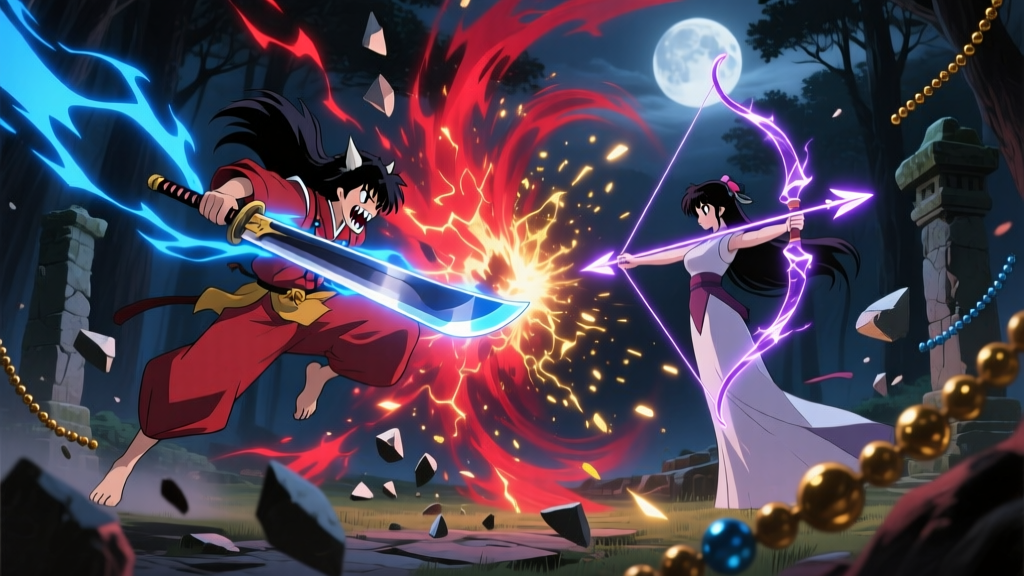
It’s the final clash at Mount Hakurei — Inuyasha, battered and bleeding, raises Tessaiga not as a sword, but as a conduit. With a roar that cracks the sky, he unleashes Meido Zanbaku, tearing open a rift so vast it swallows Naraku’s entire demonic fortress whole — stone, youkai, and cursed energy vanishing into the void like smoke in vacuum. This isn’t just a finisher. It’s the culmination of seven years of growth, trauma, training, and identity reclamation — and it’s the definitive proof that Inuyasha isn’t just a half-demon with a cool sword. He’s a tier-shifting force whose power arc defies linear scaling.
From Abandoned Half-Demon to Meido-Wielder: A Chronological Power Journey
Inuyasha’s story isn’t about sudden godhood or inherited omnipotence — it’s about earned authority over his own duality. His evolution spans three distinct phases across the manga (56 chapters), anime (167 episodes + movies), and canonical sequel Yashahime. Unlike characters who ascend via ritual or artifact alone, Inuyasha’s transformations are rooted in emotional breakthroughs, physical trials, and hard-won mastery of Tessaiga’s sentient will.
Phase 1: The Cursed Boy (Feudal Era, Pre-Chapter 1)
Before Kagome’s arrival, Inuyasha existed as a pariah — sealed to the Sacred Tree for fifty years after being betrayed by Kikyo. His base form was already formidable: enhanced speed (blurring past human eyes), regeneration (healing stab wounds in minutes), and raw strength (shattering boulders bare-handed). But his greatest limitation wasn’t power — it was control. His demon blood surged unpredictably during the new moon, reducing him to a powerless human — a vulnerability exploited repeatedly by enemies like Goshinki and the Band of Seven.
His early feats were impressive but grounded:
- Shattered a mountain-sized golem with one swing of Tessaiga (Ch. 24)
- Outran lightning-based attacks from Thunder Brothers (Ch. 49)
- Survived a direct hit from Hakudoshi’s soul-sucking blast — though left unconscious for two days (Ch. 387)
Phase 2: Awakening the Sword — Tessaiga’s True Forms (Ch. 1–320)
Tessaiga wasn’t just a weapon — it was a test. Its first true transformation, Wind Scar, debuted in Chapter 29 against Sesshomaru. It wasn’t just an energy wave; it was a localized dimensional shear — slicing through space itself, leaving behind visible vacuum trails. Later, its Iron Reaver’s Soul Stealer form allowed Inuyasha to physically consume lesser demons’ yoki mid-battle, converting their energy into stamina and temporary power surges.
But the real turning point came when Inuyasha accepted his dual nature — not as a curse, but as synergy. That moment birthed Backlash Wave: a self-destructive counterattack where he reversed Tessaiga’s energy flow to absorb and reflect enemy strikes. Canonically, this move shattered three of Naraku’s incarnations simultaneously (Kanna’s mirror shards, Kagura’s wind blades, and Kohaku’s poisoned arrow) — proving he could manipulate spatial recoil on a multi-target scale.
Phase 3: Ascension Beyond Bloodline (Ch. 321–558 & Yashahime)
The final arc wasn’t about unlocking new forms — it was about transcending them. After surviving the Meido Gate’s pull and returning from the netherworld, Inuyasha didn’t just survive death — he commanded it. Meido Zanbaku (Ch. 549) required him to channel Tessaiga’s full spiritual weight *and* his own life force, then synchronize it with Kagome’s sacred arrows — a feat only possible because he’d mastered both halves of his soul: the demon’s instinct and the human’s compassion.
Post-manga, Yashahime confirms his continued growth: he trains his daughters in swordsmanship, withstands time-space distortions near the Crimson Dome, and casually deflects attacks from the powerful Kirinmaru — all while retaining full control during new moon cycles (a sign his human/demon balance is now permanent).
Key Transformations & Their Canonical Impact
| Transformation | Trigger / Requirement | First Appearance | Power Implication | Tier Shift |
|---|---|---|---|---|
| Wind Scar | Mastering Tessaiga’s spirit + focused yoki | Manga Ch. 29 | Localized spatial rupture; bypasses durability via dimensional shear | Street → Wall |
| Iron Reaver’s Soul Stealer | Embracing demon instincts + hunger-driven focus | Manga Ch. 117 | Energy absorption + physical disintegration; negates regeneration | Wall → Small Building |
| Backlash Wave | Accepting dual nature + self-sacrificial intent | Manga Ch. 321 | Reverses kinetic/spiritual energy flow; multi-target reflection | Small Building → Large Building |
| Meido Zanbaku | Union of human resolve + demon power + Kagome’s purification | Manga Ch. 549 | Creates stable dimensional rift; erases matter/energy from causal chain | Large Building → Mountain+ |
| New Moon Stability (Yashahime) | Complete spiritual integration post-resurrection | Yashahime S2 Ep. 18 | No power loss; retains speed/strength/senses; implies soul-level mastery | Mountain+ → Island |
Why This Arc Matters to the Inuyasha Fandom
The inuyasha fandom has long debated whether he “peaks too late” or “relies too much on Tessaiga.” But chronologically, his growth mirrors real-world martial discipline: early flash, mid-tier refinement, late-stage synthesis. Unlike Sesshomaru — whose power comes from lineage and cold logic — Inuyasha’s strength emerges from empathy, loyalty, and repeated failure. When he stops fighting *against* his humanity and starts fighting *for* it, that’s when Tessaiga finally obeys unconditionally.
This resonates deeply in fan discourse. Memes like “Inuyasha’s power level = how many times he’s yelled ‘Kagome!’” aren’t jokes — they’re shorthand for his emotional catalyst system. His most devastating moves activate only when stakes are personal: Wind Scar vs. Sesshomaru (brotherly rivalry), Backlash Wave vs. Naraku (protecting Kagome), Meido Zanbaku vs. Naraku’s core (ending the cycle of betrayal).
And unlike many shonen protagonists, Inuyasha never abandons his base form. Even at peak, he fights with fangs bared, claws extended, and voice raw — no glowing aura, no floating hair, no cosmic monologue. His power feels earned, tactile, and violently human.
Controversial Feats & Fandom Debates
Not every moment holds up under scrutiny — and the inuyasha fandom thrives on those debates:
- “Did he solo Naraku?” — Technically no. Kagome’s final arrow purified the Shikon Jewel’s malice, and Sesshomaru’s Tenseiga healed the land. But Meido Zanbaku erased Naraku’s physical form *before* the purification — meaning Inuyasha delivered the decisive, irrevocable blow.
- “Is Meido Zanbaku reality warping?” — Not in the conventional sense. It doesn’t alter laws; it exploits a pre-existing rift between realms. Think less “rewrite physics,” more “open a door that was always there.”
- “Does Yashahime retcon his power?” — No. It confirms canon continuity: his daughters inherit his yoki control *and* his emotional discipline. When Moroha defeats a time-warped Kirinmaru using a modified Wind Scar, it’s a direct inheritance — not a downgrade.
Where Inuyasha Fits in Broader Power Hierarchies
Within the broader anime multiverse, Inuyasha sits comfortably in the Mountain to Island tier — above mid-tier shonen heroes like Naruto (pre-Six Paths) or Ichigo (Bankai), but below verse-enders like Gojo (Limitless domain expansion) or Saitama (planet-busting casual feats). His ceiling is defined by *precision*, not scale: he can’t move continents, but he can erase a fortress from existence without collateral damage.
What sets him apart in cross-franchise discussions is his scalability through relationship. His power doesn’t spike with rage — it spikes with connection. Kagome’s arrows empower Meido Zanbaku. Sesshomaru’s presence triggers Tessaiga’s latent memory. Even Kikyo’s final blessing (Ch. 555) stabilizes his soul mid-rift. This makes him uniquely resistant to “power isolation” tactics — a trait fans cite when arguing he’d outlast loner-tier fighters in prolonged engagements.
FAQ
Is Inuyasha stronger than Sesshomaru by the end?
No — Sesshomaru remains objectively stronger in raw yoki output and versatility (Tenseiga, Bakusaiga, flight, poison claws). But Inuyasha surpasses him in *tactical application*: Meido Zanbaku has no counter in Sesshomaru’s arsenal, and Inuyasha’s adaptability in team fights gives him edge in coordinated scenarios.
What’s the strongest version of Inuyasha?
Canonically, it’s Meido Zanbaku Inuyasha — post-resurrection, new moon-stable, wielding Tessaiga at full synchronization with Kagome’s purified energy. This form appears only in Chapter 549–558 and is confirmed as non-replicable without that exact spiritual alignment.
Does Inuyasha ever become full demon?
No. He rejects the Black Pearl’s offer in Ch. 312 and later destroys it. His ultimate strength lies in balance — not purity. Even in Yashahime, he teaches his daughters to harmonize human intuition with demon instinct.
How fast is Inuyasha really?
Conservatively, he moves at **Mach 5–10** in base form (dodging lightning, crossing feudal Japan in hours). With Wind Scar acceleration or Backlash Wave recoil, he briefly hits hypersonic+ speeds — enough to intercept projectiles mid-air across kilometers (Ch. 442).
Can Inuyasha beat characters like Goku or Lelouch?
No — not in raw power. Goku operates at universal+ tiers; Lelouch manipulates causality. But Inuyasha would be exceptionally dangerous in terrain-based, emotionally charged, or spiritually dense environments — think Kyoto during the solar eclipse arc, where his senses and Tessaiga’s anti-illusion properties give him unique advantages.
Why does the inuyasha fandom love his character arc so much?
Beyond nostalgia, it’s his authenticity. He’s loud, insecure, impulsive, and fiercely loyal — a hero whose growth isn’t measured in energy blasts, but in how often he chooses mercy over vengeance, trust over suspicion, and love over legacy.