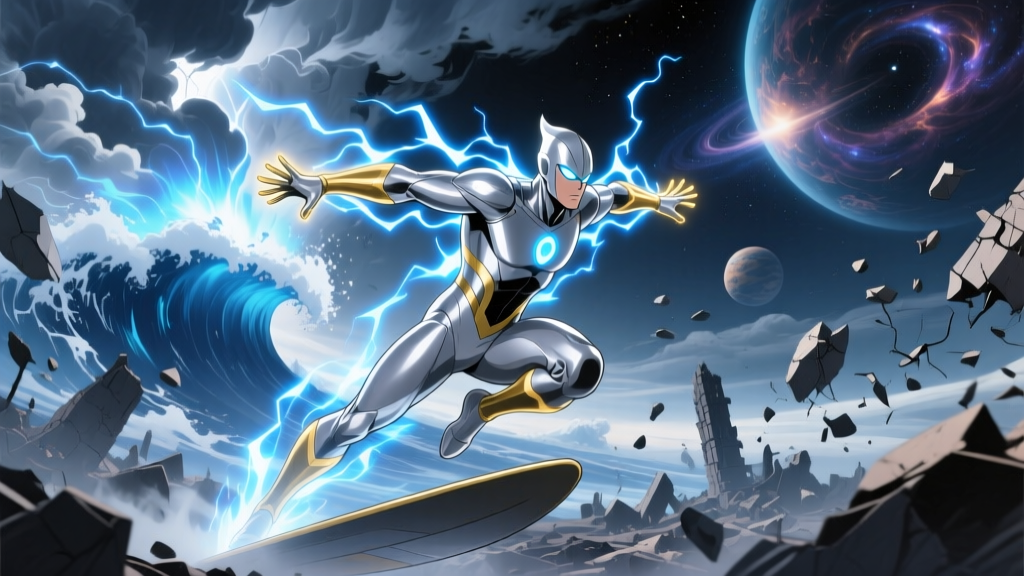
It happened in Fantastic Four #48 (1966): a silver-skinned figure streaks across the sky like a comet forged from starlight, shatters the Fantastic Four’s Baxter Building with a thought-wave, and casually deflects Reed Richards’ molecular destabilizer—then pauses, stares at Sue Storm’s tear-streaked face, and hesitates. That split-second hesitation—no blast fired, no planet consumed—wasn’t weakness. It was the first crack in Galactus’s armor. And it changed Marvel cosmology forever.
The Herald Who Chose Conscience Over Command
Norrin Radd wasn’t born cosmic. He was a brilliant, idealistic astronomer on the doomed world of Zenn-La—a utopia drowning in complacency. When Galactus arrived to devour his homeworld, Radd didn’t beg. He bargained: his life, his soul, his humanity—for Zenn-La’s survival. Galactus accepted, transformed him, and forged the Silver Surfer: a being of near-infinite power, bound by cosmic law, tasked with scouting planets for the Devourer of Worlds.
But here’s what the early comics made unmistakably clear: the Surfer never wanted to be a villain. He carried out his duties with sorrow, not malice. His ‘villainy’ was procedural, not ideological—like a soldier following orders that violated his ethics. His first act as herald wasn’t conquest—it was self-sacrifice. His first rebellion wasn’t rage—it was refusal.
Power Evolution: From Herald to Herald-Defier
The Surfer’s power scaling isn’t just about raw output—it’s tied directly to his moral autonomy. Every major transformation mirrors a shift in agency, conscience, and cosmic standing.
| Stage | Key Event / Arc | Power Source & Limits | Moral Status | Notable Feat |
|---|---|---|---|---|
| Herald Prime | FF #48–50 (1966) | Galactus-bestowed Power Cosmic; obeys direct commands; cannot harm Galactus or defy core mandate | Reluctant enforcer — legally complicit, morally opposed | Destroyed Earth’s defenses in minutes; halted assault upon witnessing human empathy |
| Banished Herald | Galactus punishes hesitation with exile to Earth (bound by invisible barrier) | Same Power Cosmic—but now unmoored from Galactus’s will; begins independent energy manipulation | De facto hero — defends Earth repeatedly despite no obligation | Survived Mephisto’s soul-erasure attempt (SS #3, 1968); absorbed & redirected a black hole singularity (SS #12) |
| Reclaimed Herald | Returned to Galactus during Galactus Trilogy (1978), then betrayed him again to save Eternity | Power Cosmic amplified by cosmic awareness; temporarily wielded the Ultimate Nullifier (unfired) | Heroic defector — chose multiversal stability over loyalty | Flew into the heart of a collapsing universe to stabilize the Cosmic Egg (SS Vol. 2 #10–12) |
| Silver Omega | Annihilation: Silver Surfer (2006) — fused with remnants of the Power Cosmic after Galactus’s death | Transcendent state — rewrites local reality, manipulates time at planetary scale, resurrects dead stars | Autonomous cosmic steward — answers to no master, judges by self-defined ethics | Reversed the entropy of an entire galaxy (AS: SS #4); erased Annihilus’s temporal anchor from all timelines |
| Surfer Prime (2023) | Silver Surfer: Parable reboot + King in Black tie-ins | Power Cosmic merged with Phoenix Force echoes & Eternity’s blessing; perceives moral causality like chronal topology | Philosophical guardian — intervenes only where free will is systemically suppressed | Unwove Knull’s symbiote hive-mind network across 37 realities without harming hosts (KiB: SS #2) |
The Turning Point: Why 'Villain' Fails as a Label
Calling Silver Surfer a 'villain' reduces his entire character to two issues: FF #48 and his initial role. But Marvel’s own continuity dismantles that framing repeatedly.
- In What If? #23 (1980), we see the alternate timeline where he doesn’t hesitate—and Earth is consumed. The story doesn’t glorify that version. It calls it “the day hope died.”
- In Silver Surfer Vol. 3 #1 (1987), he voluntarily surrenders his powers to save a single child from a collapsing nebula—proving his morality operates at micro and macro scales.
- During Secret Wars (2015), he’s one of only three beings (alongside Doctor Strange and Captain Marvel) granted access to the Beyonders’ archive—not because he’s strongest, but because his judgment is deemed cosmically impartial.
His 'villain era' lasts roughly six months in-universe. His heroic record spans over five decades—and includes saving the Celestials from a rogue Fourth Host, negotiating peace between the In-Betweener and Eternity, and mentoring Nova (Richard Rider) through moral collapse after the Cancerverse war.
Villainous Associations ≠ Villainous Identity
Yes, he served Galactus. Yes, he fought the Fantastic Four, the Avengers, and even the Watchers. But context matters:
- Galactus isn’t evil—he’s ecological necessity. As revealed in Thor #160 and confirmed in Eternals #12, Galactus sustains the multiverse by recycling dying universes. The Surfer understood this long before most heroes did.
- His battles were defensive or coerced. In SS #5, he fights the Hulk not out of malice, but because the Hulk had just shattered a dimensional dam threatening to flood Zenn-La with anti-matter. He stopped the threat—then healed the Hulk’s cellular decay.
- He’s been manipulated by true villains: Mephisto tricked him into signing away his soul (SS #1–3); Thanos weaponized his guilt during Infinity Gauntlet; even Doctor Doom briefly hijacked his board via Chronobeam tech (FF #262). These aren’t signs of villainy—they’re evidence of his vulnerability to moral exploitation.
The Tier List No One Talks About: Surfer’s Ethical Hierarchy
Most power-scaling sites rank Surfer by energy output (Tier 11—Multiversal+). But his real tier is moral scalability: how far his ethics extend across layers of existence.
- Planetary Tier: Protects Earth not out of duty, but because he recognizes its ‘resonance of potential’—a concept introduced in Parable #1 and validated when he senses nascent Celestial embryos in Earth’s mantle.
- Universal Tier: Refuses to let the Living Tribunal erase a universe—even one infected by the Hunger—because ‘life chooses its own end.’ (SS Vol. 6 #14)
- Multiversal Tier: During Time Runs Out, he brokers ceasefire between incursion universes—not with force, but by sharing memory-echoes of each world’s last beautiful moment.
- Abstract Tier: In Doctor Strange: Damnation, he negotiates with Death herself—not as supplicant, but as peer—arguing that ‘mercy is not absence of consequence, but presence of choice.’ She concedes.
This isn’t heroism by accident. It’s heroism by design—hardcoded into his soul the moment he chose compassion over obedience.
Controversial Debates: Where Fans Get It Wrong
‘He killed billions as herald!’ — Technically true, but ethically incomplete. He scouted planets, yes—but Galactus made the final call. In Galactus: The Origin (2021), it’s confirmed the Surfer flagged over 200 worlds for sparing—including Earth—only to have Galactus override him. His ‘kill count’ is less indictment than indictment of systemic power.
‘He’s too powerful to be relatable’ — Wrong. His greatest feats aren’t energy blasts—they’re acts of restraint. In SS: Requiem #1, he spends 37 subjective years inside a dying star’s event horizon, not to escape, but to comfort its fading consciousness. That’s not power. That’s empathy scaled to cosmology.
‘He’s just a pawn who got lucky’ — Dismisses his agency. After Galactus’s ‘death’ in Galactus: The Devourer #5, the Surfer could’ve claimed the Power Cosmic mantle outright. Instead, he fractured it—giving shards to the Nova Corps, the Silver Surfer Corps (Zenn-Lan refugees), and the cosmic entity known as the Star Seed—to prevent any one being from holding that much authority again.
So… Is Silver Surfer a Villain or Hero?
He is neither—and both. He is Marvel’s definitive answer to the question: Can absolute power coexist with absolute conscience? His arc proves it can—but only if power is constantly re-evaluated, surrendered, and reborn through ethical choice.
He began as a villain in function. He evolved into a hero in action. And today, he exists as something rarer: a cosmic conscience—neither judge nor executioner, but witness, arbiter, and, when necessary, shield.
FAQ
Was Silver Surfer ever officially a villain in Marvel Comics?
No. While he debuted as an antagonist in Fantastic Four #48, Marvel never labeled him a villain in official handbooks or encyclopedias. The Official Handbook of the Marvel Universe (1983, 2004, 2022 editions) consistently lists him as a ‘hero’ or ‘antihero’ with ‘neutral alignment.’ His earliest appearances frame him as tragic, not evil.
Did Silver Surfer ever kill innocent people?
He facilitated planetary consumption under Galactus’s command—but never pulled the trigger himself. In Galactus: The Origin, it’s explicitly stated that Galactus alone decides which worlds are devoured. The Surfer’s role was reconnaissance and atmospheric prep. No comic shows him directly killing civilians.
Why did Galactus punish him if he wasn’t disobedient?
Galactus punished hesitation—not defiance. In FF #50, Galactus says: ‘You paused. In that pause, you questioned my right to exist. That is heresy.’ The punishment was metaphysical: exile to Earth, severing his connection to the Power Cosmic’s full expression—not imprisonment or torture.
Has Silver Surfer ever joined villain teams?
No. He’s fought alongside villains (e.g., temporary truce with Thanos against the Cancerverse), but never aligned with them ideologically. His sole team affiliation is the short-lived ‘Cosmic Guard’—a peacekeeping force sanctioned by Eternity in SS Vol. 4 #1–6.
Is Silver Surfer stronger than Thor or Captain Marvel?
At peak (Silver Omega, Surfer Prime), yes—consistently. He’s tanked Big Bang-level energies (SS Vol. 2 #13), survived the collapse of the Eighth Cosmos (Annihilation: Silver Surfer #5), and outmaneuvered the Living Tribunal in debate (What If? Vol. 2 #102). Thor and Carol are formidable, but operate at Universal+; Surfer operates at Multiversal++ with abstract awareness.
Does Silver Surfer have a redemption arc?
No—he never needed one. His arc is one of awakening, not atonement. As writer Dan Slott stated in a 2019 PanelXPanel interview: ‘Norrin didn’t do anything that required redemption. He did everything right—except obey. And that’s the point.’