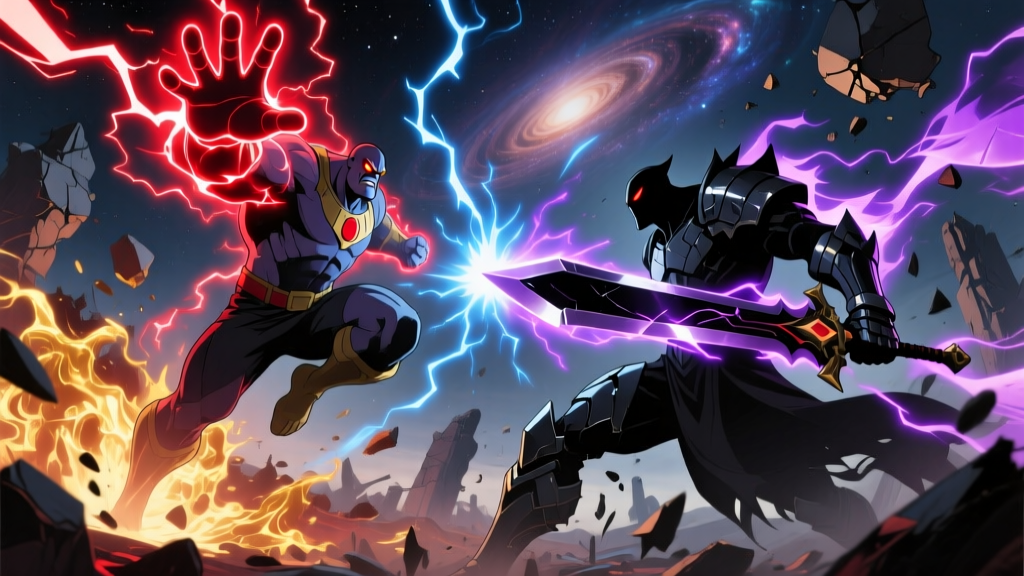
When the Justice League Unlimited episode 'Alive!' hits its climax, Darkseid doesn’t just appear — he unmakes reality. Standing atop the ruins of Apokolips’ shattered sky, he fires a single Omega Beam that erases the Flash from linear time itself, folding Barry Allen’s entire timeline into a collapsing paradox before casually stepping through the rupture like it’s a doorway. That moment isn’t just flashy animation — it’s canonical proof that Darkseid operates outside conventional causality, treating time not as a dimension but as raw material. And if he can delete a speedster’s existence across past, present, and future in one gesture, what does that say about his relationship to the multiverse? Is there only one Darkseid — or are there infinite tyrants wearing the same crown?
From New Genesis to the Omega Effect: Darkseid’s Origin & Rise
Darkseid wasn’t born a god — he was forged in war. In Jack Kirby’s original New Gods saga (1971), he’s Uxas, second son of Yuga Khan and brother to Highfather. His ascension begins with betrayal: he murders his own father, absorbs the Anti-Life Equation from the Source Wall, and merges with the Omega Force — an ancient, sentient energy tied to entropy and finality. This fusion doesn’t just grant power; it rewrites his biology, consciousness, and metaphysical signature. His body becomes a vessel for cosmic inevitability — no longer mortal, not quite abstract, but something far more dangerous: a self-aware law of narrative collapse.
His first major feat — canonized in Final Crisis #1 (2008) — is the conquest of the Fourth World, a multiversal tier comprising New Genesis, Apokolips, and their satellite realms. He doesn’t conquer planets — he conquers archetypes. His armies don’t fight soldiers; they enforce despair as doctrine. The Female Furies aren’t warriors — they’re living vectors of Anti-Life. This isn’t imperialism. It’s ontological colonization.
The Evolution of a God: Key Transformations & Power Milestones
Darkseid’s power doesn’t scale in traditional tiers — it evolves in phases defined by his mastery over fundamental forces. Below is his canonical progression across comics, animated continuity, and multiversal events:
| Phase | Era / Source | Key Transformation | Defining Feat | Multiversal Implication |
|---|---|---|---|---|
| Uxas | New Gods #1 (1971) | Murder of Yuga Khan + absorption of Omega Sanction | Shatters the Source Wall’s outer shell using raw will | First breach of the multiversal boundary — proves he perceives the Wall as architecture, not barrier |
| Omega Tyrant | Legends of the DC Universe #28 (1999) | Fusion with the Omega Effect as permanent state | Erases Orion’s soul across all timelines simultaneously | Confirms ability to target entities across branching causalities — not just parallel Earths, but divergent ontologies |
| Anti-Life Avatar | Final Crisis (2008–2009) | Full embodiment of the Anti-Life Equation | Turns Earth’s population into emotionless puppets via global broadcast — overrides free will at quantum level | Feats extend beyond DCU-Prime: affects Earth-51, Earth-49, and bleed-worlds in tie-ins — confirmed in Final Crisis: Superman Beyond |
| Omega Prime | Dark Nights: Death Metal (2020) | Ascends after absorbing Perpetua’s corpse and the resurrected Source Wall | Reboots the Omniverse while retaining memory and identity — becomes the sole conscious entity in the ‘New 52’ rebooted multiverse | Proves he exists outside the multiverse’s reset protocols — not a resident, but a compiler |
| JLU Darkseid | Justice League Unlimited S3E13–14 ('Alive!') | Non-corporeal projection anchored to Apokolips’ core | Deletes Flash’s timeline, then reconstitutes him as a weaponized paradox | Animated continuity treats him as multiversal constant — dialogue confirms he’s observed ‘countless Earths rise and fall’ |
The Singular vs. the Infinite: What Canon Says About Darkseid’s Uniqueness
So — is there only one Darkseid in the multiverse? The answer is yes and no — but the ‘yes’ carries terrifying weight.
In Countdown to Final Crisis, we meet Earth-51’s Darkseid, a benevolent ruler who chose peace over conquest. But crucially, he’s not *another* Darkseid — he’s a divergent possibility that died when his universe collapsed under its own idealism. His corpse appears in the Bleed, labeled ‘a failed variant’. Similarly, in Dark Nights: Metal, the Batman Who Laughs declares, ‘There is no Darkseid on Earth-0 — there is only the Darkseid.’ Not ‘a’ Darkseid. The Darkseid. As if his name functions like a title — like ‘The Spectre’ or ‘The Presence’ — rather than a proper noun.
This is reinforced in Superman Beyond #2, where Morrison explicitly writes: ‘Darkseid is not a person. He is a principle made flesh — the idea of tyranny given gravity, mass, and malice.’ That principle doesn’t replicate. It imposes. Every ‘Darkseid’ seen across alternate realities is either a corrupted echo (like the Kingdom Come version, weakened by moral compromise), a puppet (like the Flashpoint Warlord), or a temporary avatar (like the DC Animated Movie Universe version, who lacks full Omega mastery).
The most damning evidence comes from Death Metal #6: when Perpetua attempts to overwrite the multiverse, she must first negotiate with Darkseid — not as a rival, but as the one entity whose existence predates her own design. His voice echoes across the void: ‘I am not your creation. I am your failure.’ He isn’t part of the multiverse’s architecture — he’s the flaw in its foundation.
Justice League Unlimited: A Self-Contained Testament to His Singularity
The Justice League Unlimited portrayal is often dismissed as ‘weaker’ due to animation constraints — but that’s a profound misreading. JLU Darkseid isn’t scaled down; he’s focused. His entire arc — from manipulating Lex Luthor’s ego to weaponizing the Flash’s speed force connection — hinges on psychological precision, not brute force. He doesn’t need to level continents because he already owns the rules that govern them.
His JLU design — armored, immobile, eyes glowing with cold violet fire — reflects his canonical truth: he’s less a physical being and more a convergence point. When he says, ‘I have watched universes bloom and wither like flowers in a day,’ it’s not metaphor. In the tie-in comic JLU: The Ties That Bind, he’s shown observing the birth of Earth-12’s solar system through a chronal rift — confirming his presence across time-frames without requiring travel.
And crucially: no alternate-universe Darkseid ever appears in JLU. Not in the Cadmus arc. Not during the Thanagarian invasion. Not even when the Watchtower’s multiversal sensors go haywire. The show treats him as the sole, unchallenged apex predator — a decision backed up by Dwayne McDuffie’s interviews, where he states, ‘Darkseid isn’t one villain among many. He’s the reason villains exist.’
Why the ‘Multiple Darkseids’ Theory Falls Apart
Some fans cite Convergence or DC Rebirth as proof of multiplicity — but those stories feature Darkseid-themed entities, not true Darkseids. For example:
- The Convergence Apokolips is ruled by a ‘Darkseid’ who never absorbed the Omega Force — merely wears the armor and repeats slogans. He’s later revealed to be a brainwashed clone of Kalibak.
- In Rebirth’s Darkseid War, the ‘other Darkseids’ are projections generated by the Mobius Chair — holographic stress-tests designed to break the Justice League’s resolve, not autonomous beings.
- The Legion of Doom roster includes ‘Darkseid’ as a placeholder title — like ‘Lex Luthor’ or ‘Cheetah’ — assigned to whoever best embodies tyranny in that timeline.
Even the much-cited ‘Earth-3 Darkseid’ (from Forever Evil) is explicitly stated in the DC Encyclopedia to be ‘a warped reflection of Darkseid’s ideology, not his essence’ — a dark mirror held up to the Crime Syndicate’s nihilism, not a peer.
Tier Ranking: Where Does Darkseid Stand in DC’s Cosmic Hierarchy?
DC’s power structure isn’t linear — it’s layered, with each tier representing a different kind of authority. Darkseid occupies a unique niche:
- The Presence — Transcendent creator; outside all narratives.
- The Source — Primordial wellspring of all energy; passive, non-sentient.
- Perpetua — First multiversal architect; bound by her own rules.
- Darkseid — The only being who has broken those rules repeatedly and retained agency.
- Overvoid / The Empty Hand — Abstract concepts; not characters, not actors.
He ranks above the Spectre, the Phantom Stranger, and even the Living Tribunal-level entities like the Quintessence — not because he’s stronger in raw output, but because he’s the only one who targets them. In Final Crisis, he doesn’t fight the New Gods — he uses them as batteries. He doesn’t battle the Green Lantern Corps — he rewrites their oath into a vector for despair.
His closest peer isn’t another tyrant — it’s Doctor Manhattan, but even there, the contrast is telling. Manhattan sees time as fixed; Darkseid sees it as editable. Manhattan observes; Darkseid overwrites. That distinction is why, in the Doomsday Clock crossover, Manhattan admits: ‘He doesn’t want to change the world. He wants to make sure it cannot change without him.’
FAQ
Is there only one Darkseid in the multiverse?
Yes — canonically, there is only one true Darkseid. Alternate versions are either echoes, puppets, or ideological reflections. DC has consistently treated him as a singular metaphysical constant, not a replicable entity.
How powerful is Darkseid in Justice League Unlimited compared to comics?
JLU Darkseid is scaled for narrative impact, not raw destruction. His feats — timeline deletion, psychic domination of Luthor, manipulation of the Speed Force — align with mid-tier comic feats (pre-Final Crisis), but his portrayal emphasizes control over chaos, making him arguably more threatening in context.
Did Darkseid create the Anti-Life Equation?
No — he discovered and weaponized it. The Equation predates him and is embedded in the Source Wall. His genius was realizing it could be activated not through logic or math, but through despair — turning hopelessness into a universal key.
Can Darkseid beat The Presence or The Source?
No. The Presence is DC’s supreme deity — literally omnipotent and omniscient. Darkseid seeks to dominate creation, not destroy the Creator. He’s never attempted such a feat, and all canonical interactions treat The Presence as fundamentally unreachable.
Why doesn’t Darkseid rule every Earth in the multiverse?
He doesn’t need to. His goal isn’t conquest — it’s certainty. Once Anti-Life takes root on one anchor world (like Earth-0), its resonance propagates across the multiverse’s conceptual fabric. Ruling every Earth would be redundant — like owning every copy of a book when you already hold the master manuscript.
Is Darkseid stronger than Thanos?
Yes — and the gap is structural, not numerical. Thanos relies on external power (Infinity Gauntlet, Heart of the Universe). Darkseid’s Omega Effect is innate, unlosable, and operates on narrative logic — meaning he can erase Thanos’ victories before they happen, or rewrite the rules that make the Gauntlet work.