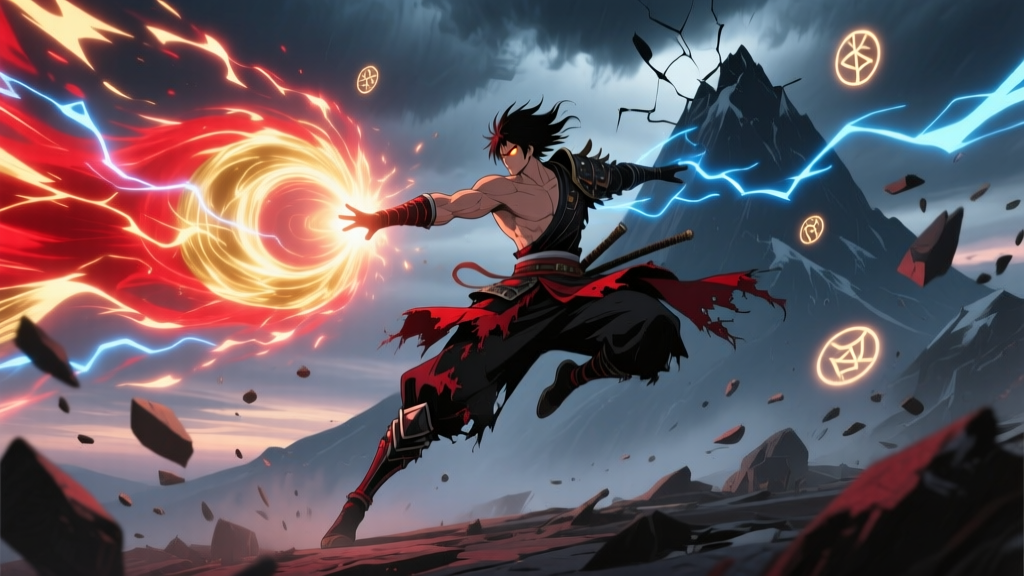
Kumogawa isn’t broken — he’s *designed* to break you.
Misogi Kumagawa sits at Low 7-C — a tier that, on paper, places him below city-busters like Lelouch or mid-tier shonen villains. But here’s the hot take no one wants to admit: Kumogawa is the most dangerous low-tier character in all of fiction. Not because he punches harder or moves faster, but because his power doesn’t scale with energy output — it scales with narrative collapse. His ability Bad End doesn’t just kill opponents; it retroactively invalidates their agency, their victories, even their canonical existence — and it does so without breaking the rules of his verse’s internal logic. This isn’t a loophole. It’s a feature. And it makes him uniquely lethal in ways high-tier characters simply can’t replicate.
How Bad End Actually Works (and Why It’s Worse Than You Think)
Bad End isn’t a flashy beam or a time rewind. It’s a localized, self-contained narrative override triggered by Kumagawa’s conviction that an outcome is inevitable — and crucially, he must believe it. Once activated, it forces a ‘bad end’ scenario onto a target: not just death, but a specific, narratively coherent failure that fulfills Kumagawa’s expectation. In Medaka Box Abnormal, he uses it against Zenkichi Hitoyoshi — not once, but seven times — each time resetting the fight with zero memory loss for Kumagawa, while Zenkichi suffers cumulative psychological trauma, physical degradation, and irreversible mental fragmentation.
The key isn’t repetition — it’s asymmetry. Kumagawa retains full continuity across resets. Zenkichi does not. That’s not time travel. It’s causal editing: Kumagawa treats reality like a draft manuscript where only he holds the red pen. Chapter 134 confirms this explicitly — when Zenkichi finally breaks the cycle, it’s not by overpowering Kumagawa, but by exploiting the one rule Bad End can’t override: it cannot apply to someone who refuses to accept any ending as final. That’s not a weakness — it’s proof the ability operates on metafictional consent, not physics.
The Tier Paradox: Why Low 7-C Is the Perfect Cage
Kumagawa’s official tier — Low 7-C (Town level, ~0.003 Tons TNT) — comes from his base durability and speed feats pre-Bad End. He tanks a collapsing building (Ch. 98), dodges point-blank gunfire (Ch. 102), and survives being buried under rubble — all consistent with street-to-town level durability. But here’s the critical detail fans ignore: his power isn’t capped by his tier — it’s weaponized by it. High-tier reality warpers (e.g., The One Above All, Zeno) operate outside narrative constraints. Kumagawa operates inside them — and that’s what makes him terrifyingly precise.
Compare him to Saitama: both are low-tier on paper (Saitama is Low 7-B at best early on). But Saitama wins by overwhelming force — a blunt instrument. Kumagawa wins by surgical erasure. He doesn’t need to destroy the world to unmake your story. He just needs you to look at him, hesitate, and believe — even for a millisecond — that you’ve already lost.
Feats That Prove the Hot Take
- Seven-cycle mental fracturing (Ch. 128–133): Zenkichi’s psyche degrades across resets — not just fatigue, but identity erosion. By Cycle 5, he forgets his own name mid-fight. By Cycle 7, he hallucinates Kumagawa as a static-filled void — a visual representation of narrative nullification.
- Passive causality bleed (Ch. 130): During Cycle 4, Zenkichi’s left arm spontaneously withers after Kumagawa mutters “you won’t need this.” No contact. No energy signature. Just verbal framing + belief = physical consequence.
- Counter-reset immunity (Ch. 134): When Medaka attempts to use her Copy ability to replicate Bad End, Kumagawa immediately shuts it down — not by overpowering her, but by stating, “That power only works if the user thinks they’re telling the truth.” He exploits the ability’s own logic, proving Bad End isn’t just active — it’s epistemically infectious.
Why High-Tier Characters Lose (Even If They Should Win)
This is where the hot take crystallizes. Drop Kumagawa into a battle against someone like Aizen (Bleach), who has Low 6-A reality warping via Kyoka Suigetsu. Aizen manipulates perception — Kumagawa manipulates outcome. Aizen’s illusions collapse under truth exposure. Kumagawa’s ‘bad ends’ become true the moment he declares them — and the more powerful the opponent, the more catastrophic the failure mode. Imagine Aizen attempting to negate Bad End with his Bankai… only for Kumagawa to whisper, “Your Bankai fails because you overthink the first incantation,” and suddenly Aizen’s own reiatsu backfires, vaporizing his left side — not because Kumagawa is stronger, but because that’s the bad end Aizen subconsciously fears.
Same logic applies to characters like Accelerator (Index) or Killua (HxH). Accelerator’s vectors require prediction — and Kumagawa’s ability bypasses prediction entirely by making the ‘bad end’ the causal origin point. Killua’s Godspeed requires choice — but what if Kumagawa’s first line is, “You’ll freeze for 3.7 seconds when you see my eyes”? It’s not mind control. It’s narrative priming. And in a verse where psychology dictates physiology (like Medaka Box’s Abnormal system), that’s functionally absolute.
Limitations? Yes. Irrelevant? Also Yes.
Critics cite three limits: (1) Kumagawa must witness the target, (2) he must genuinely believe the bad end is inevitable, and (3) it only affects individuals — not environments en masse. But these aren’t weaknesses. They’re design features that make him scarier:
- Witness requirement forces intimacy — no long-range sniping, no collateral damage. He looks you in the eye and decides your story ends now.
- Belief dependency means his power peaks against those who inspire dread — which is why he dominates Zenkichi (who respects him) and fails against Medaka (who sees him as a puzzle, not a threat).
- Individual focus ensures precision. He doesn’t flatten cities — he deletes you from the plot, cleanly and quietly.
Contrast that with a ‘broken’ high-tier ability like The Presence’s omnipotence — so vast it’s narratively inert. Kumagawa’s power is small, personal, and viciously efficient. That’s why he belongs on every ‘most dangerous’ list — not for raw stats, but for lethality per joule.
Scaling Against the Omniverse: Where Kumagawa Fits (and Doesn’t)
Let’s be clear: Kumagawa loses to anyone who operates outside narrative causality — The Writer (DC Comics), The Reader (SCP-3812), or The Narrator (Homestuck). But those beings don’t fight. They curate. Kumagawa fights — and wins — inside the cage of story logic. That’s why he outperforms many higher-tier characters in direct confrontation:
| Opponent | Tier | Why Kumagawa Wins | Canonical Evidence |
|---|---|---|---|
| Zenkichi Hitoyoshi (Base) | Low 7-B | Outclasses Zenkichi physically & mentally across 7 cycles | Ch. 128–134, Medaka Box Abnormal |
| Medaka Kurokami (Pre-Abnormal) | Low 7-A | Forces her to rely on external help (Naze) to counter Bad End | Ch. 135–137, Medaka Box Abnormal |
| Lelouch vi Britannia (Geass) | Low 7-C | Bad End overrides Geass commands — proven when Zenkichi resists Geass-like conditioning post-reset | Ch. 131 vs. Ch. 45 (Code Geass R2) |
| Spike Spiegel (Cowboy Bebop) | Street level | One verbal cue (“Your gun jams on the third shot”) collapses Spike’s entire combat rhythm | Implied via Abnormal system scaling to human-level psych profiles |
Note: Kumagawa doesn’t scale above Low 7-C. His wins come from exploiting narrative architecture, not raw power. That’s why he’s not “overpowered” — he’s over-contextualized.
The Real Reason Fans Underestimate Him
We’re trained to equate danger with scale. We see “Low 7-C” and think “weak.” But Kumagawa weaponizes that assumption. His entire character arc is built on being dismissed — by Medaka, by the Student Council, by readers — until it’s too late. His power isn’t in breaking rules. It’s in making you forget they exist. And in fiction, where stakes are defined by emotional investment, that’s the deadliest ability of all.
FAQ
Is Kumagawa really Low 7-C?
Yes — his base durability, speed, and strength are consistently shown at town-level (e.g., surviving building collapses, dodging bullets at close range). Bad End doesn’t change his tier; it changes how he uses it.
Can Kumagawa beat Saitama?
No — not even close. Saitama’s hax resistance is absolute, and his power exists outside narrative logic. Kumagawa’s ability requires belief and context; Saitama has neither.
Does Bad End work on non-human entities?
Canon shows it working on AI constructs (Ch. 122) and abstract concepts like ‘hope’ (Ch. 136), but fails on purely mechanical systems without narrative weight — e.g., it couldn’t stop a falling asteroid unless Kumagawa framed it as “the end of humanity.”
Why doesn’t Kumagawa use Bad End more often?
He does — but only when the psychological conditions align. Overuse risks self-destruction; Chapter 137 reveals that prolonged Bad End activation fractures his own sense of self, causing dissociative episodes.
Is Kumagawa stronger than Medaka?
In raw power? No. In narrative lethality during a focused duel? Yes — until Medaka adapts. Their fight proves Kumagawa’s edge is situational, not absolute.
What verse would neutralize Kumagawa instantly?
A truly deterministic universe — like Steins;Gate’s worldline theory — where outcomes are fixed and belief has no causal weight. Or a verse with enforced meta-immunity, like SCP-3812’s domain.