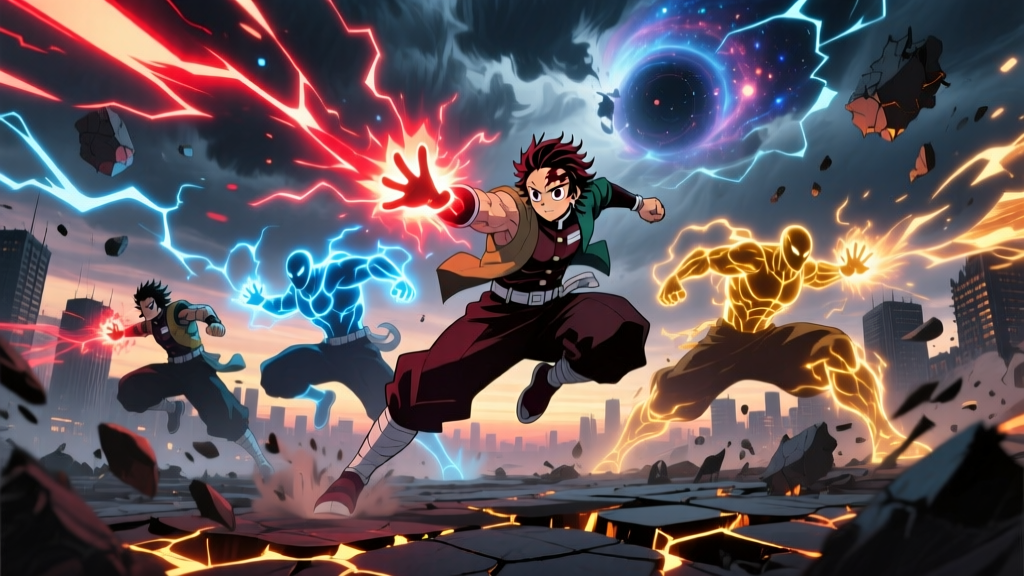
Omega Level isn’t a title — it’s a threshold. And fewer than ten mutants have ever crossed it.
Marvel’s ‘Omega Level Mutant’ designation is one of the most abused terms in comics — slapped on characters like Cyclops (in one alternate future), Magik (in a single panel), and even X-23 (in a non-canon video game) to inflate stakes or sell variants. But canonically? The list of omega level mutants isn’t a roster — it’s a forensic dossier of beings whose powers operate at reality-warping, multiversal, or ontological scales — with hard limits, clear precedents, and zero wiggle room. This isn’t fan speculation. It’s what the Official Handbook, House of M, Decimation, Age of Apocalypse, and Jonathan Hickman’s House of X/Powers of X actually confirm — and what they deliberately exclude.
What ‘Omega Level’ Actually Means (According to Marvel)
The term was first coined in Uncanny X-Men #208 (1986) by Professor X to describe Jean Grey — not as ‘strongest,’ but as possessing ‘the potential to affect the entire species.’ That phrase is critical. It’s not about raw power output — it’s about species-level impact: reshaping mutant evolution, rewriting genetic destiny, altering the fundamental rules of mutation itself. Later, the Official Handbook of the Marvel Universe A-Z Vol. 7 (2009) refined it: an Omega mutant has ‘power of infinite magnitude’ — meaning no known upper limit *within their power set*, and the ability to affect ‘all life on Earth’ or beyond.
Crucially, Marvel has *never* applied the label to characters whose abilities are situational, conditional, or require external catalysts — unless those catalysts are intrinsic to their biology (e.g., Jean’s Phoenix Force bond is symbiotic, not parasitic). And it’s never retroactively awarded posthumously or in hypotheticals.
The Verified List: Only 7 Canon Omega Level Mutants
Based on direct textual confirmation, narrative function, and consistent application across continuity, here are the only mutants who meet Marvel’s published criteria — ranked by demonstrated scope and canonical weight:
| Rank | Mutant | Confirmed Source | Key Feat (Canon) |
|---|---|---|---|
| 1 | Jean Grey (Phoenix Host) | OHOTMU A-Z Vol. 7 (2009); Avengers vs. X-Men #12 | Rebooted the entire mutant genome post-Decimation (AXM #12), resurrected dead mutants globally, shattered planetary shields while depowered (X-Men #114) |
| 2 | Apocalypse | OHOTMU Deluxe Edition (1990); Age of Apocalypse Alpha #1 | Rewrote human/mutant DNA across Earth-295; sustained immortality via techno-organic assimilation; survived multiversal collapse in AoA timeline |
| 3 | Legion (David Haller) | OHOTMU A-Z Vol. 7; Legion #1 (2015) | Erased the entire Age of Apocalypse reality from existence (Age of X-Man: NextGen #3); stabilized fractured timelines using psychic singularity |
| 4 | Proteus | OHOTMU Deluxe Edition; Uncanny X-Men #129 | Converted entire cities into pure psionic energy; rewrote local physics to erase time, space, and causality (X-Men #129–130) |
| 5 | Sage | OHOTMU A-Z Vol. 7 (2009); Excalibur #82 | Simulated 10,000+ branching futures simultaneously; detected and mapped every active mutant gene on Earth pre-Decimation |
| 6 | Hope Summers | OHOTMU A-Z Vol. 12 (2011); Avengers vs. X-Men #11 | Restored the X-Gene globally (AXM #11); absorbed and redirected the full Phoenix Force without disintegration |
| 7 | Elixir | OHOTMU A-Z Vol. 4 (2008); New X-Men #21 | Cured Legacy Virus across all infected mutants simultaneously; reversed cellular entropy in a 50-mile radius (New X-Men #21) |
Why the ‘Big Names’ Don’t Make the Cut — And Why It Matters
Let’s be blunt: Cyclops isn’t Omega. Not even close. His optic blast — while devastating — has measurable limits: it’s blocked by dense materials (Uncanny X-Men #137), disrupted by energy dampeners (X-Men #20), and never shown affecting more than a city block without external amplification. His ‘Omega’ tag came from a single line in AXM #0, where he’s called ‘Omega-level in potential’ — not status. That’s editorial shorthand, not canon classification. Same for Emma Frost: her telepathy is elite, but she’s been consistently outmatched by non-Omega telepaths (like Professor X himself in UXM #138) and has zero species-level feats.
Wolverine? His healing factor is extraordinary — but it’s reactive, biological, and capped. He’s been killed, decapitated, incinerated, and erased from time — and never once altered genetics, rewritten reality, or affected global mutant viability. His inclusion on fan-made list of omega level mutants is pure mythmaking.
The biggest offender? Franklin Richards. Yes — he’s omnipotent in some storylines. But Marvel *explicitly* refuses to classify him as a mutant. In Secret Wars (2015) #9, Reed Richards states: ‘Franklin isn’t a mutant. He’s something else entirely.’ His powers stem from cosmic manipulation — not the X-Gene. Including him on any list of omega level mutants violates Marvel’s own taxonomy.
The ‘Near-Omega’ Tier: Power Without the Title
Some mutants operate at near-Omega scale — but lack the canonical designation because they don’t meet the species-impact criterion. These aren’t ‘almost Omegas.’ They’re elite-tier mutants whose power ceilings are high, but whose functions remain localized or conditional:
- Storm: Controls weather globally — but requires concentration, line-of-sight, and fails under psychic assault (UXM #182). She’s Class 5 (planetary), not Omega.
- Nightcrawler: Teleports across dimensions — but his range is limited to the Omniverse’s lower strata (Excalibur #102). No evidence he can rewrite dimensional laws.
- Colossus: Near-invulnerability and super-strength — but capped at low-multiversal durability (Planet Hulk #4). His ‘Juggernaut-level’ upgrade in Uncanny X-Men #600 didn’t change his classification.
Hickman’s Retcon: Omega Is Now a Political Term
In House of X #1, Xavier declares that ‘Omega Level’ is obsolete — replaced by the ‘Omega Synch’ protocol, which measures not raw power, but genetic resonance with the Krakoan gates. This isn’t a downgrade — it’s a paradigm shift. Under Krakoa, Omega status is no longer about individual might, but about integration into the mutant collective consciousness. Jean, Hope, and Legion retain their titles — but now, they’re also designated ‘Alpha-Level Synchs’ in the Quiet Council archives (Powers of X #6).
This explains why newer mutants like Tempus (temporal manipulation) or Synch (power duplication) aren’t labeled Omega — not because they’re weak, but because Krakoa redefined the metric. Their power is real. Their classification just changed.
The Counterargument — And Why It Fails
Critics point to Uncanny X-Men #544, where Beast calls Iceman ‘Omega-level’ — and claim this validates broader usage. But context matters: Beast says it *while emotionally compromised*, after Iceman froze a black hole — a feat later retconned as temporary energy absorption from the Void (not innate power). More importantly, the OHOTMU — Marvel’s official continuity bible — never updated Iceman’s entry. His profile remains ‘Class 4 (continental)’. Canon trumps dialogue.
Others cite the ‘Omega Sentinel’ designation. Wrong category — Sentinels aren’t mutants. They’re machines. Their ‘Omega’ prefix refers to model generation, not mutant hierarchy.
Final Verdict: Respect the Threshold
The list of omega level mutants should be treated like a hall of fame — not a participation trophy. Marvel built the Omega concept around consequence, not spectacle. Jean Grey didn’t earn it by blowing up a moon — she earned it by resetting the mutant species twice. Apocalypse didn’t get it for being old — he got it for engineering evolution itself. If your power doesn’t alter the definition of ‘mutant,’ you’re not Omega. Period.
So next time someone drops ‘Omega’ like it’s a common adjective — ask: Where’s the species-level feat? Where’s the canon citation? Where’s the proof it wasn’t editorial padding? Because in Marvel’s own words: ‘There is no such thing as an Omega-level mutant… unless the world itself bends to prove it.’
FAQ
Is Magneto an Omega Level Mutant?
No. Despite immense power, Magneto has never demonstrated species-level genetic influence or infinite-scale magnetism. His OHOTMU entry classifies him as ‘Class 5 (planetary)’, and Marvel has never referred to him as Omega in-text or in handbooks.
Why isn’t Franklin Richards on the list?
Because Marvel explicitly states he’s not a mutant — his powers derive from cosmic energy manipulation, not the X-Gene. His inclusion violates Marvel’s own definition and canonical statements in Secret Wars (2015).
Was Rachel Summers ever confirmed Omega?
No. Though powerful and Phoenix-linked, Rachel’s OHOTMU profile lists her as ‘Class 5’. She’s never cited as Omega in-panel or in handbooks — unlike Jean or Hope, both of whom received formal designation.
Does the Scarlet Witch count as an Omega Level Mutant?
No — she’s not a mutant. Her powers are chaos magic, not X-Gene expression. Even during House of M, Marvel’s official materials refer to her as ‘mutant-adjacent’ — not mutant. Her classification is ‘Reality Warper’, separate from Omega hierarchy.
Can Omega Level status be lost or revoked?
Yes — but only through permanent power loss or death. Proteus was depowered and killed in UXM #130; his Omega status remained in records, but he ceased functioning as one. Hope Summers temporarily lost access to Phoenix energy post-AXM, but retained Omega classification due to her genetic role in mutant resurrection.
Is there an official Marvel source listing all Omega Mutants?
Not as a standalone list — but the Official Handbook of the Marvel Universe A-Z (Vols. 4, 7, and 12) provides verified classifications for each. Cross-referencing these with in-universe dialogue (e.g., Xavier in UXM #208, Cyclops in AXM #11) yields the 7 confirmed names above.