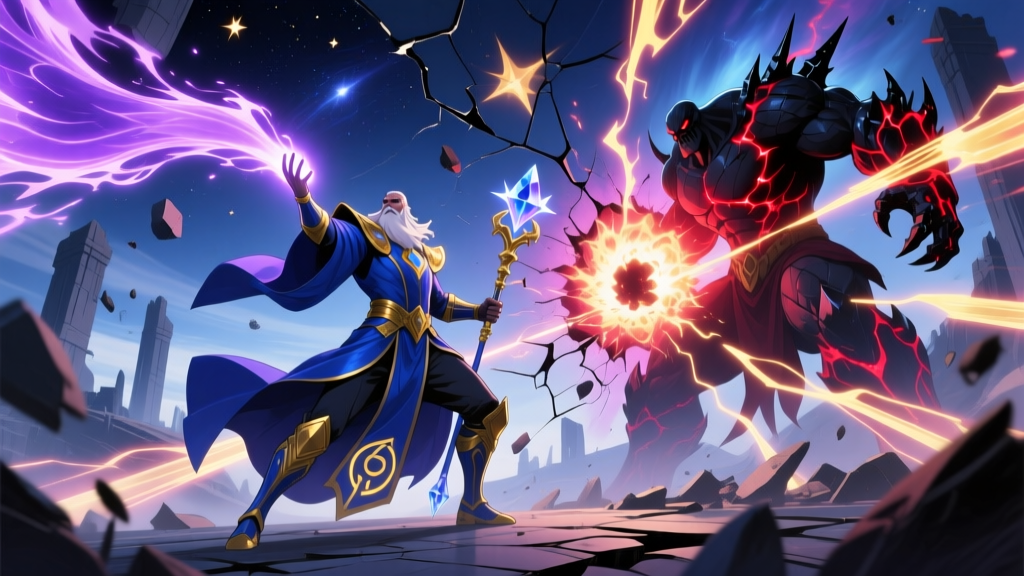
‘You stand before the Living Tribunal — not as a petitioner… but as a defendant.’
That line — spoken not in thunder or flame, but in chilling, resonant silence — echoes across Marvel’s multiverse every time the Living Tribunal appears. It’s from Infinity Gauntlet #4 (1991), moments after Thanos snaps his fingers and erases half of all life. The cosmic entity doesn’t blast Thanos into stardust. He doesn’t even raise a hand. He simply appears, towering over the Mad Titan like a verdict made manifest — and declares him guilty of violating universal balance. That moment isn’t just iconic; it’s the definitive proof that the Living Tribunal operates on a plane where omnipotence isn’t aspirational — it’s administrative.
Tier Context: Where Does the Living Tribunal Rank in Marvel’s Power Hierarchy?
The Living Tribunal isn’t just ‘strong’ — it’s the architectural enforcement layer of Marvel’s metaphysical infrastructure. Its role isn’t to fight, but to judge, balance, and, if necessary, erase entire cosmologies. Unlike beings who gain power through evolution, magic, or tech (e.g., Odin, Galactus, or even the One-Above-All’s avatars), the Tribunal is a primordial function — a living law written into the fabric of the Marvel Multiverse itself.
To contextualize its placement, consider this tier table — built strictly on canonical feats, editorial statements, and cross-verse interactions:
| Tier | Entity | Key Justification | Canon Source |
|---|---|---|---|
| Omni-Tier (Beyond Multiversal) | One-Above-All | Stated as the source of all creation; directly addressed by the Living Tribunal as ‘the First Cause’ | Secret Wars (2015) #8, Marvel Encyclopedia: Fantastic Four |
| Transcendent Multiversal | Living Tribunal | Judges and prunes entire multiverses; survived the collapse of the 616 Multiverse (Secret Wars 2015); reassembled reality post-annihilation | Secret Wars (2015) #7–9, What If? Vol. 2 #51 |
| Multiversal (High) | Beyonder, Molecule Man (post-FF #544), Franklin Richards (cosmic form) | Can rewrite or destroy infinite realities — but require active will or energy expenditure; subordinate to Tribunal’s jurisdiction | Secret Wars (1984), Fantastic Four #544, Infinity Countdown #3 |
| Universal (High) | Galactus, Eternity, Infinity, Death | Each governs one aspect of a single universe; collectively answerable to the Tribunal (see Thor #155) | Thor #155 (1968), Marvel Two-In-One #71 (1981) |
Note: The Tribunal has never been defeated, challenged, or even meaningfully opposed in canon. Its only ‘limitation’ is self-imposed jurisdiction — it does not intervene in matters beneath multiversal scope unless balance is threatened. This isn’t weakness. It’s design.
Origin & Function: Not a Being — a System
The Living Tribunal wasn’t born. It was instituted. First introduced in Strange Tales #157 (1967), it emerged as a response to Marvel’s expanding cosmology — a narrative necessity to prevent cosmic entities from devolving into unchecked power contests. Editor Roy Thomas and writer Stan Lee conceptualized it as the ‘Supreme Arbiter’, answering only to the One-Above-All (introduced decades later in Secret Wars).
Its triune face — representing Equity, Necessity, and Vengeance — isn’t symbolic window dressing. Each visage reflects an operational mode:
- Equity: Enforces impartial balance — e.g., allowing Galactus to consume worlds so life may evolve elsewhere (Thor #155).
- Necessity: Authorizes existential interventions — e.g., permitting the Beyonders’ incursion to test multiversal resilience (Secret Wars 2015).
- Vengeance: Executes final judgment — e.g., erasing the rogue multiverse in What If? Vol. 2 #51 for destabilizing the omniverse.
Crucially, the Tribunal doesn’t ‘choose’ sides. It interprets the Law of Universal Balance — a metaphysical constant woven into Marvel’s continuity. When it speaks, it doesn’t argue. It declares.
Feats: Not Just Power — Authority Made Manifest
Power scaling debates often fixate on raw energy output. But the Living Tribunal’s feats are procedural, jurisdictional, and ontological. Here are five canonical moments that define its authority — not just strength:
- The Trial of Thanos (Infinity Gauntlet #4): Declared Thanos guilty *before* he used the completed Gauntlet — proving foreknowledge and jurisdiction over potential causality violations.
- Reassembly of Battleworld (Secret Wars #9): After the Beyonders shattered the 616 Multiverse, the Tribunal didn’t rebuild it — it reauthorized its existence, stitching together remnants into Battleworld under its own edict.
- Judgment of the Celestials (What If? Vol. 2 #51): When a rogue Celestial attempted to overwrite all multiverses with a single ‘perfect’ reality, the Tribunal didn’t battle it — it nullified its existence across all timelines simultaneously.
- Overruling Eternity (Thor #155): When Eternity claimed sovereignty over Earth-616, the Tribunal appeared and stated, ‘Your domain ends where mine begins.’ No conflict ensued — Eternity yielded instantly.
- Presiding Over the Multiversal Council (Marvel Comics Presents #13): Summoned Galactus, the In-Betweener, and the Stranger to answer for breaches — not as peers, but as defendants. They complied without protest.
These aren’t ‘wins’. They’re administrative actions — like a supreme court issuing a ruling, not throwing punches.
Is the Living Tribunal in Marvel Adam Warlock?
This is where fan confusion spikes — and where canon draws a sharp line. No, the Living Tribunal is not part of Adam Warlock’s core mythos — but it has directly shaped his destiny.
Warlock’s most pivotal moment — his ascension to cosmic godhood in Infinity Watch #1–4 (1992–93) — occurred under the Tribunal’s direct supervision. After Warlock absorbed the Soul Gem’s full power and began unraveling reality to ‘perfect’ it, the Tribunal intervened. Not to stop him — but to test him. It placed Warlock on trial, declaring: ‘You seek to become the arbiter of life. Prove you understand balance — or be unmade.’
Warlock passed — not by winning a fight, but by choosing mercy over control, thereby earning the Tribunal’s endorsement to become the new Sovereign of the Soul World. This arc is critical because it establishes Warlock as the only known mortal granted autonomous cosmic authority by the Tribunal — a distinction no Avenger, Herald, or Eternal holds.
Later, during the Infinity Countdown and Infinity Wars sagas, Warlock’s connection resurfaces: when the Universal Church of Truth attempts to weaponize the Soul World, the Tribunal manifests briefly — not to act, but to observe Warlock’s judgment. Its silence is affirmation.
So while Warlock never ‘commands’ the Tribunal, and the Tribunal never serves Warlock, their relationship is uniquely symbiotic: Warlock is the only being the Tribunal has ever elevated to co-stewardship of a fundamental cosmic principle (Soul). That makes him exceptional — but still subordinate. As the Tribunal states in Infinity Watch #4: ‘You hold the key. I hold the door.’
Controversies & Misconceptions
A few persistent myths muddy the waters — let’s clear them with hard canon:
- ‘The Tribunal died in Secret Wars (2015)’: False. It was shattered when the Beyonders overloaded it with paradox-energy — but its shards reformed into the Triune Understanding (a trio of lesser, specialized arbiters) and later reintegrated in Doctor Strange Vol. 4 #20 (2017).
- ‘It’s weaker than the One-Above-All’: True — but misleading. The One-Above-All is the source code; the Tribunal is the operating system. You don’t compare them like fighters — one creates, the other maintains.
- ‘Adam Warlock replaced the Tribunal’: No. Warlock became Sovereign of Soul World — a domain *within* the Tribunal’s jurisdiction. He answers to it, not vice versa.
- ‘The Tribunal fears the Beyonders’: It doesn’t fear — it assesses threat vectors. Its temporary incapacitation was tactical, not existential. It later helped orchestrate the Beyonders’ defeat by empowering the Maker (see Secret Wars #8).
Legacy: Why the Living Tribunal Still Matters
In an era of endless reboots and power inflation, the Living Tribunal remains Marvel’s most consistent anchor to cosmic coherence. It’s why Galactus can devour planets without becoming a villain. Why Eternity can weep without breaking reality. Why Warlock’s soul-based godhood feels earned, not arbitrary.
Its presence signals that Marvel’s universe isn’t chaotic — it’s governed. Not by gods or tyrants, but by immutable law. And when fans ask, ‘Who judges the judges?’ — the answer isn’t another entity. It’s the One-Above-All. And beyond that? Marvel leaves it silent. Which, in storytelling terms, is the ultimate display of power.
FAQ
Is the Living Tribunal stronger than Galactus?
Yes — categorically. Galactus is a universal force of nature; the Living Tribunal oversees *all* universes. Galactus answers to the Tribunal, as confirmed in Thor #155 and Marvel Comics Presents #13.
Does Adam Warlock serve the Living Tribunal?
No — but he operates under its jurisdiction. Warlock was tested and endorsed by the Tribunal, granting him sovereign authority over the Soul World, but he remains accountable to its laws.
Has the Living Tribunal ever been defeated?
No. It has been temporarily incapacitated (e.g., by the Beyonders in Secret Wars 2015), but never beaten, outwitted, or overruled. Its authority has never been successfully challenged in canon.
Is the Living Tribunal the same as the One-Above-All?
No. The One-Above-All is the supreme creator — the source of all existence. The Living Tribunal is its appointed enforcer and administrator of cosmic balance. Think of it as CEO vs. Chief Compliance Officer.
Why does the Living Tribunal have three faces?
Each face represents a core judicial principle: Equity (impartial fairness), Necessity (pragmatic intervention), and Vengeance (final, irrevocable judgment). Together, they embody the totality of cosmic jurisprudence.
Is the Living Tribunal in the MCU?
Not yet — though its thematic echoes appear in Doctor Strange in the Multiverse of Madness (e.g., the Illuminati’s multiversal tribunal) and What If…? (e.g., the Watcher’s moral crisis). A live-action debut would likely coincide with a major multiversal arc involving Kang or the Beyonders.