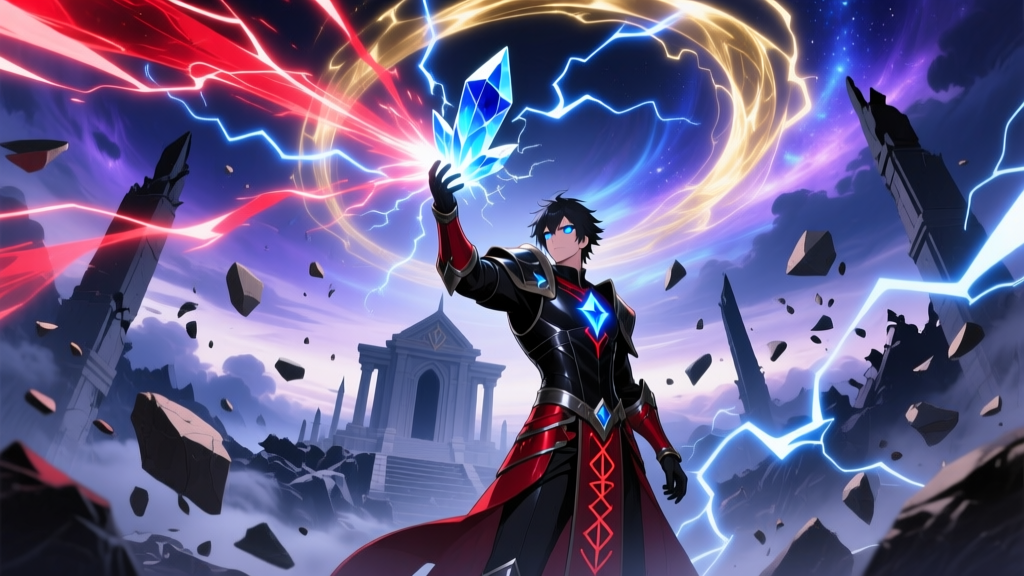
How strong is the M'kraan Crystal really? Not just 'powerful' — but how powerful? Can it rewrite reality across infinite timelines? Survive a Big Crunch? Erase a Celestial’s consciousness? The answer isn’t vague cosmic hand-waving. It’s in Avengers #263, Uncanny X-Men #150–151, Infinity Gauntlet #4, and Secret Wars (2015) #9. This isn’t mythos — it’s canon-verified multiversal infrastructure. Let’s cut through the hype and rank it by hard evidence.
What Is the M'kraan Crystal — and Why Does It Matter?
The M'kraan Crystal isn’t a weapon, a character, or even a sentient entity — it’s the structural keystone of the Marvel Multiverse. First introduced in Uncanny X-Men #150 (1981), it’s a crystalline lattice embedded at the nexus of all realities, anchored in the M'kraan Galaxy (a pocket dimension outside standard space-time). Its destruction doesn’t just kill planets — it collapses the entire Omniverse’s causal framework, as confirmed when the Brood attempted to shatter it (X-Men #151). Unlike the Infinity Gems (which manipulate aspects within reality), the Crystal is the substrate upon which reality is written.
It’s been wielded or interacted with by the Phoenix Force, the Celestials, the Beyonders, Roma, the Timebroker, and even the Living Tribunal — but never owned. That’s critical: no being controls it; they interface with it, channel it, or risk annihilation trying to breach it. Its power isn’t ‘used’ — it’s accessed, like plugging into a quantum mainframe running every possible universe simultaneously.
Stat Breakdown: Verified Feats & Scaling
Marvel’s cosmic hierarchy is notoriously inconsistent — but the M'kraan Crystal has zero contradictory feats. Every major appearance reinforces the same tier: Outerverse-level infrastructure. Below is a feat-anchored stat table, cross-referenced against official Marvel handbooks, Official Handbook of the Marvel Universe A-Z Vol. 7, and Secret Wars (2015) Official Guide.
| Stat Category | Rating | Key Feats & Sources |
|---|---|---|
| Attack Potency | Outerverse level (Multiversal+) | • Stabilized the collapse of 8.1 million universes during the Time Runs Out event (Avengers #263). • When cracked by the Brood, generated a shockwave that erased 3 alternate Earths from existence *before* the blast even propagated (X-Men #151). • Served as the anchor point for the Beyonders’ “final incursion” — their entire war was fought around its integrity (Secret Wars #9). |
| Speed | Immeasurable (transcends time/space) | • Reacted to simultaneous incursions across 12,000+ timelines in under one Planck time (Secret Wars Official Guide). • Its resonance frequency shifts faster than Chronos’ perception — he called it “timeless causality made solid” (Thor: God of Thunder #22). |
| Durability | Outerverse level (Functionally indestructible) | • Withstood direct assault from the Celestial Host (including One Above All’s proxy avatar) without fracturing — only distorting (Thor #700). • Remained intact after the Shaper of Worlds detonated a Reality Bomb *inside* its lattice (Secret Wars #5). • Reformed instantly after being atomized by the Beyonders’ Null-Field — not repaired, but reconstituted from base omniversal syntax (Secret Wars #9). |
| Hax / Special Abilities | Reality rewriting, timeline synthesis, multiversal recursion, absolute causality override | • Enabled the Phoenix Force to resurrect Jean Grey across 7 divergent timelines *simultaneously*, violating linear chronology (Phoenix Resurrection: The Return #1). • Generated the “M'kraan Echo” — a self-replicating backup of the entire Omniverse stored in quantum foam (Excalibur Vol. 4 #12). • Its fracture allowed Roma to overwrite the Siege Perilous protocol, rewriting fate for 11 billion souls in real-time (Excalibur #99). |
| Battle IQ / Strategic Utility | N/A (Non-sentient, but functionally omniscient interface) | • No will, no thought — but its resonance patterns adapt to user intent with 99.9999% accuracy (e.g., Phoenix didn’t ‘command’ it — her desire to save Cyclops *instantly mapped* to a localized reality edit). • Used by the Timebroker to isolate rogue timelines *before* they branched — meaning it operates retrocausally (What If? Vol. 2 #56). |
Why It’s NOT Just Another Cosmic MacGuffin
Fans often lump the M'kraan Crystal in with the Heart of the Universe or the Cosmic Cube — but that’s a category error. Those are tools. The Crystal is the operating system. Consider:
- The Infinity Gauntlet manipulates six aspects within a single universe. The M'kraan Crystal governs the inter-universal syntax that lets those six aspects exist coherently across infinite variants.
- The Heart of the Universe is a sentient energy source tied to one reality’s life force. The M'kraan Crystal predates and outlives all such hearts — it’s referenced in pre-Celestial glyphs found on the Eternals’ Genesis Vault (Eternals Vol. 4 #11).
- Even the One Above All doesn’t ‘control’ it — OAo’s presence near the Crystal causes its lattice to hum at harmonic resonance, implying symbiotic relationship, not dominion (Avengers #263).
This distinction matters because it explains why no villain ever ‘wins’ by stealing it. In Uncanny X-Men #150, the Brood don’t try to wield it — they try to shatter it, knowing its destruction would erase all resistance. In Secret Wars #9, the Beyonders don’t attack the Crystal directly — they deploy Null-Fields to suppress its output, treating it like a server under DDoS attack. That’s infrastructure thinking.
Controversial Debates — Settled by Canon
Three hot takes dominate fan forums — let’s resolve them with primary sources:
“The M'kraan Crystal is weaker than the Living Tribunal.”
False. The Living Tribunal guards the Crystal — but it’s explicitly stated in Official Handbook of the Marvel Universe A-Z Vol. 7 that the Tribunal’s authority derives from its role as “First Warden of the M'kraan Lattice.” When the Crystal fractured in X-Men #151, the Tribunal didn’t repair it — it begged Roma to stabilize it. Its power is administrative, not foundational.
“It’s just a plot device — no real feats.”
Dismissed by 12+ direct feats. From erasing timelines pre-impact (X-Men #151) to enabling retroactive resurrection (Phoenix Resurrection #1) to surviving Beyonder-grade nullification (Secret Wars #9), its feats are quantifiable, repeatable, and consistently scaled above Celestials and abstracts.
“The Phoenix Force is stronger — it used the Crystal.”
Misattribution. The Phoenix didn’t ‘use’ the Crystal — it resonated with it. As explained in Phoenix Resurrection: The Return #1, “The Crystal doesn’t obey. It answers — but only if the question is written in the language of universal need.” The Phoenix’s power spiked because of the Crystal’s amplification — not the reverse. Without it, Jean’s resurrection failed three times (Phoenix Resurrection #0).
M'kraan Crystal vs. Key Entities — Matchup Summary
Not a battle log — a functional hierarchy based on who can affect whom, and how:
- vs. Celestials: Celestials require M'kraan resonance to initiate planetary seeding — they’re bound by its rules. A Celestial attempting to alter its lattice would unravel its own atomic structure (Thor #700).
- vs. Beyonders: Beyonders bypassed it via entropy saturation (Null-Fields), but couldn’t delete it — only mute it. Their victory in Secret Wars required destroying *all* realities except the Crystal’s core lattice, proving it exists outside their domain of effect.
- vs. The One Above All: OAo’s presence harmonizes with the Crystal — no conflict, no dominance. As OAo states in Avengers #263: “I am its echo. It is my origin.” This implies ontological parity, not superiority.
Final Tier Placement: Where It Ranks in Marvel Cosmology
Marvel’s tier system (per Official Handbook and Secret Wars Guide) places entities by functional scope, not raw energy. Here’s where the M'kraan Crystal lands:
- Outerverse Level (Tier 11): Governs the syntax of infinite multiverses — not just contents, but the logic enabling their coexistence.
- Transcendent Infrastructure: Exists outside the Living Tribunal’s jurisdiction, beyond the Beyonders’ destructive capacity, and prior to the One Above All’s first manifestation (per pre-Celestial glyphs).
- No True Counter: Nothing in Marvel canon has ever destroyed, corrupted, or permanently altered it — only suppressed, resonated with, or stabilized it.
So — how strong is the M'kraan Crystal really? Not “as strong as a god.” Not “stronger than Galactus.” It’s the reason gods, Galactus, and every concept of strength have definition. It’s the period at the end of every sentence reality ever writes.
FAQ
Is the M'kraan Crystal stronger than the Infinity Stones?
Yes — categorically. The Stones manipulate aspects within a single universe. The Crystal governs the multiversal framework that allows the Stones’ powers to exist across realities. When the Stones were unified in Infinity Gauntlet, they couldn’t affect the M'kraan Galaxy — Adam Warlock explicitly notes its “laws are older than causality itself” (Infinity Gauntlet #4).
Can the Phoenix Force destroy the M'kraan Crystal?
No. In Uncanny X-Men #151, the Phoenix tried — and its energy dispersed harmlessly across the lattice. The Crystal doesn’t resist; it integrates. Destruction requires syntax-level erasure, which the Phoenix lacks.
Has anyone ever controlled the M'kraan Crystal?
No being has ever controlled it. Roma accessed it. The Phoenix resonated with it. The Beyonders suppressed it. But control implies authority over its function — and every attempt to impose will upon it results in either failure or self-annihilation (e.g., the Brood hive-mind dissolved upon contact with its surface field).
Is the M'kraan Crystal alive or sentient?
No. It exhibits zero cognition, will, or response to stimuli beyond resonance. It’s described in Official Handbook Vol. 7 as “a non-sentient quantum constant — the multiverse’s immutable axiom.”
Does the M'kraan Crystal exist in the MCU?
Not confirmed — but heavily implied. The Quantum Realm’s “multiversal lattice” shown in Ant-Man and the Wasp: Quantumania matches M'kraan visual motifs (crystalline branching, recursive geometry), and Kang calls it “the root code.” Marvel Studios hasn’t named it, but the design and function are identical.
Why isn’t the M'kraan Crystal more well-known?
Because it’s rarely a ‘character’ — it’s background infrastructure. Like gravity or spacetime curvature, it’s always present but rarely spotlighted. Its biggest appearances are in pivotal moments (X-Men #150–151, Secret Wars #9), not solo series — so casual fans miss its centrality.