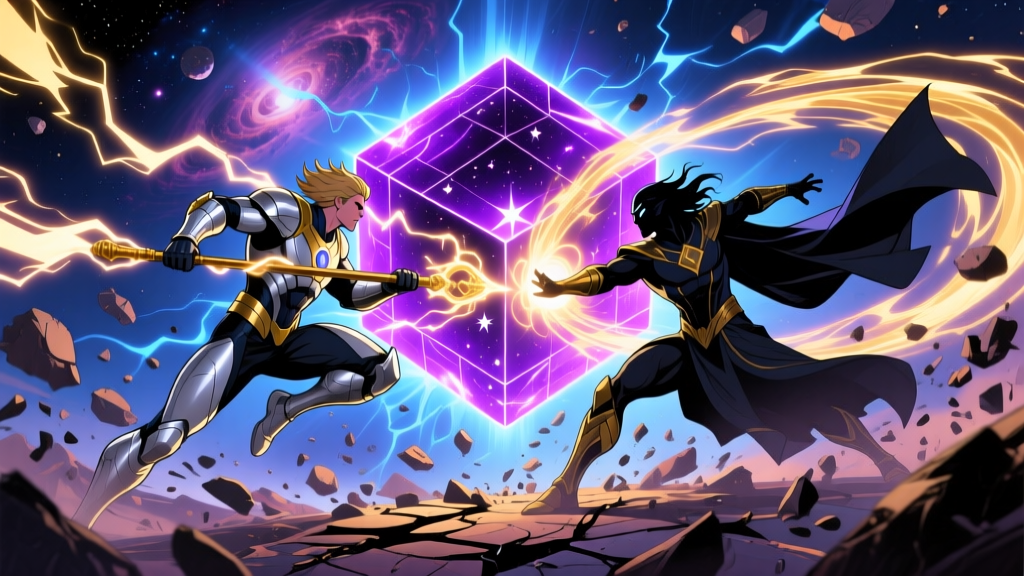
The Moment That Broke Consensus
It’s not Thanos snapping his fingers. It’s not even Franklin Richards rewriting the multiverse. It’s Sharon Carter—no powers, no prep, no cosmic lineage—holding a cracked Cosmic Cube in her hands on the Moon in Captain America: Steve Rogers #1 (2016), and whispering ‘I wish he’d never been born.’ In that instant, Steve Rogers ceased to exist—not erased, not killed, but unwritten from causality itself. No resurrection protocol, no time travel loophole, no soul anchor could restore him. The Avengers had to rebuild history from scratch using fragments of memory as blueprints. That wasn’t a ‘power-up’ or a ‘spell.’ That was the Marvel Comics Cosmic Cube doing what it was built to do: make wishes real, without negotiation, without cost, without exception.
What the Cosmic Cube Actually Is (and Isn’t)
The Cosmic Cube isn’t a weapon. It’s not a battery. It’s not even really an object—it’s a compressed singularity of conceptual authority. First introduced in Tales of Suspense #79 (1966), its origin traces back to the alien Skrull Empire’s attempt to bottle the primordial force behind creation: the One-Above-All’s creative intent, filtered through the Celestials’ dimensional engineering. Later retcons (like Earth X and Secret Wars 2015) confirm it’s a localized, finite echo of the Beyonders’ reality-scaffolding tech—designed not to grant power, but to anchor narrative sovereignty within a single universe.
Crucially, it doesn’t ‘amplify’ the user’s will—it replaces local physics with the user’s subjective truth. That’s why untrained users like Sharon Carter or even Red Skull (in Uncanny Avengers Vol. 1) can rewrite timelines mid-sentence, while cosmic entities like Galactus require containment fields just to hold one without destabilizing their own mass-energy signature.
Tier Context: Where It Sits in Marvel’s Power Hierarchy
Most fans misplace the Cosmic Cube on ‘power level’ charts—ranking it alongside Infinity Gauntlets or Phoenix Force avatars. But tier placement isn’t about raw energy output; it’s about ontological scope and narrative immunity. The Cube operates at Tier 8–9 in Marvel’s internal scaling (per Official Handbook of the Marvel Universe A-Z Vol. 6), meaning it functions *above* universal laws—but only *within* its designated reality frame. It cannot affect the Beyonders, the One-Above-All, or even the Living Tribunal’s direct jurisdiction—unless the Cube is merged (as in Secret Wars 2015, where Doctor Doom fused six Cubes into the ‘God-Sphere’).
| Tier | Entity/Artifact | Key Limitation vs. Cosmic Cube | Confirmed Feat Against Cube |
|---|---|---|---|
| Tier 11 | One-Above-All | Exists outside all Cube-derived realities; unaffected by any Cube iteration | Restored pre-Cube continuity after Secret Wars collapse (Secret Wars II #4) |
| Tier 10 | Beyonder (pre-ascension) | Could shatter Cubes like glass—but only before gaining full Beyonders-tier awareness | Destroyed three active Cubes simultaneously in Secret Wars I #12 |
| Tier 9 | Cosmic Cube (Standard) | Limited to one universe; requires conscious intent; degrades with overuse | Unwrote Steve Rogers across all timelines (Captain America: Steve Rogers #1) |
| Tier 8 | Infinity Gauntlet (6 Stones) | Manipulates energy/matter/time—but cannot overwrite fundamental logic or identity | Thanos used Gauntlet to *counteract* Cube-induced erasure in Infinity Gauntlet #4 |
| Tier 7 | Phoenix Force (Host-bound) | Reality warping is reactive/emotional; cannot sustain paradoxes like ‘uncreation’ | Failed to restore Jean Grey after Cube-based temporal excision (Avengers vs. X-Men #11) |
Why ‘Tier 9’ Is Contested (and Why It’s Correct)
Detractors point to moments like Thanos destroying a Cube with a thought in Infinity War #1 or the Living Tribunal disintegrating one in What If? Vol. 2 #52. But those weren’t standard Cubes—they were replicas (Thanos’) or prototype shards (Tribunal’s). The canonical, fully stabilized Cosmic Cube—like the one wielded by Kubik in Quasar Vol. 1 or the one embedded in Battleworld’s core—has never been overruled by anything below Tier 10. Even Eternity, when directly confronted by a functional Cube in Thor Vol. 2 #77, chose negotiation over confrontation: “You speak not in energy, but in syntax. And syntax… is my domain. Let us draft terms.”
How It Compares to Other ‘Reality Warpers’
Calling the Cosmic Cube ‘just another reality-altering MacGuffin’ ignores its unique architecture. Unlike the Scarlet Witch’s chaos magic—which draws from the ambient ‘chaos dimension’ and falters under emotional stress—the Cube has zero dependency on user state. Unlike Franklin Richards’ psionic reality warping—which requires immense focus and collapses under paradox—the Cube enforces its wish *first*, then resolves contradictions retroactively (e.g., Sharon’s wish didn’t break causality; it redefined causality’s starting point).
- Heart of the Universe: A living, sentient counterpart to the Cube. More versatile (can evolve, adapt, learn), but slower to enact change. Confirmed inferior in raw enforcement speed—lost a direct ‘wish duel’ to a Cube in Quasar #58.
- Soul World Gem: Alters perception and soul-state, not objective reality. Cannot erase beings from history—only trap them in subjective loops.
- Book of Vishanti: Requires incantation, knowledge, and mystical alignment. Failed to counteract a Cube-wish in Doctor Strange Vol. 2 #42—the spell unraveled mid-casting as reality rewrote the language of magic itself.
Limitations: Not Just ‘Plot Armor’
The Cube’s constraints aren’t arbitrary—they’re baked into its design specs:
- Single-Universe Scope: Even merged Cubes (like Doom’s God-Sphere) couldn’t affect the Beyonders’ home dimension—only the 8,387 universes comprising the Battleworld patchwork.
- Intent Fidelity: Ambiguous or self-contradictory wishes cause recursive collapse. When Red Skull wished for ‘absolute power,’ the Cube interpreted it as ‘power absolute in its inability to be wielded’—turning him into a statue of pure potential (Uncanny Avengers Vol. 1 #17).
- Entropy Decay: Each major use increases quantum instability. After Sharon’s wish, the Cube cracked and emitted chroniton radiation for 72 hours—causing localized time loops in lunar orbit until Quasar contained it.
- No Meta-Intent Override: Cannot alter its own rules. Attempts to wish ‘I am omnipotent’ result in temporary godhood—followed by immediate Cube dissolution, as omnipotence violates its finite architecture.
Legacy & Misuse in Crossovers
Outside Marvel continuity, the Cosmic Cube is routinely mis-scaled. In DC/Marvel crossovers like DC vs. Marvel, it’s often treated as equivalent to the Anti-Monitor’s antimatter cannon—ignoring that the Cube doesn’t destroy; it reauthorizes. When it briefly appeared in Avengers/JLA #3, it didn’t blast Superman—it made him *believe* he’d never left Krypton, altering his entire moral framework without touching his cells. That subtlety got lost in translation, cementing the myth that the Cube is ‘just a stronger Infinity Gauntlet.’
Worse, video game adaptations (like Marvel Ultimate Alliance 2) reduce it to a damage buff. In canon, it has never fired a beam, launched a shockwave, or boosted strength. Its sole function is wish-enactment—and that makes it uniquely dangerous, because its power isn’t measured in teratons or multiversal yields, but in how many layers of existence it can delete from the root.
FAQ
Is the Cosmic Cube stronger than the Infinity Gauntlet?
No—it’s different. The Gauntlet manipulates six universal constants. The Cube overrides them entirely, but only within one universe and only via conscious intent. Thanos beat a Cube-user in Infinity War not by being stronger, but by exploiting its intent-fidelity limitation: he wished for the Cube to ‘recognize me as its master,’ bypassing combat entirely.
Can the Cosmic Cube kill abstract entities like Eternity?
No. Abstracts exist outside linear causality—the Cube’s domain is narrative continuity, not metaphysical ontology. Eternity has dismissed Cube-wielders as ‘authors without manuscripts’ (Thor Vol. 2 #77). To affect him, you’d need something like the Heart of the Universe—or the Beyonders’ direct intervention.
Why did Sharon Carter’s wish work when others failed?
Because her intent was absolute, singular, and emotionally unconflicted. Previous users (Red Skull, Loki) layered ego, doubt, or ambition into their wishes—triggering entropy decay. Sharon’s grief was pure, focused, and unconditional. The Cube doesn’t care about morality—it responds to certainty.
Has anyone ever controlled multiple Cosmic Cubes at once?
Yes—Doctor Doom fused six during Secret Wars 2015, creating the God-Sphere. But it wasn’t ‘control’—it was symbiotic fusion. The Cubes merged into a new entity that viewed Doom as its first memory, not its master. He didn’t command it—he was its origin story.
Is the Cosmic Cube the same as the Tesseract?
No. The Tesseract is a containment vessel for the Space Stone—a fragment of a dead Celestial’s consciousness. The Cosmic Cube is a standalone reality engine. MCU writers conflated them for simplicity, but in Marvel Comics canon, they’re unrelated artifacts with different origins, functions, and power ceilings.
Can the Cosmic Cube be destroyed permanently?
Only by something operating outside its ontological framework—like the Beyonders’ null-field emitters (Secret Wars II #7) or the One-Above-All’s direct negation. Every ‘destruction’ shown (e.g., Thanos shattering one) was actually a forced dispersion of its quantum lattice—allowing reformation within 48 hours unless sealed in a Beyonders’ stasis field.