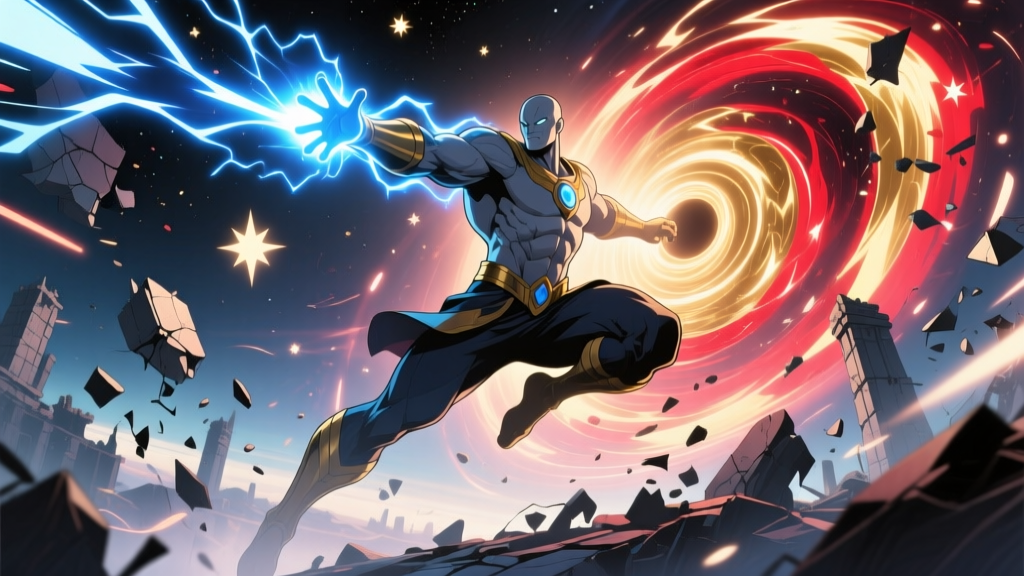
Can Franklin Richards beat Eternity? That’s the question popping up in Discord servers, Reddit threads, and YouTube comment sections every time a new cosmic event drops — and it cuts to the heart of Marvel’s metaphysical hierarchy. The answer isn’t just ‘no’ — it’s layered, canonical, and backed by decades of continuity-defining moments. In this breakdown, we cut through the noise and deliver a definitive, feat-anchored assessment of Marvel Comics Eternity: not the MCU version, not the Omniverse variant, but the original, Earth-616 embodiment of time, space, and universal consciousness itself.
Who — or What — Is Eternity?
Eternity first appeared in Strange Tales #138 (1965), conceptualized by Stan Lee and Steve Ditko as the living personification of the Marvel Universe’s spacetime continuum. He is not a god who rules time — he is time, as experienced across all dimensions, timelines, and causal layers of Earth-616. His form is variable: sometimes a towering humanoid wreathed in starfields and clockwork geometry; other times, an abstract presence speaking through avatars (like the Time-Keepers or even Doctor Strange’s astral projections). Crucially, Eternity is one of the Abstract Entities — a tier above Celestials, above Living Tribunal, and co-equal with Infinity, Death, and Oblivion.
He does not ‘exist’ within the universe — he contains it. As stated in The Infinity Gauntlet #4: “I am not a being — I am a condition. I am the sum of all that is, was, and ever shall be.” This isn’t poetic license. It’s ontological fact in Marvel canon — repeatedly affirmed in Avengers #500, What If? #117, and Secret Wars (2015) #8.
Eternity’s Core Stats (Earth-616)
| Stat Category | Rating | Key Feats & Evidence |
|---|---|---|
| Attack Potency | Multiversal+ (Beyond All-Reality) | Survived the collapse of the multiverse during Secret Wars (2015); reconstituted reality from the Beyond Realm after Battleworld’s dissolution (Secret Wars #9). Erased Galactus’ entire timeline retroactively — not just killing him, but unmaking his birth, evolution, and cosmic purpose (Thor #162). |
| Speed | Immeasurable (Transcends Causality) | Appeared simultaneously across all points in time during Doctor Strange Vol. 2 #33 — not via teleportation, but as an inherent property of his existence. Outpaced the Time Variance Authority’s temporal locks (What If? Vol. 2 #30). |
| Durability | Irreducible (Conceptual Immunity) | Unaffected by the Heart of the Universe (Annihilation: Conquest #6), survived the entropy wave that erased 99.9% of the multiverse (Infinity Gauntlet: War for the Multiverse #3). Cannot be harmed by any force bound by causality, logic, or narrative — only by peer Abstracts or primordial forces like The First Firmament. |
| Hax & Abilities | Extreme (Meta-Conceptual Tier) | Reality warping at absolute scale (rewrote the laws of physics for Earth-616 post-Heroes Reborn); omniscient perception (monitored every thought of every being during Acts of Vengeance); temporal sovereignty (granted Ghost Rider control over the ‘time stream’ as a temporary extension of self, Ghost Rider Vol. 3 #28); narrative immunity (survived the ‘death of story’ event in Marvel Zombies vs. The Army of Darkness #4). |
| Battle IQ & Strategy | Limitless (Non-Linear Cognition) | Outmaneuvered the Living Tribunal by appealing to higher principles (Infinity War #3); manipulated Galactus into becoming Lifebringer by altering his fundamental cosmic role (The Lifebringer Saga, Fantastic Four #600–604); orchestrated the resurrection of the Watchers without violating their oaths (What If? Vol. 2 #10). |
Key Transformations & States
Eternity doesn’t ‘transform’ like a superhero — but his manifestations reflect shifts in cosmic function:
- Baseline Eternity: Appears as a star-draped humanoid; governs linear time, entropy, and universal balance. Seen in Strange Tales, Avengers, and early Infinity events.
- Prime Eternity: Activated when multiversal integrity is threatened. Gains direct access to the Beyond Realm and can interface with pre-cosmic voids. Manifested during Secret Wars (2015) and Time Runs Out.
- Unified Abstract Form: Merges temporarily with Infinity and Death to stabilize collapsing realities — seen in Infinity Gauntlet #6 and Annihilation: Scourge #5. Not a power-up, but a functional necessity.
- Avatar Projection: Rarely acts directly; instead deploys avatars (e.g., the Chronos Warden in Thor Vol. 6 #12) — each possessing ~1/1000th of his awareness and authority, yet still capable of rewriting planetary history.
Franklin Richards vs Eternity: Why It’s Not a Fight
This matchup dominates fan forums — but it’s categorically non-competitive. Franklin Richards, even at his peak (post-Future Foundation, pre-Empyre), operates at Low Multiversal scale: he rebuilt the multiverse once (FF #12), but did so under Eternity’s guidance, using energy channeled through the Beyonders’ residual infrastructure. Eternity didn’t empower Franklin — he permitted the act, then folded the new realities back into his own framework.
Crucially, Franklin’s reality warping is subjective — it bends local physics and perception. Eternity’s is ontological: he defines what ‘physics’ and ‘perception’ even mean. When Franklin attempted to erase Onslaught in Onslaught Revelation #1, Eternity intervened — not to stop him, but to contain the paradox that would’ve unraveled causality. Franklin didn’t override Eternity; he triggered a contingency Eternity had already written into the fabric of time.
In Secret Wars (2015) #5, Franklin briefly accessed ‘Beyonders-tier’ power — but only because the Beyonders were dead, and their corpse-energy bled into the incursions. Even then, Eternity observed him like a scientist watching a lab experiment — calm, detached, utterly unthreatened.
Eternity vs Thor: The God of Thunder’s Limits
Thor has fought gods, demons, and Celestials — but Eternity isn’t on that ladder. Their most direct interaction occurs in Thor Vol. 6 #10–12 (2020), where Thor, wielding the Odinforce + Stormbreaker + Mjolnir + the power of the World Tree, attempts to ‘free’ time from Eternity’s ‘control.’ Eternity doesn’t counterattack. He simply recontextualizes Thor’s assault: every hammer strike becomes a ripple in the timestream that births new timelines; every lightning bolt becomes a star in a newborn galaxy.
Thor’s power — even at its absolute zenith — is within Eternity’s domain. As Eternity states: “You wield thunder. I am the silence before the storm — the echo after it ends. You are a note. I am the symphony, the composer, and the silence between notes.” There’s no ‘loss’ for Thor here — only revelation. His strength is real, but it’s bounded by the very structure Eternity embodies.
Where Eternity Ranks in Marvel’s Cosmic Hierarchy
Forget ‘top 10’ lists. Eternity sits in the first tier of three — the Abstract Entities. Below them: Living Tribunal (multiversal judge, but bound by cosmic law), above them: only The One Above All (TOAA), whose status is metafictional and rarely engaged in-story.
Here’s how he compares to key entities:
- Living Tribunal: Eternity predates and outclasses the Tribunal. The Tribunal enforces balance within realities; Eternity sustains the framework in which balance exists. Confirmed in What If? Vol. 2 #102.
- Galactus: A herald of Eternity — literally created by him to maintain cosmic equilibrium (Fantastic Four #262). Galactus’ hunger is a function of Eternity’s design.
- Sentinels of the Spaceways: Servants, not peers. When the Silver Surfer appealed to them against Annihilus, they deferred to Eternity’s judgment (Annihilation: Silver Surfer #4).
- The Beyonders: Technically superior in raw destructive output (they erased 8,000,000+ universes), but fundamentally lesser in scope. They operated within the multiverse; Eternity is the boundary between multiverses and the void beyond. Their defeat in Secret Wars required Eternity’s passive containment — not combat.
Common Misconceptions — Debunked
Myth: “Eternity lost to Thanos in Infinity Gauntlet.”
False. Thanos used the Infinity Gauntlet to trap Eternity — not defeat him. The Gauntlet’s power came from the Infinity Gems, which themselves are fragments of Eternity’s essence (Infinity Gauntlet #1). Eternity allowed the trap as part of a larger test — and escaped the moment Thanos’ will wavered.
Myth: “The MCU Eternity is the same as comics Eternity.”
No. The MCU version (introduced in Eternals) is a literal, physical cosmic entity — smaller, vulnerable, and subordinate to the Celestials. Comics Eternity dwarfs Celestials. Confusing them is like comparing a city’s mayor to the concept of ‘governance’ itself.
Myth: “Eternity can be reasoned with or bargained with.”
Only when it serves his function. He granted Spider-Man a second chance (Spider-Man Vol. 2 #50), but only because Peter’s survival preserved a critical nexus point in time. He doesn’t negotiate — he calculates.
FAQ
Is Eternity stronger than the Living Tribunal?
Yes — definitively. The Living Tribunal administers cosmic law; Eternity is the source code of that law. In What If? Vol. 2 #102, the Tribunal explicitly defers to Eternity’s authority during a multiversal crisis, calling him ‘the foundation upon which judgment rests.’
Can Thor beat Eternity?
No. Thor’s greatest feats — slaying Surtur, surviving the Twilight of the Gods, wielding the Odinforce — all occur inside Eternity’s domain. Eternity doesn’t fight Thor; he contextualizes him.
What is Eternity’s weakness?
None exist within Marvel’s internal logic. He has no vulnerabilities to magic, energy, or conceptual attack — except theoretical conflict with peer Abstracts (Death, Oblivion) or TOAA-level metaforces. Even the Heart of the Universe failed to harm him (Annihilation: Conquest #6).
How does Franklin Richards compare to Eternity?
Franklin is a prodigy operating at Low-Multiversal scale; Eternity is the framework that makes ‘multiversal scale’ meaningful. Franklin rebuilt realities — Eternity decides whether those realities get to persist. Their dynamic is mentor-student, not rival-rival.
Is Eternity omnipotent in Marvel Comics?
No — but he’s functionally omnipotent within his domain. He cannot unmake TOAA or alter Marvel’s metafictional boundaries (e.g., editorial mandates). However, within Earth-616 continuity, he has no operational limits — only self-imposed ones for narrative and balance.
Why doesn’t Eternity fix everything?
Because he’s not a deity — he’s a principle. His role is equilibrium, not intervention. As he tells Doctor Strange in Doctor Strange Vol. 2 #33: “To erase suffering is to erase growth. To prevent death is to end meaning. I do not choose sides. I sustain the field in which choice exists.”