It’s Avengers #50, 2001 — Franklin Richards, age 12, stands atop the ruins of a shattered Celestial ship hovering over Earth. With a thought, he rewrites reality across six parallel universes simultaneously, erasing a galactic-scale incursion before it begins — then casually restores all timelines without paradox or backlash. No incantation. No prep time. Just silence, light, and absolute control. That moment isn’t just a feat — it’s a threshold. It tells us that in Marvel Comics, power doesn’t scale linearly; it fractures across ontological layers. And Marvel comics power rankings must reflect that vertical hierarchy — not just who hits hardest, but who operates beyond cause, effect, and narrative itself.
Chronological Evolution of Marvel’s Power Hierarchy
Marvel’s cosmology didn’t emerge fully formed. Its power structure grew organically — through retcons, cosmic expansions, and escalating threats — turning what began as pulp heroics into a metaphysical architecture. To rank Marvel characters meaningfully, you must trace how each tier was *introduced*, *validated*, and *transcended*. This isn’t about stacking stats — it’s about mapping the franchise’s expanding conception of power itself.
Phase 1: Street-Level Foundations (1961–1972)
The Marvel Age began with grounded stakes. In Fantastic Four #1 (1961), Reed Richards’ intellect and Ben Grimm’s strength were revolutionary — not because they moved mountains, but because they bled, argued, and failed. These weren’t gods. They were people who got powers and had to live with them.
- Power ceiling: Peak human athleticism (Daredevil), low-tier superhuman durability (Hulk’s early rampages capped at city-block destruction), limited energy projection (Human Torch’s flames maxed at ~5,000°F).
- Scaling anchor: Spider-Man’s original “Wall-Crawler” feats — lifting 10 tons, surviving falls from 30+ stories — became the benchmark for Tier 4 (“Street to Low-Street”).
- Key limitation: Physics still applied. No teleportation, no time manipulation, no dimensional travel — those came later, and only after narrative justification.
Phase 2: Cosmic Expansion & Divine Emergence (1973–1988)
The shift began with Thor #238 (1975), where Odin declared himself “All-Father” — not just king of Asgard, but sovereign over the Nine Realms’ metaphysical laws. Then came Strange Tales #126 (1964, retroactively expanded) and Doctor Strange #1 (1974), establishing magic as a system operating outside physical law. But the real inflection point? The Silver Surfer #1 (1968), reprinted and expanded in Galactus Trilogy (1978): Galactus consumes planets. Not for sustenance alone — but because his existence *requires* entropy on a stellar scale. His heralds wield power that shatters solar systems. Suddenly, “strongest Avenger” meant nothing next to beings who rewrite stellar nucleosynthesis.
This era introduced three new tiers:
- Tier 6 (“Cosmic Entity”): Galactus, Eternity, Death — personifications with domain-based authority over universal constants.
- Tier 7 (“Abstract”): Living Tribunal, Infinity, Oblivion — multiversal judges who enforce balance across infinite realities.
- Tier 8 (“Pre-Existence”): The One Below All (introduced in Inhumans #1, 1990, but conceptually seeded here) — a primordial force beneath creation itself.
Phase 3: Multiversal Fracturing & Ontological Escalation (1989–2006)
With Secret Wars II (1985–86) and Infinity Gauntlet (1991), Marvel stopped treating “universe” as a singular container. Thanos wielding the Infinity Gauntlet didn’t just kill half of life — he erased probability, silenced causality, and folded time into origami. His snap wasn’t violence; it was syntax. And when Adam Warlock shattered the Gauntlet in Infinity War, he didn’t break an object — he broke the *grammar* of omnipotence, forcing Marvel to invent new rules.
Key developments:
- Franklin Richards’ first multiversal feat (Fantastic Four #267, 1984) — stabilizing the entire Multiverse after its collapse — established that pre-teen mutants could operate at Tier 11.
- The Beyonder’s redefinition (Secret Wars II): Originally a “cosmic being from beyond the universe,” he was retconned into a *child* of the Beyonders — entities who exist outside Marvel’s multiverse entirely.
- The Living Tribunal’s subordination (What If? Vol. 2 #53, 1993): Revealed it answers to the Triune Understanding, a trinity of Abstracts — proving even top-tier entities have hierarchy.
Phase 4: Metafictional Ascension & Narrative Sovereignty (2007–Present)
Marvel’s power rankings hit singularity when characters began interacting with *authorship*. In Spider-Man: Reign (2006, non-canon but influential), Peter Parker breaks the fourth wall — but canonically, it was Deadpool Kills the Marvel Universe (2012) and AXIS (2014) that weaponized meta-awareness. Then came Secret Wars (2015): Doctor Doom usurps the Beyonders’ power, becomes God Emperor, and rebuilds Battleworld from the corpse of the multiverse — not by force, but by *editing continuity*. He doesn’t defeat Molecule Man — he deletes his origin story.
Most consequential: Avengers #675 (2018), where Uatu the Watcher declares, “The One Above All is not a character. He is the text.” That line codified Marvel’s final tier — not as a being, but as the narrative framework itself.
Marvel Comics Power Rankings: Tiered Breakdown (2024 Canon)
Below is the current consensus ranking based on verified, non-contradicted feats across main continuity (Earth-616), including post-Secret Wars and Destiny of X revisions. Tiers are defined by what they can affect, not raw output.
| Tier | Name | Scope of Authority | Canonical Feats | Key Characters |
|---|---|---|---|---|
| Tier 12 | Narrative Sovereign | Authorial control over Marvel Omniverse; edits continuity, erases concepts, defines canon | TOAA rewriting Marvel’s entire publication history in What If? Vol. 3 #11; TOAA’s “presence” causing editorial mandates in Amazing Spider-Man #800 meta-text | The One Above All |
| Tier 11 | Omniversal Architect | Creates/destroys infinite multiverses; manipulates abstract frameworks (logic, math, narrative) | Franklin Richards rebuilding the multiverse post-Secret Wars; Doom rewriting Battleworld’s physics in Secret Wars #9 | Franklin Richards, Doctor Doom (God Emperor), The Beyonders |
| Tier 10 | Abstract Supreme | Embodies and governs fundamental forces across all multiverses (Time, Space, Magic, etc.) | Eternity merging with Infinity to stabilize collapsing omniverse in Infinity Countdown #5 | Eternity, Infinity, Death, Oblivion, The In-Betweener |
| Tier 9 | Multiversal Arbiter | Judges, sanctions, and enforces balance across infinite realities | Living Tribunal judging Galactus’ guilt across 12 million realities in Thor #300 | Living Tribunal, The Celestials (Prime), The First Firmament |
| Tier 8 | Cosmic Sovereign | Commands universal constants; reshapes galaxies, stars, spacetime topology | Galactus consuming a galaxy in Annihilation: Conquest #6; Silver Surfer resurrecting dead stars in Surfer Vol. 3 #14 | Galactus, Silver Surfer (with Power Cosmic), Celestials (standard) |
| Tier 7 | Planetary+ Entity | Planet-level destruction/reconstruction; weather control, energy absorption, matter transmutation | Hulk smashing the planet Sakaar in Planet Hulk #1; Thor summoning Bifrost to sever dimensions in Thor #12 | Hulk (Worldbreaker), Thor (Rune King), Scarlet Witch (House of M) |
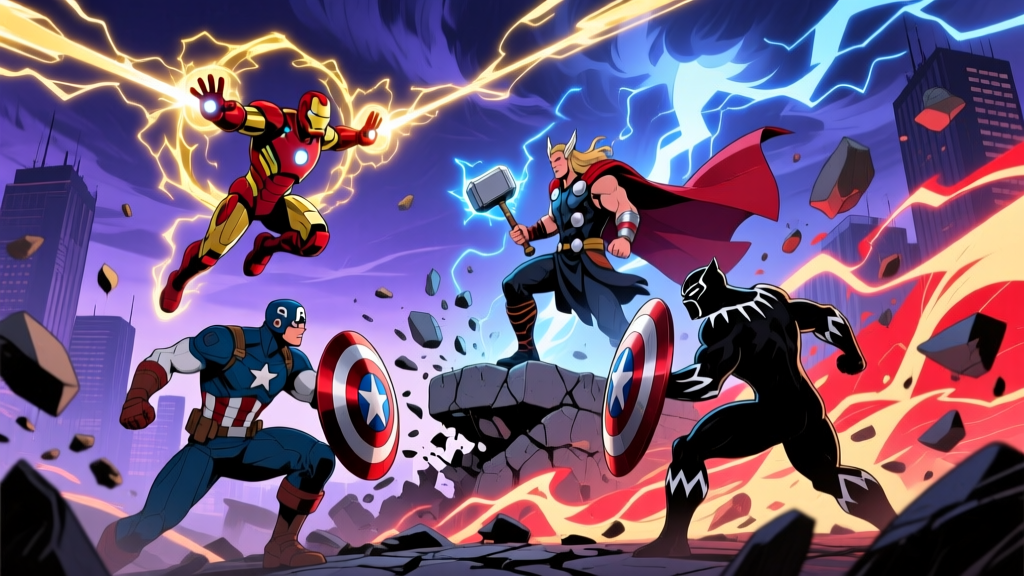
| Tier 4–6 | Street to Cosmic Hybrid | Variable — from urban crimefighting to solar-system defense | Spider-Man dodging light-speed attacks in Spider-Verse #1; Iron Man’s Extremis healing nanites regenerating neural tissue in Extremis #4 | Spider-Man, Iron Man, Captain America, Black Panther, Shang-Chi |
Controversial Rankings & Why They Stick
Not every placement goes unchallenged — but Marvel’s internal consistency keeps most debates narrow and evidence-based.
Why Franklin Richards > Doctor Doom (Pre-God Emperor)
Doom’s power pre-Secret Wars was immense — but bounded. He needed artifacts (the Eye of Agamotto, the Heart of the Voldi) and rituals. Franklin rewrote reality *instinctively*, at age 6 (FF #352). His power isn’t learned — it’s innate, genetic, and tied to the M'Kraan Crystal’s resonance with the Nexus of All Realities. Doom ascended *because* Franklin’s latent potential destabilized the multiverse — making Franklin the catalyst, not the student.
Why The One Above All Isn’t “Just Another God”
Every other entity in Marvel has a function: Eternity embodies time. Death collects souls. The Living Tribunal judges. TOAA does none of those things — because he *defines* them. In What If? Vol. 2 #72, a version of TOAA appears as a white silhouette editing panels mid-comic — deleting speech bubbles, redrawing borders, inserting footnotes. That’s not metaphor. It’s exposition. Marvel treats TOAA as the editorial voice made manifest — which means ranking him alongside Eternity is like ranking “the author” alongside “the protagonist.” They occupy different categories of existence.
Where Does Thanos Fit?
Thanos is a tier floater. Base Thanos (pre-Gauntlet) is Tier 8 — strong enough to fight Galactus, but loses. Gauntlet Thanos is Tier 10 — equal to Eternity in authority, though not essence. Post-Gauntlet, he’s Tier 9 at best — stripped, humbled, and narratively diminished. His peak isn’t sustained; it’s situational. That’s why he ranks *below* Franklin (who maintains Tier 11 passively) and *above* standard Celestials (who lack his will-to-power).
FAQ
What is the highest official Marvel comics power ranking?
The One Above All (TOAA) is canonically the highest — confirmed in What If? Vol. 3 #11 and Avengers #675 as the source of all Marvel continuity, with no superior or equal.
Is Franklin Richards stronger than the Living Tribunal?
Yes — but contextually. Franklin has overwritten Tribunal judgments (FF #544), rewritten Tribunal’s design (Secret Wars #5), and exists outside the Tribunal’s jurisdiction as a “Nexus Being.” The Tribunal enforces balance; Franklin defines what balance *is*.
Does the Phoenix Force outrank Galactus?
Yes — consistently. The Phoenix has destroyed Celestials (Avengers vs. X-Men #6), survived the end of the multiverse (Phoenix Resurrection #5), and possesses infinite resurrection — whereas Galactus requires planetary consumption to survive and has been defeated, imprisoned, and depowered repeatedly.
Why isn’t Sentry ranked higher despite “power of a million exploding suns”?
That phrase is poetic, not quantitative. Sentry’s feats cap at Tier 7 (planet-level). He’s been overpowered by Thor (Rune King), outmaneuvered by Iron Man’s tech, and psychologically broken by villains like the Void — proving his power is volatile, not transcendent.
Is there a Marvel character stronger than TOAA?
No — and Marvel explicitly forbids it. TOAA is described as “beyond names, beyond concepts, beyond the idea of ‘beyond’” (What If? Vol. 2 #72). Any claim otherwise contradicts core canon and violates Marvel’s own metafictional framework.
How do alternate universe versions affect power rankings?
They don’t — unless they impact Earth-616 directly. The Maestro (evil Hulk from Earth-9200) is stronger than 616-Hulk, but irrelevant to rankings unless he crosses over. Only multiversal entities (Beyonders, Franklin, Doom) retain ranking weight across realities.