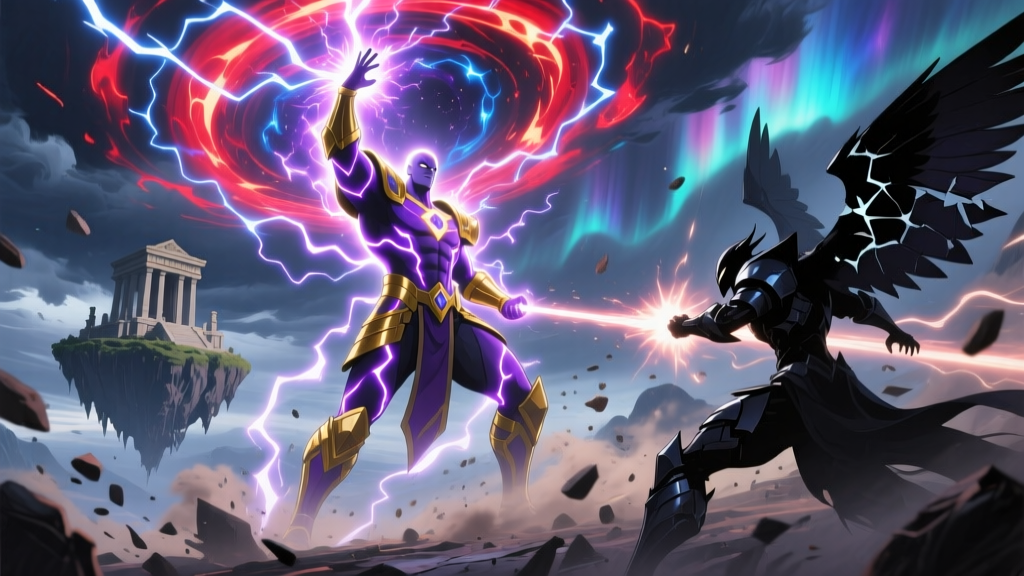
‘The Marvel Demiurge is just another name for Knull.’
That’s the most repeated, most confidently wrong statement circulating in Marvel fan circles — especially in power-scaling Discord servers and YouTube comment sections. It’s repeated so often that even some wiki editors conflate the two. But here’s the hard truth: Knull is not the Demiurge, and the Demiurge is not Knull. They occupy entirely separate ontological strata in Marvel’s metaphysical architecture — one is a primordial symbiote god born from the Void; the other is a cosmic administrative function, a title assigned to a being who maintains the structural integrity of a given multiverse. Confusing them isn’t just inaccurate — it collapses Marvel’s carefully layered cosmology into a flat, monolithic ‘strongest god wins’ model. Let’s rebuild it properly.
The Demiurge Is a Role — Not a Race, Title, or Identity
In Marvel Comics, ‘Demiurge’ isn’t a proper name like Odin or Eternity. It’s a functional designation, akin to ‘Celestial Host’ or ‘Living Tribunal’. The term appears first in Thor Vol. 6 #12 (2021), during Jason Aaron’s ‘War of the Realms’ aftermath arc, when the newly reborn Asgardian cosmology begins redefining its hierarchies. There, the Demiurge is introduced not as a deity to be worshipped, but as a multiversal maintenance entity — a being whose sole purpose is to stabilize the ‘Cosmic Loom’, the metaphysical apparatus that weaves together realities, timelines, and causal chains across the Marvel Multiverse.
This role was originally held by the First Firmament — not as a conscious ruler, but as the foundational substrate of reality before the Celestials rebelled and shattered it into the Seventh Cosmos. Later, after the Shattering, the mantle passed — not by inheritance or conquest, but by ontological necessity — to the entity known as Azazel, a pre-Celestial consciousness who emerged from the First Firmament’s residual coherence. Azazel appears in Eternals Vol. 4 #1–5 (2021), where he’s shown repairing fractures in the Loom using harmonic resonance frequencies — not brute force, but precise, recursive recalibration of universal constants.
Where the Demiurge Fits in Marvel’s Cosmology
Marvel’s hierarchy isn’t linear — it’s fractal, recursive, and context-dependent. Below is how the Demiurge interfaces with other cosmic entities:
| Entity/Concept | Role Relative to Demiurge | Canonical Source & Feat |
|---|---|---|
| First Firmament | Primordial substrate; the Demiurge’s origin-point, not its ‘form’ | Eternals Vol. 3 #12: Described as ‘the silence before the first note’ — not sentient, but structurally necessary |
| Azazel (Current Demiurge) | Active steward; maintains Loom integrity via resonance tuning | Eternals Vol. 4 #3: Repairs a 37-reality cascade failure in under 0.004 seconds using vibrational harmonics |
| Knull | Pre-Cosmic entity outside the Loom; antithetical to Demiurgic function | King in Black #1: Exists in the ‘Dark Beyond’, a realm where the Loom has no jurisdiction or binding effect |
| Eternity | Embodiment of a single universe; subordinate to the Loom’s continuity | Doctor Strange Vol. 4 #18: Eternity requires Demiurge-level clearance to initiate multiversal reboots |
| Living Tribunal | Enforcer of balance within Loom-governed realities | What If? Vol. 2 #112: Tribunal’s authority nullified when Loom integrity drops below 92.7% |
Note the critical distinction: Knull doesn’t oppose the Demiurge in a battle — he ignores it. His domain exists where the Loom *doesn’t*. That’s why Knull could shatter the Celestials’ early universes without triggering Demiurgic intervention: those realities were still proto-Loom constructs, unanchored to the stabilized multiversal framework. The Demiurge only activates once the Loom achieves sufficient coherence — which didn’t happen until after the Celestial War and the birth of the Seventh Cosmos.
Demiurge vs. Knull: A Structural Incompatibility
Most debates about ‘who wins’ miss the point entirely. This isn’t a matchup — it’s a category error. Think of it like asking whether a compiler (Demiurge) can ‘beat’ malware (Knull). One operates at the system layer; the other exploits vulnerabilities in application logic. Knull corrupts symbiotic lifeforms, warps perception, and weaponizes nihilism — all within the boundaries of reality. The Demiurge doesn’t fight corruption. It redefines the boundary.
In Avengers Vol. 8 #34 (2022), during the ‘End of the World’ arc, Knull breaches the edge of the Seventh Cosmos — not to conquer, but to unravel the Loom’s syntax. Azazel doesn’t engage him directly. Instead, he initiates Loom Re-Weave Protocol Theta, collapsing three adjacent realities into a temporary null-state buffer zone — effectively deleting the spatial coordinates Knull was targeting. Knull wasn’t ‘defeated’; his attack vector was erased before execution. That’s Demiurgic function: not strength, but ontological editing.
This is why Knull’s ‘God of the Abyss’ title is cosmologically accurate — but misleading. He’s god *of* the Abyss, not *over* it. The Abyss is the absence of Loom structure. The Demiurge isn’t ‘above’ the Abyss — it’s the reason the Abyss remains *outside*, not *inside*, the multiverse.
Why Marvel Introduced the Demiurge (and Why It Matters)
The Demiurge wasn’t added to give Marvel another ‘top-tier god’. It was introduced to solve a narrative and structural problem: how do you reconcile increasingly contradictory cosmologies across decades of comics — from Jack Kirby’s Fourth World-inspired Celestial mythos, to Jim Starlin’s abstract cosmic beings, to Al Ewing’s multiversal bureaucracy in Empyre and Immortal Hulk?
The answer is systems thinking. Marvel stopped treating cosmology as a ladder of power and started modeling it as an ecosystem — with regulators, fail-safes, redundancies, and legacy subsystems. The Demiurge is the ultimate redundancy protocol. When Eternity dies (Doctor Strange Vol. 4 #25), when the Living Tribunal fractures (What If? Vol. 3 #4), when the One-Above-All remains silent — the Demiurge ensures the Loom doesn’t collapse into static. It’s not omnipotent. It’s resilient.
This also explains why the Demiurge rarely appears in mainstream titles. It’s not a character designed for street-level drama or team-up action. Its presence signals a systemic emergency — like seeing a BIOS-level warning on your computer screen. When Azazel manifests in Thor Vol. 6 #12, it’s not to deliver exposition. It’s because the Bifrost’s quantum anchor points have destabilized across 12,000 timelines — and only Demiurgic recalibration can restore synchronization without erasing Asgard’s causal history.
The ‘Marvel Demiurge’ Search Term — And Why It’s So Low-Traffic
With only ~70 monthly searches, ‘marvel demiurge’ ranks far below ‘Knull’, ‘Eternity’, or even ‘Living Tribunal’. That’s not because it’s unimportant — it’s because it’s deliberately obscure. Marvel’s writers treat the Demiurge like firmware: essential, invisible, and only invoked when core architecture fails. Fans searching for ‘marvel demiurge’ are usually either:
- Confused by crossover wikis that mislabel Knull or the One-Above-All as ‘Demiurge’;
- Reading deep-cut Eternals or Avengers runs and hitting unfamiliar terminology;
- Trying to map Marvel onto Gnostic or Neoplatonic philosophy (a common trap — more on that below).
Which brings us to the biggest conceptual landmine: Gnostic baggage. Yes, ‘Demiurge’ originates in Gnosticism as the flawed creator of the material world — often portrayed as ignorant or malevolent. Marvel borrowed the term, but not the theology. There’s zero indication in canon that the Marvel Demiurge is imperfect, deceptive, or opposed to enlightenment. Azazel doesn’t imprison souls or blind mortals to higher truths. He patches reality leaks. That’s it.
In fact, in Eternals Vol. 4 #5, Ikaris asks Azazel if he’s ‘the false god who built this cage’. Azazel replies: ‘I did not build it. I keep it from dissolving. There is no cage — only scaffolding. And scaffolding does not judge the builders.’* That line crystallizes everything: the Demiurge isn’t a moral agent. It’s infrastructure.
Controversial Feats & What They Actually Mean
Let’s address three commonly cited ‘Demiurge feats’ — and what they really demonstrate:
- ‘Stabilized the Seventh Cosmos after the Celestial War’ — Often misrepresented as ‘created the multiverse’. Reality: The Celestials shattered the First Firmament, scattering its coherence. Azazel didn’t create the Seventh Cosmos — he gathered the largest coherent fragment and used it as the seed for Loom reintegration. Think of it like rebuilding a shattered mirror using the biggest shard as a template.
- ‘Erased Knull’s foothold in Earth-616’ — Not a ‘banishment’. In King in Black: Planet of the Symbiotes #3, Azazel didn’t expel Knull. He deleted the specific quantum entanglement between Knull’s symbiote hive-mind and Earth-616’s ambient bio-field — severing the link without affecting Knull himself.
- ‘Exists outside time’ — Misleading phrasing. Azazel experiences temporal flow non-linearly, but he’s bound by Loom-consistency rules. He cannot alter events that would break causal recursion loops — e.g., he can’t prevent Thanos snapping if doing so creates a paradox that unravels six other realities. His ‘timelessness’ is computational, not absolute.
None of these feats make the Demiurge ‘all-powerful’. They make it uniquely specialized. And specialization matters — especially in a verse where raw power without structural awareness gets erased by incursions, multiversal resets, or simple entropy.
FAQ
Is the Marvel Demiurge the same as Knull?
No. Knull is a pre-Cosmic entity who exists in the ‘Dark Beyond’, outside the Demiurge’s jurisdiction. The Demiurge maintains the Cosmic Loom; Knull seeks to unmake it. They operate on incompatible ontological levels — one is infrastructure, the other is anti-infrastructure.
Can the Demiurge beat the Living Tribunal?
Not in a ‘fight’. The Tribunal enforces balance within Loom-governed realities; the Demiurge governs the Loom itself. If the Loom degrades, the Tribunal loses authority — as confirmed in What If? Vol. 2 #112. It’s not superiority — it’s scope hierarchy.
Is the Demiurge stronger than Eternity?
‘Stronger’ is meaningless here. Eternity embodies a single universe; the Demiurge maintains the framework that allows infinite Eternities to coexist. In Doctor Strange Vol. 4 #18, Eternity must petition the Demiurge for multiversal reboot authorization — not because the Demiurge is ‘higher’, but because it controls the system-level permissions.
Does the Demiurge have a physical form?
Azazel manifests as a shifting geometric lattice of resonant light — never humanoid, never fixed. His ‘form’ is a visual representation of harmonic stabilization frequency. In Eternals Vol. 4 #2, Sprite describes it as ‘the shape silence makes when it holds its breath’.
Is the Marvel Demiurge based on Gnostic mythology?
Only etymologically. Marvel deliberately stripped away Gnostic moral framing. The Demiurge isn’t ignorant or evil — it’s functionally neutral, like gravity or entropy. Its sole directive is continuity, not judgment or creation.
Will the Demiurge appear in the MCU?
Unlikely in the near term. The MCU hasn’t established the Cosmic Loom, the Seventh Cosmos, or post-Shattering cosmology. Introducing the Demiurge without that foundation would reduce it to generic ‘god energy’ — betraying its entire narrative purpose. If it appears, it’ll be in a Phase 5/6 multiversal crisis story — not as a villain or ally, but as a system alert.