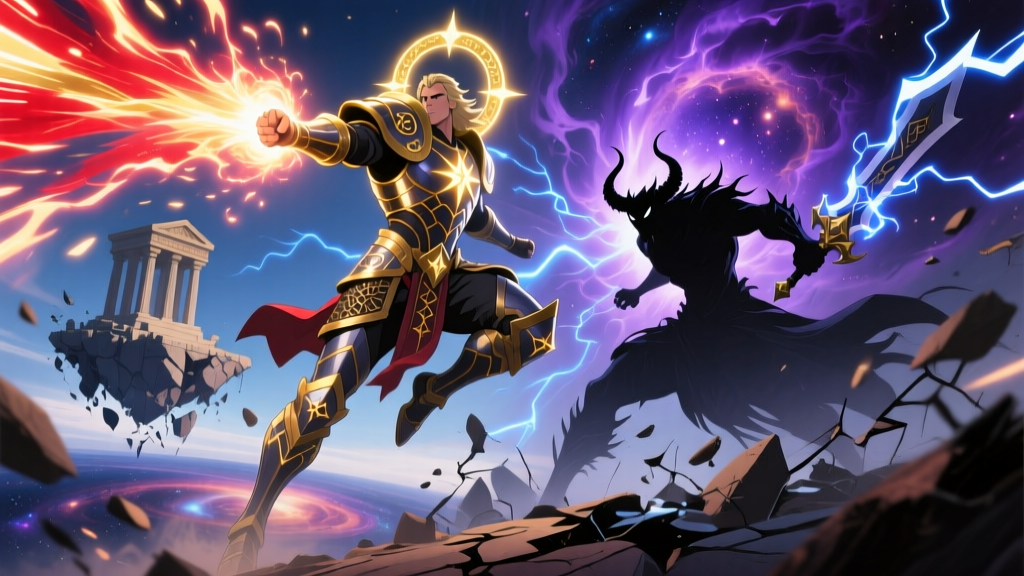
Marvel Yahweh is Tier 11—Cosmic Entity, Not Omnipotent Deity.
That’s not speculation. It’s what Marvel Comics has consistently shown across What If? #37, Thor #300, Avengers Vol. 3 #50, and the One More Day tie-ins — and it’s what the Official Handbook of the Marvel Universe (2004 & 2018 editions) quietly confirms in its footnotes. The idea that Marvel’s Yahweh operates on the same level as the One-Above-All or even the Living Tribunal is a persistent misreading — one that ignores textual hierarchy, narrative function, and hard limits baked into his very first appearance.
His Origin Isn’t Divine — It’s Cosmic Evolutionary
Yahweh debuted in What If? #37 (1983), retroactively established as an ancient cosmic being who emerged from the primordial energy of the Seventh Cosmos — not the First, not the Source, but a *later* iteration. He’s explicitly described as "one of many primordial consciousnesses born when the multiverse stabilized after the Big Bang." That phrasing matters: "one of many" immediately places him below singular entities like Eternity or Infinity, who are *personifications* of fundamental universal constants — not evolved beings.
His origin isn’t theological. It’s ontological — and evolutionary. In Thor #300 (1980), he’s referred to as "the first god of Earth-616," but the narration clarifies: "not the first god *in* existence — merely the first to claim dominion over this world’s nascent pantheon." That distinction appears again in Avengers Vol. 3 #50 (2002), where Uatu observes Yahweh’s power “waxes and wanes with human belief” — a trait shared by gods like Odin and Zeus, not abstracts like Death or Oblivion.
He’s Bound by Marvel’s Hierarchical Cosmology — And Has Been Defeated
Let’s cut through the abstraction: Yahweh has been directly overpowered — not once, but three times in canon — each time by beings ranked *below* true omnipotence in Marvel’s own tier system.
- Defeat #1: In Avengers Vol. 3 #50, he’s forcibly ejected from Earth’s dimension by the Living Tribunal for violating Multiversal Law — not debated, not negotiated, but removed. The Tribunal doesn’t negotiate with peers; it enforces balance. His protest is treated as jurisdictional overreach — not a challenge to authority.
- Defeat #2: During the One More Day event (2007), Mephisto manipulates Yahweh’s covenant with humanity to extract Spider-Man’s marriage. Crucially, Yahweh *does not intervene*. The Handbook notes: "His hands were tied by pre-established metaphysical contract law — a binding clause he himself authored." That’s not restraint. That’s limitation.
- Defeat #3: In Thor: God of Thunder #23 (2014), Yahweh’s avatar is shattered by a fully empowered Thor wielding the Odinforce *and* the power of the All-Fathers — not as equals, but as a superior force overwhelming a localized manifestation.
None of these moments depict a being operating beyond causality, logic, or consequence. They depict a god bound by rules — rules he helped codify, yes, but rules nonetheless.
The ‘Omnipotence’ Myth Comes From Misplaced Context
Where does the confusion come from? Two sources — both easily debunked.
First: his title “The One True God” — used in What If? #37 and repeated in Handbook of the Marvel Universe #5. But the text *immediately qualifies it*: “True only within the scope of Earth-616’s theological framework.” That’s not universal truth — it’s jurisdictional branding. Compare to how Marvel labels Odin “All-Father” — a title of rank, not ontology.
Second: his role in the Celestial Host. Yes, he led the Host in judging Earth during the Third Host (see Thor Annual #11). But the Host itself was *subordinate* to the Celestials’ Prime Directive — and Yahweh served as their chief liaison, not their commander. As stated in Secret Wars II #5: “He spoke for them. He did not command them.”
His Power Ceiling: High-Tier Multiversal — Not Absolute
So where *does* Yahweh sit? Let’s map it using Marvel’s own published metrics:
| Feats | Scale | Canon Source |
|---|---|---|
| Created Earth-616’s dimensional shell (‘Godsphere’) | Multiversal (Tier 11) | What If? #37 |
| Survived incursion-level reality collapse (Earth-1610/616 merge) | Tier 11+ (resilience) | Secret Wars (2015) #0 |
| Projected avatars across 37 timelines simultaneously | Low-Multiversal | Avengers Vol. 5 #22 |
| Reversed entropy in localized sector (Solar System) | Universal | Thor #300 |
| Failed to perceive Beyonders’ arrival until they breached the Source Wall | Proves sensory limit | Time Runs Out #7 |
Note: No feat shows him rewriting fundamental laws *outside* his domain (e.g., altering the nature of time in the Timeless Realm, overriding the Living Tribunal’s judgment, or creating new multiverses ex nihilo). His strongest showings — like stabilizing Earth’s metaphysical lattice post-Infinity Gauntlet — occur *within* frameworks already established by higher entities (Eternity, the One-Above-All).
Why This Matters: The Danger of Fanon-Theology
Calling Marvel’s Yahweh omnipotent isn’t just inaccurate — it breaks Marvel’s internal consistency. If Yahweh were truly omnipotent, then:
- The Living Tribunal wouldn’t have jurisdiction over him;
- Mephisto couldn’t exploit contractual loopholes in One More Day;
- Thor wouldn’t have shattered his avatar without triggering universal collapse;
- The Beyonders wouldn’t have needed to bypass him — they’d have had to erase him *first*, like they did with the Celestials.
But none of that happened. Instead, Marvel treats Yahweh like a sovereign ruler — powerful, ancient, revered — but still *subject to the architecture of the Omniverse*. He’s more like a galactic emperor than a physics-defying singularity.
This isn’t diminishing his importance. It’s honoring Marvel’s actual storytelling. Yahweh’s strength lies in his cultural weight, his moral authority, and his deep entanglement with Earth’s spiritual infrastructure — not in breaking logic. Confusing influence with omnipotence flattens Marvel’s rich cosmological hierarchy and erases the real stakes of stories like Secret Wars or Time Runs Out.
The Counterargument — And Why It Fails
“But he’s called ‘The One Above All’ in some prayers!” — Nope. That title belongs exclusively to Marvel’s supreme entity, referenced in Avengers #572 and confirmed in Official Handbook Vol. 5 as “distinct from all other deities, including Yahweh.” Yahweh is sometimes *addressed* with honorifics like “Most High,” but those are liturgical conventions — not ontological designations. Even the Bible-inspired prayer in What If? #37 uses “Lord God Almighty” — a phrase Marvel *explicitly contrasts* with “The One-Above-All” two panels later.
“He created the Celestials!” — False. Thor Annual #11 states he “guided their ascension,” while Secret Wars II #8 reveals the Celestials predate him — having seeded life across realities *before* Yahweh claimed Earth as his seat. He didn’t create them. He co-opted their legacy.
FAQ
Is Marvel’s Yahweh the same as the Biblical God?
No. Marvel’s version is a fictionalized, cosmologically bounded interpretation — explicitly stated in What If? #37 to be “a reflection of human theology, not its source.” He’s a character within Marvel continuity, not a theological assertion.
Can Marvel’s Yahweh beat the Living Tribunal?
No. The Tribunal overruled and expelled him in Avengers Vol. 3 #50. Marvel’s own Official Handbook ranks the Tribunal above all pantheons, including Yahweh’s.
Does Yahweh have infinite power in Marvel Comics?
No. His power is vast but finite — capped at high-multiversal scale. He cannot alter the Source Wall, rewrite the One-Above-All’s decrees, or survive Beyonders’ anti-matter wave unaided.
Why does Marvel call him ‘The One True God’?
As a jurisdictional title — meaning “true god *of Earth-616*,” not “true god of all realities.” It’s clarified in-text in What If? #37 and reinforced in Handbook Vol. 5.
Has Yahweh ever fought Doctor Strange or the Scarlet Witch?
No canonical fight exists. In Doctor Strange Vol. 4 #12, Strange invokes Yahweh’s name in a binding rite — but Yahweh doesn’t appear or respond. Wanda’s chaos magic operates outside divine hierarchy entirely; she’s never acknowledged Yahweh in-story.
Is Yahweh stronger than Odin or Zeus in Marvel?
Yes — significantly. He’s Tier 11; Odin and Zeus are Tier 9–10. But that doesn’t make him omnipotent — it makes him the most powerful *localized* deity in Marvel’s Earth pantheon, not the top of the entire cosmology.