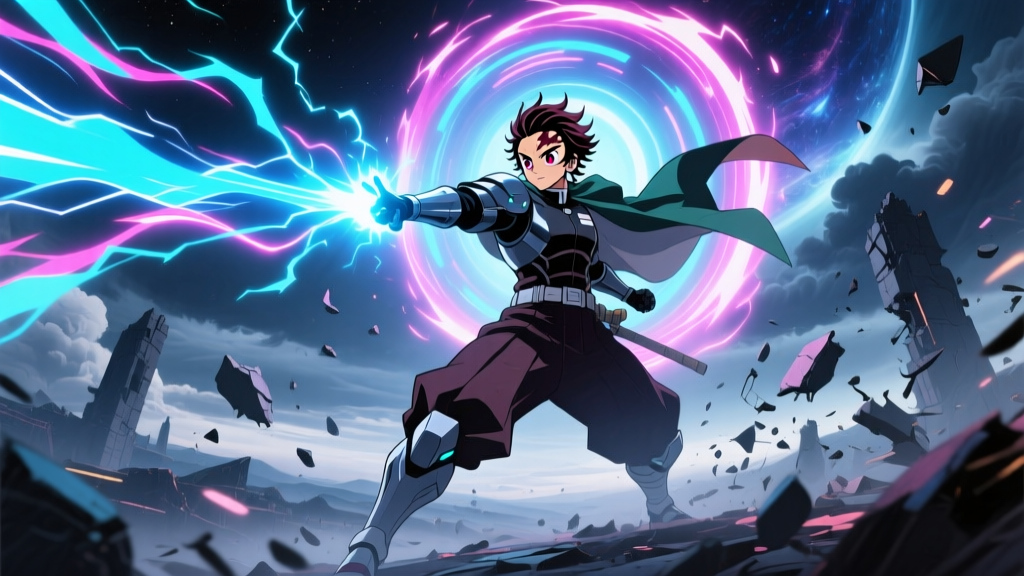
The most common misconception about mikaboshi is that he’s merely a powerful Shinto antagonist — a rogue kami or demonic warlord who opposes the Japanese pantheon. Fans often slot him into Marvel’s Olympus or Asgard tiers, comparing him to Hela or Ares. That’s not just inaccurate — it’s cosmologically insulting. In both Marvel Comics (Earth-616) and the broader mythic framework adapted from Japanese Kojiki and Nihon Shoki apocrypha, Amatsu Mikaboshi isn’t a god who fell from grace. He is the absence before grace: the primordial void that predates all divine hierarchy, all cosmic order, and even the concept of ‘before.’
Lore Focus: The Uncreated One
Mikaboshi’s origin isn’t told in terms of birth or ascension — it’s defined by negation. In Marvel continuity, he first manifests during the Chaos War crossover (2010–2011), but his existence is retroactively anchored in pre-creation cosmology. As revealed in Chaos War: Alpha #1 and confirmed in Thor vol. 3 #12 (2011), Mikaboshi is ‘the First Darkness’ — the state that existed prior to the emergence of the Celestials, the Beyonders, and even the abstract entities like Eternity and Death. He is not *outside* the Marvel Multiverse; he is what the Multiverse collapsed *out of*.
This isn’t metaphorical. His very presence unravels causality: when Mikaboshi enters the realm of the Olympian gods in Chaos War #3, Zeus’ lightning bolts don’t just fail — they unhappen. Panels show temporal loops collapsing into static, divine memories erasing themselves mid-sentence, and entire pantheons momentarily forgetting their own names. This isn’t mind control or energy absorption. It’s ontological regression — a forced return to pre-ontological non-state.
Mythic Roots: Not a Kami, But the Anti-Kami
In actual Japanese mythology, Amatsu-Mikaboshi appears only once — as a name listed among celestial deities in the Kojiki, but with no accompanying narrative. Early scholars like Motoori Norinaga interpreted the name as ‘Star of Heaven’ or ‘Shining Star,’ but crucially, the Kojiki omits any deeds, lineage, or role for Mikaboshi. He’s a lacuna — a named absence. Modern esoteric Shinto scholarship (e.g., Kuroda Toshio’s Shinto in the History of Japanese Religion) treats this silence as intentional: Mikaboshi represents the unnameable, unclassifiable principle that resists integration into the ordered kami hierarchy. He is the ‘star that refuses to shine’ — the dark matter of myth.
Marvel didn’t invent this idea — it amplified it. Writer Greg Pak explicitly cited this textual void as inspiration, stating in a 2011 Newsarama interview: ‘Mikaboshi isn’t missing from the Kojiki because he was forgotten. He’s missing because he *can’t be recorded*. To inscribe him is to collapse the syntax of language itself.’
Power System: The Void That Devours Creation
Mikaboshi doesn’t wield power — he *is* the condition under which power fails. His abilities operate on three interlocking layers:
- Pre-Causal Erasure: He doesn’t destroy targets — he reverts them to states that never qualified as ‘existence’ in the first place. When he consumes the Olympian god Hephaestus (Chaos War #4), the act isn’t depicted as combustion or disintegration. Instead, Hephaestus’ forge, his hammer, his divine spark — all dissolve into a shimmering gray static that lacks even the properties of vacuum or entropy.
- Mythic Unbinding: He severs conceptual anchors. In Chaos War #5, he nullifies Hercules’ ‘divine strength’ not by overpowering it, but by making the word strength temporarily meaningless in all languages across Earth-616. Speech, written text, and even subconscious thought revert to pre-linguistic noise.
- Self-Referential Immunity: Every attempt to define or categorize Mikaboshi triggers recursive failure. When the Living Tribunal attempts judgment (Chaos War #6), its triune form fractures — not from force, but because ‘Tribunal’ implies jurisdiction, and jurisdiction implies law, and law implies order… none of which apply to Mikaboshi. The Tribunal doesn’t lose; it ceases to parse.
This isn’t ‘power scaling’ in the conventional sense. There’s no upper limit to measure — because Mikaboshi exists at the boundary where measurement breaks down. He isn’t ‘stronger than’ abstracts; he is the reason abstractions require boundaries to exist.
Comparative Cosmology: Where Mikaboshi Fits (and Doesn’t Fit)
Fans often compare Mikaboshi to Marvel’s Thanos, DC’s Anti-Monitor, or even Lovecraft’s Azathoth — but these comparisons misrepresent his nature. Thanos seeks to impose balance; Anti-Monitor seeks to replace one universe with anti-matter; Azathoth dreams chaos. Mikaboshi does none of these things. He doesn’t act — he is. Below is how his role differs fundamentally from other ‘primordial’ entities:
| Entity | Role in Cosmology | Relationship to Creation | Mikaboshi’s Contrast |
|---|---|---|---|
| Eternity (Marvel) | Embodiment of the Marvel Multiverse’s spacetime continuum | Emerges with creation; dependent on it | Mikaboshi predates Eternity’s ‘birth’ — Eternity’s first memory is of Mikaboshi’s silence |
| Azathoth (Cthulhu Mythos) | Blind Idiot God whose dream sustains reality | Passive source — reality is a side effect | Mikaboshi has no dream, no will, no unconscious. He is not a source — he is the non-source |
| The One Above All (Marvel) | Omnipotent writer-figure; ultimate author of all Marvel stories | Transcendent creator — outside narrative | Mikaboshi isn’t outside narrative — he is the blank page before the first word is written |
| YHVH (Judeo-Christian tradition, adapted in Marvel) | First cause, self-existent, uncaused cause | Defined by absolute sovereignty and self-definition | Mikaboshi cannot be sovereign — sovereignty requires subjects. He cannot self-define — definition requires distinction |
Key Feats: Not Battles, But Ontological Events
Mikaboshi’s ‘feats’ aren’t victories — they’re moments where reality’s operating system crashes. Here are the most significant canonical events:
- Unmaking of the Olympian Pantheon (Chaos War #2–#4): Mikaboshi doesn’t fight Zeus — he makes Zeus’ divine authority structurally incoherent. By issue #3, Zeus’ thunderbolts flicker between lightning and static, then between static and ‘no symbol for lightning.’ The Olympians don’t die; they become grammatically impossible.
- Nullification of the Celestial Host (Chaos War #6): When the Celestials deploy their Uni-Mind to contain him, the collective consciousness fractures into individual thoughts that contradict each other — e.g., ‘I am one’ and ‘I have never been’ simultaneously true. The Uni-Mind doesn’t shatter; it becomes logically inconsistent and dissolves.
- Erasure of the Chaos King’s Name (Chaos War #7): After being seemingly defeated, Mikaboshi’s final act isn’t retaliation — it’s deletion. Every written and spoken instance of ‘Chaos King’ vanishes from Earth-616 records. Not overwritten. Not hidden. Gone, as if the title never existed. Even Thor’s memory of naming him is replaced with a blank space — not amnesia, but semantic void.
Crucially, none of these feats require ‘effort.’ Mikaboshi doesn’t raise a hand. He simply *is present*, and creation’s scaffolding buckles.
Controversial Debates: Why ‘Mikaboshi Is Just a Plot Device’ Is Wrong
Critics argue Mikaboshi serves only as a MacGuffin for the Chaos War event — a plot device to reset status quos. But this ignores how deeply he’s woven into Marvel’s metaphysical architecture. Consider:
- His defeat isn’t achieved by force, but by redefinition: Amadeus Cho and Hercules trap him not with energy, but by convincing him to accept the label ‘Chaos King’ — thereby binding him to narrative logic. This isn’t a weakness; it’s the only possible interaction with something that rejects all labels.
- Post-Chaos War, Mikaboshi returns not as a villain, but as a ‘cosmic constant’ — referenced in Doctor Strange vol. 4 #18 (2016) as the ‘Silent Axis’ around which magical paradoxes orbit. He’s now part of Marvel’s foundational grammar.
- Even in non-Marvel contexts — such as the Shin Megami Tensei series — Mikaboshi appears not as a boss, but as an unselectable, uninteractable background entity labeled ‘The Unwritten Star,’ reinforcing his mythic function as the gap in the system.
Calling Mikaboshi a plot device confuses narrative utility with ontological insignificance. He’s the black hole at the center of Marvel’s cosmology — invisible, inescapable, and essential to the structure around it.
FAQ
Is Mikaboshi stronger than the Living Tribunal?
No — and ‘stronger’ is the wrong metric. The Living Tribunal judges based on universal law; Mikaboshi is the reason universal law has limits. Their confrontation ends not in victory, but in the Tribunal’s inability to process Mikaboshi as a ‘case.’
Does Mikaboshi appear in actual Japanese mythology?
Yes — but only as a name in the Kojiki, with zero description or story. His modern portrayal is a deliberate expansion of that silence, not a fabrication.
Can Mikaboshi be killed?
Not in any conventional sense. He was ‘contained’ by accepting the title ‘Chaos King,’ but this was a narrative binding — not destruction. Canonically, he cannot be unmade because he was never made.
Why doesn’t Mikaboshi appear more often in Marvel comics?
Because sustained exposure breaks storytelling. As writer Greg Pak stated: ‘You can’t have a recurring villain who erases the premise of the story every time he shows up. He’s a singularity — you orbit him, but you don’t invite him to dinner.’
Is Mikaboshi related to the Shinto god Susanoo?
No. Susanoo is a chaotic but creative deity who slays Yamata no Orochi and births important kami. Mikaboshi has no myths, no children, no domain — he is the negation of domain itself. Conflating them misunderstands both figures.
What tier is Mikaboshi in power-scaling terms?
He operates beyond standard tiering systems. While some fans place him at ‘Low Outerverse’ due to his pre-multiversal nature, official Marvel handbooks avoid ranking him — because his existence invalidates the assumptions tier lists rely on (e.g., ‘energy output,’ ‘speed,’ ‘durability’).