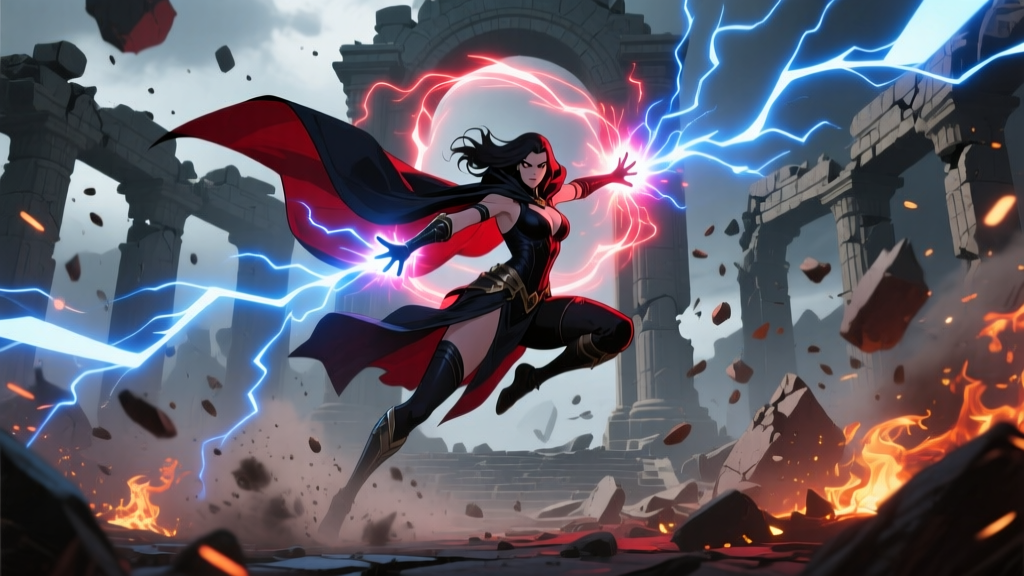
Mistress Death Marvel is NOT an omnipotent cosmic force—she’s a narrative prop with inconsistent authority, limited scope, and zero canonical victory over true abstractions.
That’s not hyperbole. It’s what happens when you read Avengers Annual #17 (1988), Thanos Quest #1–2, The Infinity Gauntlet (1991), and Death of Doctor Strange (2021) side-by-side—and stop treating her as Marvel’s personification of mortality rather than what she actually is: a localized, emotionally reactive, functionally subordinate abstraction who answers to higher laws.
She’s Not the Personification of Death—She’s a Facsimile With a Brand
Here’s the uncomfortable truth no fan site wants to admit: Marvel has two canonical Death entities—and only one is truly fundamental. The first is the abstract entity known as Death, introduced in Strange Tales #158 (1967) as a silent, omnipresent force behind all endings—even of gods. The second is Mistress Death, codified in Avengers Annual #17 as a sentient, anthropomorphic, romantically fixated version who flirts with Thanos and grants him power—but only after he builds a shrine to her. That’s not cosmology. That’s mythopoeic theater.
Her design—purple skin, skeletal motifs, flowing robes—wasn’t born from metaphysical necessity. It was created to give Thanos a foil with emotional stakes. And it worked: readers loved the tragic romance. But love ≠ lore accuracy. In Infinity Gauntlet, when Thanos snaps, Death doesn’t intervene—not because she’s restrained, but because she has no jurisdiction over universal-scale entropy or soul-erasure. That’s Entropy’s domain. Death oversees biological cessation—not reality deletion.
Her Feats Don’t Scale Beyond Mortal Life Cycles
Let’s list every confirmed, non-delegated, non-ambiguous feat tied directly to Mistress Death:
- Appears to dying beings (e.g., Mar-Vell in Marvel Graphic Novel #1)
- Grants Thanos temporary resurrection (in Thanos Quest #2, but only after he sacrifices half the universe)
- Reappears post-Gauntlet to comfort Thanos (Infinity War #4)
- Is briefly “replaced” by a corrupted version during Death of Doctor Strange—but that version is explicitly a magical mimicry, not her true self
Notice what’s missing? No reality warping. No time manipulation. No conceptual rewriting. No interaction with the One-Above-All’s hierarchy. She doesn’t appear in What If? Planet Hulk when the Hulk kills the Living Tribunal. She’s absent from Secret Wars (2015)’s incursions—even though those involved multiversal collapse. She doesn’t show up when Galactus consumes the Sixth Cosmos in Galactus: The Devourer #1. Why? Because her mandate ends where biology ends.
The Hierarchy Isn’t Suggested—It’s Explicitly Stated
Marvel’s cosmic hierarchy isn’t fan speculation. It’s spelled out in Doctor Strange Vol. 2 #48 (1981):
“Eternity is the living embodiment of space-time within this universe. Infinity is its counterpart—the embodiment of all energy and matter. Death and Oblivion are their children… and yet, even they bow before the will of the Living Tribunal.”
That line isn’t metaphorical. In Earth X #12, the Tribunal judges Death for interfering in mortal affairs—and she accepts his verdict without resistance. In Annihilation: Conquest – Prologue, when the Cancerverse threatens to consume all life, it’s Eternity—not Death—who mobilizes the cosmic entities. Death watches. She doesn’t act.
And don’t cite the “Death is above Thanos” talking point—that’s like saying “gravity is above apples.” Yes, she governs his end—but so does a bullet, a virus, or a black hole. Her authority is categorical, not hierarchical.
Why Fans Think She’s Stronger Than She Is
Three illusions prop up Mistress Death’s inflated reputation:
- The Thanos Halo Effect: Because Thanos worships her, fans assume she must be worthy of worship. But Thanos also worships nihilism, entropy, and his own ego. His devotion proves nothing about her power—only his pathology.
- Visual Symbolism Over Substance: Her purple-and-black aesthetic, throne of bones, and whispered dialogue make her feel ancient and absolute. But aesthetics ≠ authority. Dormammu wears fire and speaks in echoes—but he’s been stomped by Doctor Strange without the Eye of Agamotto.
- Misreading Abstract Personification: People confuse “personifying death” with “controlling death.” Marvel’s Death doesn’t decide who dies—she attends the moment of cessation, like a coroner at a scene. She doesn’t kill; she witnesses.
Head-to-Head: Where She Actually Stands
Let’s cut through the hype with a tiered comparison table based on canonical appearances, stated roles, and direct confrontations:
| Entity | Canon Authority Over Death? | Can Override Her Domain? | Direct Canon Interaction With Her | Tier (Marvel Cosmic Scale) |
|---|---|---|---|---|
| Eternity | No — governs spacetime | Yes (Infinity Gauntlet #4: halts entropy cascade) | Commands her presence during multiversal crises | Abstract Prime (Tier 11) |
| Living Tribunal | No — judges all abstractions | Yes (What If? #35: revokes Death’s autonomy temporarily) | Summons & disciplines her for overreach | Triune Hierophant (Tier 12) |
| Oblivion | No — governs anti-existence | Yes (consumes souls after Death claims them) | Coexists, but operates beyond her cycle | Abstract Prime (Tier 11) |
| Mistress Death | Yes — biological cessation only | No — cannot prevent resurrection, soul-binding, or temporal undoing | Never commands another abstract; always responds | Abstract Offspring (Tier 9) |
| Soul World Entities (e.g., Mephisto) | No — but manipulates souls post-Death | Yes (binds souls, alters afterlife pathways) | Operates in parallel, often in defiance | Pre-Cosmic (Tier 8) |
Note: Tier 12 = One-Above-All (non-interactive). Tier 11 = Eternity/Infinity/Oblivion. Tier 10 = Celestials (cosmic architects). Tier 9 = Death, Entropy, Infinity’s aspects. Tier 8 = Mephisto, Chthon, Dormammu.
The Fatal Contradiction: She Can Be Replaced, Erased, and Ignored
In Death of Doctor Strange #5, a necromantic rift spawns a “False Death”—a magical simulacrum indistinguishable from the real one, even to Wong and Clea. Crucially, the real Mistress Death doesn’t sense the impostor’s existence until it begins altering soul-anchors. That’s not oversight—it’s functional blindness. A true omnipresent abstraction wouldn’t need notification to detect a usurper in her own domain.
Then there’s Thor #600 (2009), where Thor shatters Yggdrasil’s roots and triggers Ragnarök-level soul dissolution. Death appears—but only to collect Asgardian spirits already dying. She doesn’t stabilize the World Tree. She doesn’t halt the collapse. She waits. And when Odin resurrects himself via the Well of Urd, Death doesn’t protest—because resurrection isn’t her jurisdiction. It’s magic’s.
Worst of all: in Guardians of the Galaxy Vol. 3 #1, when Adam Warlock uses the Soul Gem to erase an entire timeline, Death is nowhere to be seen—even though billions died outside natural cycles. Why? Because Warlock didn’t kill them. He unmade them. That’s Entropy’s lane. Death doesn’t handle unmaking.
So What *Is* She, Really?
Mistress Death Marvel is Marvel’s most successful narrative abstraction—not a metaphysical one. She exists to humanize mortality, dramatize loss, and give Thanos a god-shaped mirror. Her power isn’t measured in multiversal yields or conceptual dominance. It’s measured in emotional resonance.
That’s valuable. It’s iconic. But it’s not power-scaling material.
If you’re debating whether she beats the Spectre or DC’s Death of the Endless, stop. They operate under entirely different ontologies—and DC’s Death has canonically observed the Source Wall, rewritten fate in Books of Magic, and judged Dream himself. Marvel’s version hasn’t judged anyone since the Living Tribunal told her to sit down.
FAQ
Is Mistress Death Marvel omnipotent?
No. She has no feats of omnipotence—no creation, no omniscience, no control over time or logic. She is bound by Marvel’s cosmic hierarchy and repeatedly shown subordinate to Eternity and the Living Tribunal.
Can Mistress Death beat Thanos without the Infinity Gauntlet?
Not meaningfully. Thanos has killed avatars of Death (e.g., in Thanos Wins), survived her attempts to claim him (Infinity Abyss), and manipulated her domain using Soul World tech. She’s his obsession—not his superior.
Is Marvel’s Death the same as DC’s Death of the Endless?
No. DC’s Death is a calm, compassionate, near-omniscient aspect of The Endless, operating outside linear time and influencing fate itself. Marvel’s Mistress Death is a reactive, emotionally driven, universe-limited abstraction with no authority beyond biological death.
Why does Thanos worship her if she’s not all-powerful?
Because Thanos conflates mortality with meaning—and romanticizes oblivion. His worship reflects his psychology, not her power. He also worships entropy, nihilism, and his own genius. None of those are cosmic entities.
Has Mistress Death ever won a major battle?
No. She has never defeated another abstract entity in canon. Her only “victories” are passive—collecting souls at natural endpoints. Even her confrontation with the Cancerverse ended with Eternity stepping in while she observed.
Is she stronger than Mephisto?
Context-dependent. Mephisto manipulates souls *after* Death claims them—and has bound her avatars (Ghost Rider Vol. 3 #27). Death governs the moment of death; Mephisto governs what comes next. Neither consistently dominates the other—they operate in adjacent, overlapping lanes.