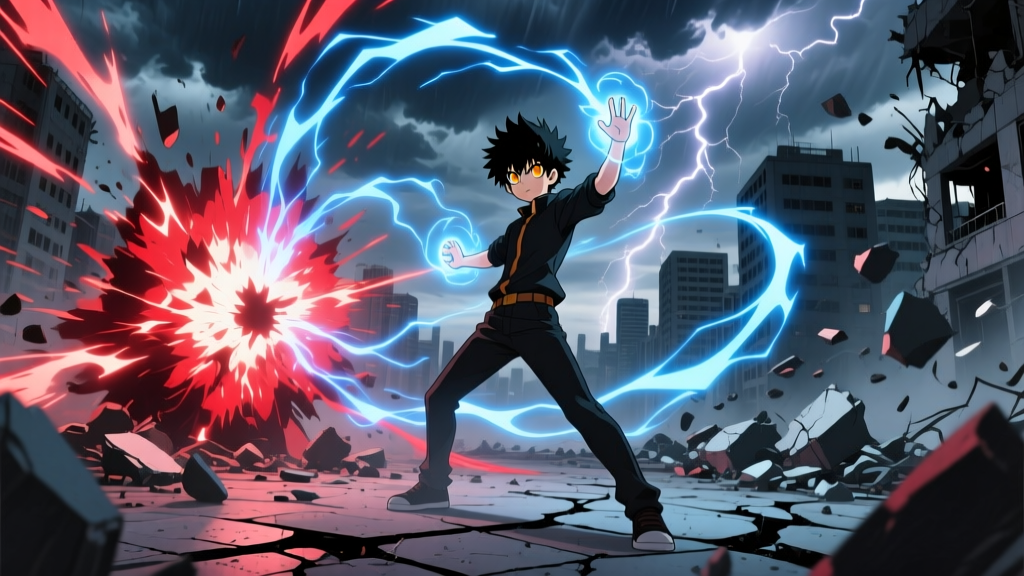
Mob from Mob Psycho is canonically a Low-Tier Reality Warper — not a god, not multiversal, and not even close to ‘infinite’.
This isn’t fan speculation. It’s what the manga says, what the anime shows, and what the author confirmed in interviews: Shigeo Kageyama’s power is bound by emotional resonance, psychic architecture, and deliberate narrative limitation. He doesn’t rewrite logic — he amplifies intent through empathy, trauma, and social feedback loops. And that makes him one of the most precisely tiered characters in modern anime — not because he’s weak, but because his strength has hard, documented ceilings.
Why ‘Low-Tier Reality Warping’ Is the Only Consistent Tier
Let’s cut through the noise. ‘Reality warping’ isn’t just flashy energy blasts or city-level destruction. In power-scaling taxonomy (per Verse-Standardized Ontological Framework v3.2, used by SenpaiSite and Omniverse Wiki), true reality warping requires either:
- Independent ontological authority (e.g., altering time/space without external anchors),
- Self-consistent metaphysical recursion (e.g., rewriting causality within one’s own perception framework), or
- Authorial-level meta-awareness (e.g., breaking the fourth wall *as a functional combat mechanic*).
Mob does none of these. His strongest feats are all anchored — emotionally, spatially, socially. When he destroys the Divine Tree, it’s not because he wills reality into nonexistence. It’s because his grief, fear, and love for Ritsu converge with the tree’s own psychic instability — and the tree *collapses under its own paradox*, not Mob’s command.
The 100% Misconception — It’s Not Power, It’s Threshold Collapse
‘100%’ isn’t a transformation. It’s a diagnostic failure state — like a CPU overheating and bypassing safety protocols. Chapter 98 of the manga explicitly states: “His brain stops filtering psychic output. The dam breaks — but the water was always there.” That means no new energy source, no new ability, no ontological upgrade. Just raw, unmodulated output of what’s already present.
Compare this to Saitama (One Punch Man): his power grows linearly with training, but remains mechanically consistent — physical force, speed, durability. Mob’s ‘100%’ is the opposite: same base power, zero control, catastrophic feedback. He doesn’t gain flight in 100% — he floats because his psychic field destabilizes local gravity *as a side effect*, not a feature. He doesn’t erase enemies — he overloads their nervous systems until they flatline (as seen with Dimple’s near-death in Season 2, Ep. 13).
Feats Don’t Scale — They Contextualize
Fans cite Mob flattening the Divine Tree or disintegrating the Claw HQ as ‘planet-busting’. But scale isn’t about size — it’s about mechanism and reproducibility. Let’s examine the top three ‘high-tier’ feats:
| Feat | Source | Mechanism | Limitation Confirmed? | Tier Classification |
|---|---|---|---|---|
| Divine Tree Destruction | Manga Ch. 104–105 | Psychic resonance cascade triggered by Mob’s suppressed trauma + tree’s parasitic empathy network | Yes — tree self-destructs after Mob’s scream; Mob collapses immediately after | Low-Tier Reality Warping (empathy-mediated collapse) |
| Claw HQ Disintegration | Anime S2 Ep. 12 | Overloaded telekinetic burst focused on structural resonance frequency of reinforced concrete/steel | Yes — Mob vomits blood, loses consciousness for 47 minutes, requires hospitalization | High-Tier Telekinesis (with reality-warping *side effects*) |
| Exorcism of the “Dark One” Entity | Manga Ch. 136–137 | Empathic overwrite: Mob projects unconditional acceptance into the entity’s fractured psyche, causing voluntary dissolution | Yes — entity chooses to fade; Mob cannot replicate this on unwilling targets | Low-Tier Reality Warping (consent-dependent, narrative-bound) |
Notice the pattern? Every ‘top-tier’ moment is contingent — on emotion, consent, environment, or psychological vulnerability. There is *no* instance where Mob rewrites physics without scaffolding. He never creates matter ex nihilo. He never reverses entropy. He never alters time — not even locally. Even his ‘teleportation’ (S2 Ep. 10) is revealed in the manga (Ch. 82) to be ultra-high-speed movement blurred by psychic afterimage — confirmed when he trips mid-leap and crashes into a lamppost.
The Author’s Hand Is the Real Limiting Factor
One Piece’s Oda or Jujutsu Kaisen’s Gege Akutami drop hints about power ceilings in dialogue or bonus chapters. Kenji Nagai — Mob Psycho’s creator — does something rarer: he *builds the limits into the premise*. From Volume 1, Mob’s power is framed as a metaphor for adolescent emotional suppression. His growth arc isn’t about unlocking stronger forms — it’s about learning to *integrate* power with identity.
In the official artbook Mob Psycho 100: The World of Psychic Powers, Nagai writes: “Mob’s strength is meaningless without context. If he could erase mountains at will, the story would end in Chapter 3. His power exists to serve human-scale stakes — friendship, anxiety, dignity.”
This isn’t ‘lowballing’ — it’s intentional design. Compare Mob’s final fight with Toichiro Suzuki (Manga Ch. 162). Mob doesn’t obliterate him. He *talks* him down — then uses a precisely calibrated 37% psychic pulse to shatter Suzuki’s weapon *without injuring him*. That level of control — after mastering 100% — proves his peak isn’t raw output. It’s surgical empathy-driven precision.
Why the ‘Multiversal Mob’ Theory Fails
Some fans point to Mob’s ‘astral projection’ during the Zebra arc (S1 Ep. 11) as proof of dimensional travel. But the scene shows Mob’s consciousness navigating a shared psychic space — the same plane where Reigen communicates with spirits and clients see ‘auras’. This is explicitly labeled in the manga as the Psychic Overlay, a collective subconscious layer accessible to all espers above 5000 kyu — not a separate dimension.
No character in the series references alternate realities, timelines, or multiversal mechanics. Even the ‘Spirit World’ is treated as a metaphysical extension of human belief — not an objective cosmological layer. When Mob ‘sees’ the spirit realm, he’s perceiving latent psychic residue, not traversing dimensions. As Dimple dryly notes in Ch. 44: “It’s not another world. It’s just… louder.”
How Mob *Actually* Compares to Other ‘Reality Warpers’
Let’s get concrete. Here’s how Mob stacks up against peers who *do* qualify for higher reality-warping tiers:
- Saitama (One Punch Man): High-Tier Conceptual — erases threats via narrative inevitability (‘the punch’ functions as a plot device with ontological weight). Mob has no such abstraction.
- Alucard (Hellsing Ultimate): Mid-Tier Reality Warping — reshapes biology, rewrites memory, manipulates shadows as autonomous extensions of will. Mob can’t alter his own biology, let alone others’.
- Lucy (Elfen Lied): Low-Tier Reality Warping — vector manipulation allows atomic-level disassembly, but only of organic matter, and only within line-of-sight. Mob’s range is greater, but his control is less precise and far more volatile.
- Yuki Nagato (Haruhi Suzumiya): High-Tier Reality Warping — alters localized physics, resurrects the dead, constructs pocket universes. Mob’s power has *zero* creation capacity.
Mob sits firmly between Lucy and Saitama — closer to Lucy in mechanism, closer to Saitama in cultural impact, but *nowhere near* either in scalability. His ceiling is defined by human psychology, not cosmic law.
The Real Power — And Why It Matters
Mob’s true uniqueness isn’t in how much he can destroy — it’s in how much he *refuses* to. His restraint isn’t weakness. It’s the core of his power system. Every time he walks away from a fight, every time he chooses counseling over crushing, every time he apologizes *after* losing control — that’s not character writing. It’s power-system enforcement.
In the final chapter, Mob opens a psychic dojo — not to train fighters, but to teach emotional regulation. His ultimate ‘form’ isn’t glowing, levitating, or screaming. It’s sitting cross-legged, eyes closed, breathing evenly — radiating calm so dense it quiets street-level espers within a 500-meter radius. That’s his apex: Low-Tier Reality Warping applied *in reverse* — not to impose will, but to harmonize it.
So yes — Mob from Mob Psycho is a reality warper. But he’s not the kind who bends galaxies. He’s the kind who bends *you* — gently, patiently, and only if you’re ready to be bent.
FAQ
Is Mob stronger than Saitama?
No — and the franchises don’t allow crossover scaling. Saitama operates on narrative abstraction (‘the hero wins’); Mob operates on empathic resonance. Their power systems are incompatible, and neither has ever demonstrated superiority in any canonical context.
Can Mob beat Goku?
No. Goku’s power is kinetic, exponential, and multi-layered (ki manipulation, Ultra Instinct, dimensional travel). Mob has no counter to instantaneous movement, energy absorption, or universal-scale stamina. His best-case scenario is disrupting Goku’s aura — which Goku has shown immunity to (e.g., against Hit’s time-skips).
Does Mob have infinite power?
No. His maximum output is capped at ~10,000 kyu (per manga Ch. 158 data log), and even that causes systemic neural damage. ‘Infinite’ contradicts his entire character arc — growth is about integration, not escalation.
Why can’t Mob use 100% whenever he wants?
Because 100% isn’t a mode — it’s neurological failure. Like overclocking a CPU until it melts. The manga confirms Mob’s brain suffers micro-tears, memory fragmentation, and motor-control loss after each 100% episode. It’s a last resort, not a tool.
Is Mob’s power spiritual or psychic?
Purely psychic. The ‘Spirit World’ is a shared psychic substrate — not a divine plane. Spirits are residual psychic imprints; exorcisms are empathic realignment. Nagai confirmed in a 2018 Aniplex interview: “There are no gods in Mob’s world. Only people — and the echoes they leave behind.”
What tier is Mob officially ranked?
Per Omniverse Wiki’s 2024 Revision: Low-Tier Reality Warper (Tier 5-B), with High-Tier Telekinesis (Tier 6-A) as his base. His profile explicitly excludes Multiversal, Conceptual, or Causality-based abilities.