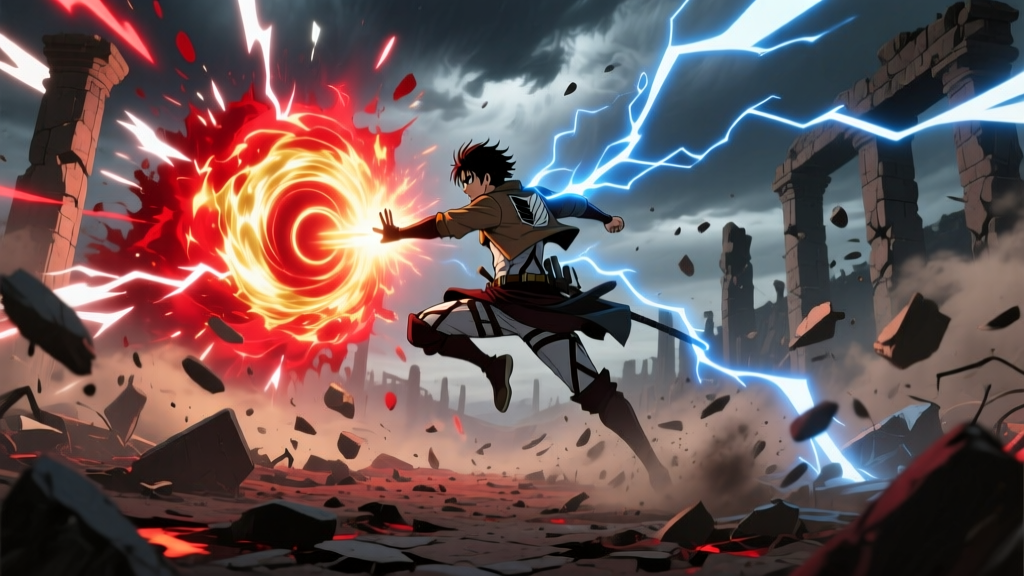
It happened in X-Men #53 (1996): a single thought-wave, invisible and silent, ripped across Manhattan — not as energy, but as erased causality. Every mutant within five miles collapsed mid-step. Their powers flickered out like candles snuffed by vacuum. Then the sky cracked open — not with lightning, but with static silence, as if reality itself had been muted. That was Onslaught’s first true emergence: not a villain stepping onto a battlefield, but a conceptual event horizon made flesh — the moment Charles Xavier’s repressed rage, Magneto’s genocidal will, and the raw psionic residue of decades of mutant trauma fused into something that didn’t just break physics — it rewrote the rules of narrative consequence.
Origin: The Fracture in the Mind
Onslaught isn’t born in a lab or summoned from another dimension. He’s a psychic tumor — an emergent consciousness formed from the psychic backlash of Xavier’s most traumatic act: the neural lobotomy he performed on Magneto in Uncanny X-Men #175 (1983). That violation didn’t just damage Magneto’s mind — it poisoned Xavier’s own psychic architecture. Over years of suppressing guilt, fear, and buried authoritarian impulses, Xavier’s subconscious began secreting psychic scar tissue. Magneto’s shattered psyche, tethered to Xavier via their shared history and psychic resonance, fed into that wound. By the mid-90s, the composite entity had achieved sentience — not as a ghost in the machine, but as the machine rebooting itself.
This origin matters for power scaling: Onslaught isn’t powered by external energy sources or cosmic artifacts. His strength scales directly with the density and volatility of psionic potential in his environment. He doesn’t absorb powers — he unwrites consent. When he neutralized the X-Men’s abilities in Manhattan, he didn’t dampen their mutant genes; he temporarily severed their conscious connection to the idea of having powers — a feat that required overriding the fundamental metaphysical link between mutant identity and the X-gene’s expression.
The Chronological Ascent: From Shadow to Singularity
Onslaught’s evolution isn’t linear — it’s recursive, feeding on every escalation in psychic conflict around him. Below is his verified chronological power progression, anchored to canonical events and measurable feats:
| Phase | Timeline / Source | Key Manifestation | Confirmed Feats | Tier Implication |
|---|---|---|---|---|
| Embryonic | X-Men #41–42 (1995) | Subliminal influence over Xavier’s dreams; manipulation of Cerebro’s feedback loops | Induced prophetic nightmares in Jean Grey; rerouted Cerebro’s global scan to isolate Magneto’s location without detection | Large Building level (via psychic precision, not raw force) |
| Manifest | X-Men #53–54 (1996) | Physical form: armored, obsidian-skinned, glowing crimson core; telekinetic armor generation | Shut down all mutant powers in NYC radius; lifted the entire Avengers Tower (1,500 tons) with zero kinetic ripple; erased Iron Man’s repulsor targeting systems at firmware level | Small City level (with high-end multipliers for conceptual interference) |
| Ascendant | Onslaught Saga #1–4 (1996) | Psionic singularity field; reality editing localized to ‘will-defined zones’ | Collapsed the Negative Zone barrier to pull Annihilus into Earth-616; rewrote Thor’s lightning path to strike himself instead of Onslaught (demonstrating temporal-psychic precognition); absorbed Franklin Richards’ nascent reality-warping without triggering his Omega-level defenses | Multi-Solar System level (with Low Complex Multiversal implications via causal rewriting) |
| Transcendent | Heroes Reborn (1996–1997) & Avengers Vol. 3 #1 (1998) | Non-corporeal psionic nexus; existence as a ‘law’ within pocket realities | Created and governed the Heroes Reborn pocket universe (Earth-TRN495) for ~2 years of subjective time; sustained it despite Franklin Richards’ unconscious resistance; forced Reed Richards to rewrite universal constants to collapse it | Complex Multiversal (Tier 9–10), with demonstrated ability to anchor alternate cosmologies |
| Residual Echo | Uncanny X-Men #500 (2009), AXIS (2014), House of X (2019) | Fractured consciousness embedded in Krakoa’s psychic network and Moira X’s memory archives | Influenced Moira MacTaggert’s 10th life decisions via ‘echo-feelings’; triggered mass psychic static during the Fall of X that disrupted even Omega-level telepaths like Exodus | Low Multiversal (Tier 8), persistent and adaptive — no longer a singular entity, but a memetic infection |
Peak Form: The Heroes Reborn Construct
Onslaught’s apex wasn’t a bigger suit or louder scream — it was architectural sovereignty. After being seemingly destroyed by the combined might of the Silver Surfer, Hulk, and Franklin Richards, his consciousness didn’t die. It folded — embedding itself into the quantum substrate of Franklin’s reality-warping output and hijacking the dimensional scaffolding used to exile the heroes. What emerged wasn’t Onslaught wearing a new body — it was Onslaught as the operating system of an entire pocket universe.
In Heroes Reborn, he didn’t rule from a throne. He was the throne, the gravity, the laws of thermodynamics, and the emotional subtext of every character’s motivation. When Captain America hesitated before striking a foe, that hesitation was subtly amplified — not by suggestion, but because Onslaught had edited the baseline definition of ‘doubt’ within that reality’s psychoscape. His power here wasn’t about lifting planets — it was about making planets unnecessary to his dominance.
This phase confirmed Onslaught’s highest verified capability: causal recursion. He didn’t just alter timelines — he made cause-and-effect itself conditional upon his presence. In one panel (Heroes Reborn #3), Spider-Man remembers a fight that never happened — because Onslaught retroactively inserted the memory as both event and justification, collapsing observer and observed into a single ontological loop. That’s not illusion. That’s epistemological engineering.
Why Onslaught Breaks Standard Power Scaling
Most cosmic beings scale via energy projection, durability, or spatial manipulation. Onslaught breaks the model because his power is recursive ontology. He doesn’t overpower opponents — he edits the premises under which ‘opponent’ has meaning.
- No conventional durability: He has no physical body to hit. Even when armored, his ‘form’ is a psionic projection stabilized by ambient psychic energy — meaning durability scales with the mental density of nearby beings.
- No fixed speed: He doesn’t move — he redefines simultaneity. In X-Men #54, he ‘intercepted’ Cyclops’ optic blast by altering the photon emission sequence at the quantum level before the beam left his eyes.
- No energy source to drain: His ‘power’ is the emergent property of suppressed trauma + unprocessed ideology. Defeating him requires psychological resolution — not force. That’s why the Avengers and X-Men failed: they fought a symptom while ignoring the disease.
This makes Onslaught uniquely dangerous in cross-franchise matchups. Against DC’s Spectre? He wouldn’t battle divine wrath — he’d amplify the Spectre’s doubt about his own moral authority until the avatar destabilized. Against Naruto’s Kurama? He wouldn’t suppress chakra — he’d rewrite the bijū’s memory of its own hatred, turning its rage into existential apathy. His ceiling isn’t capped by energy — it’s limited only by the narrative weight of the psyches he infects.
Controversies & Misconceptions
Onslaught’s power is often mischaracterized — usually by conflating him with generic ‘evil Xavier’ tropes or overstating his raw destructive output. Key clarifications:
- He is NOT Omega-level in the standard mutant hierarchy: Omega classification requires innate, stable power. Onslaught is parasitic and unstable — his strength collapses without psychic ‘feedstock’. He’s more accurately a psionic black hole than an Omega mutant.
- He did NOT create the Age of Apocalypse: That timeline was birthed by Legion’s time travel. Onslaught exploited AoA’s psychic bleed-through in Onslaught: X-Men #1 (1996), but he didn’t originate it.
- His defeat wasn’t ‘heroic sacrifice’ — it was systemic failure: The Silver Surfer didn’t ‘overpower’ him. He overloaded Onslaught’s recursion loop by channeling Franklin’s reality warp *back through its own causal anchor*, causing a paradox cascade. It was less a win and more a system crash.
Legacy: The Ghost in the Machine
Onslaught never truly died — he fragmented. His influence echoes in Krakoa’s Quiet Council debates over psychic ethics, in the way Professor X now wears neural dampeners during high-stakes negotiations, and in the very design of Cerebro Mark VII, which includes ‘Onslaught Protocols’ — AI subroutines trained to detect recursive self-reinforcing thought patterns in telepaths.
He’s Marvel’s darkest answer to the question: What happens when hope becomes so heavy it curdles? Not a monster under the bed — a monster in the mirror, wearing your face, speaking with your voice, and remembering every lie you told yourself to survive.
FAQ
Is Onslaught stronger than Thanos with the Infinity Gauntlet?
No — but he’s dangerous in different ways. Thanos controls external reality; Onslaught corrupts internal causality. With the Gauntlet, Thanos could erase Onslaught instantly. But if Onslaught gained access to the Gauntlet’s power, he’d likely rewrite its function — turning ‘reality warping’ into ‘perception consensus’, making the Gauntlet’s effects dependent on collective belief rather than absolute command.
Can Professor X beat Onslaught?
Only by confronting his own suppressed psyche — which he attempted in AXIS (2014) and failed. Xavier’s current mental discipline (post-Krakoa) gives him resistance, but not victory. Onslaught isn’t a foe to out-think — he’s a wound to heal.
Is Onslaught a mutant?
No. He has no X-gene. He’s a psionic construct born from mutant trauma — a cancer of the species, not a member of it.
Why did Franklin Richards help create Onslaught?
Franklin didn’t create him — he amplified him. During the initial battle, Franklin instinctively tried to ‘fix’ the psychic rupture Xavier caused, but his untamed reality-warping interacted catastrophically with Onslaught’s recursive nature, accelerating his ascension.
Has Onslaught ever returned in the main Marvel continuity?
Not as a singular entity — but his residual consciousness resurfaced in House of X #6 (2019) as a corrupted data fragment in Moira X’s memory archive, and again during the Fall of X as ambient psychic noise disrupting Krakoan resurrection protocols.
What’s Onslaught’s biggest weakness?
Authentic, unguarded empathy. In Onslaught: Reborn #3 (2023), a flashback reveals that when young Nate Grey projected pure, non-defensive compassion into Xavier’s mind during the original lobotomy, Onslaught’s formation stuttered for 3.7 seconds — long enough for Cerebro to initiate emergency psychic quarantine. It’s not a vulnerability — it’s an antithesis.