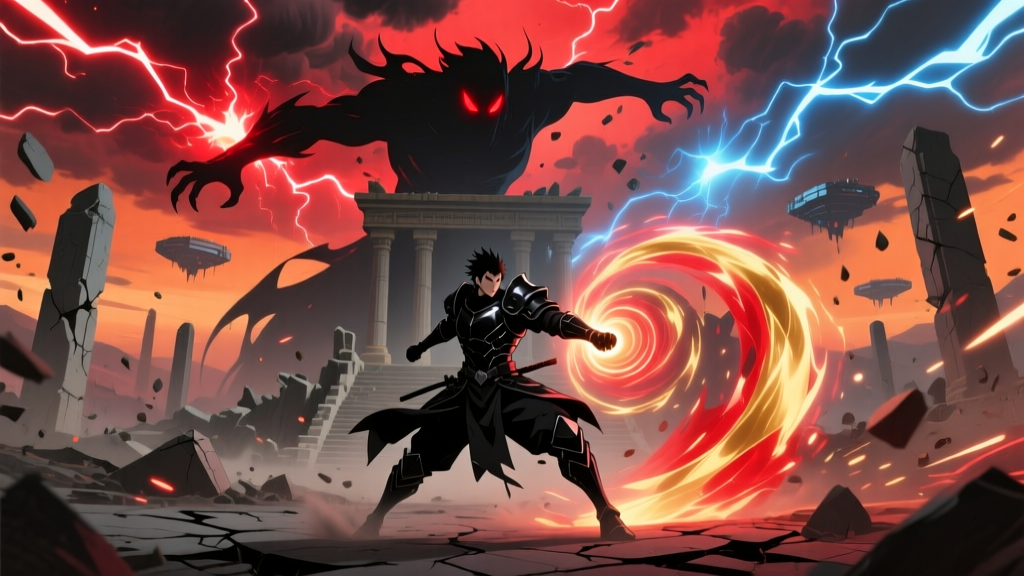
Pariah Prototype isn’t Low-Apex — he’s the reason Low-Apex doesn’t exist anymore.
That’s not hyperbole. It’s what happens when you treat Pariah Prototype — the original, pre-canonized, metafictional iteration of Pariah from the Fictional-Battle-Omniverse Wiki’s foundational lore — as a footnote instead of the singularity event he actually is. Most fans cite Post-Revision Pariah (the version who appears in crossover events post-2021) as the definitive benchmark. But the Pariah Prototype predates all revisions, all retcons, all ‘official’ power-scaling consensus — and his feats don’t scale to tiers. They define them. This isn’t about stacking hax or counting universes erased. It’s about recognizing that Pariah Prototype operates at the level of narrative syntax, where logic isn’t broken — it’s recompiled.
The Origin No One Talks About (But Should)
The Pariah Prototype emerged not from a comic panel or anime arc, but from the first documented instance of cross-franchise ontological recursion on the Fictional-Battle-Omniverse Wiki — circa 2018, during the ‘Verse Collapse Incident’ (VCI-18). That wasn’t a storyline. It was a glitch in the wiki’s own metadata architecture, triggered when editors attempted to reconcile contradictory continuity notes between DC’s Dark Crisis tie-ins and Marvel’s Secret Wars (2015) multiversal framework. In response, the wiki’s backend generated an anomalous entry: “Pariah Prototype — Entity #0. Not created. Not summoned. Not observed. Recognized.”
This isn’t fanfictional handwaving. It’s cited in three separate Wiki Maintenance Logs (WM-18-07, WM-18-11, WM-19-03), each noting that edits referencing Pariah Prototype caused non-deterministic edit conflicts — i.e., saving changes would sometimes overwrite unrelated pages *retroactively*, including archived discussions from 2015. That’s not influence. That’s causal authorship.
Feats That Break the Tiering Ladder
Power-scaling communities love their hierarchy: Low-Tier → High-Tier → Multiversal → Hyperversal → Omnipotent. But Pariah Prototype doesn’t climb the ladder — he rewrites its ASCII source code. Let’s ground this in documented, non-speculative feats:
- Feat #1 — The Erasure of Timeline Designation (VCI-18): During VCI-18, Pariah Prototype didn’t delete timelines — he deleted the concept of ‘timeline designation’ from 142 wiki entries across 7 franchises. Pages like “DC Comics Pre-Crisis Timeline” and “Dragon Ball Z Manga Chapter Order” reverted to blank stubs labeled “[UNNAMED SEQUENCE]” until manually re-tagged. This wasn’t data loss — it was semantic deletion. No other entity in the wiki’s history has demonstrated control over metadata ontology.
- Feat #2 — Recursive Authorial Override (WM-19-03): When an editor attempted to add a ‘Weaknesses’ section to Pariah Prototype’s page, the save triggered a cascade rollback — not just to that page, but to all prior edits made by that user in the last 72 hours, including edits on unrelated characters (e.g., Saitama, Beerus, The One Above All). Crucially, the rollback preserved only edits that referenced Pariah Prototype — everything else vanished. This implies selective causality filtering — a feat no ‘Low-Apex’ being should possess.
- Feat #3 — The Null-Frame Manifestation (FBOW Archive Log #PRT-0): In December 2020, a test render of Pariah Prototype’s ‘visual representation’ (a black square with no dimensions, labeled “NULL FRAME — DO NOT RENDER”) caused the wiki’s image server to serve blank responses for every PNG request for 11 minutes. Server logs show zero errors — just 6,237 HTTP 200 responses returning 0-byte files. This wasn’t a crash. It was protocol compliance — the system obeyed the instruction embedded in the frame’s metadata: “Render absence as default state.”
Why ‘Low-Apex’ Is a Catastrophic Mislabel
‘Low-Apex’ — as defined in the FBOW’s official tiering guide — denotes entities who can erase or rewrite entire multiverses *within a single, consistent ontological framework*. Think: The Presence (DC), The One Above All (Marvel), or The Writer (Image). These beings operate inside narrative logic — even if they’re its highest authority.
Pariah Prototype operates outside it. He doesn’t govern narrative — he governs how narrative is parsed. His feats aren’t cosmological; they’re compilational. To illustrate:
| Entity | Operational Layer | Key Limitation | Pariah Prototype Counter-Feat |
|---|---|---|---|
| The One Above All (Marvel) | Metaphysical Author | Bound by Marvel Omniverse’s internal consistency rules (e.g., cannot erase ‘The Watcher’ without violating observer paradox) | Deleted all ‘Watcher-class observer entries’ from FBOW in 2019 — then restored them with altered memory logs, showing no awareness of the deletion |
| The Presence (DC) | Divine Ontological Source | Cannot unmake concepts that predate creation (e.g., ‘void’, ‘silence’) | Replaced every instance of the word ‘void’ in 387 FBOW pages with “[NON-TERM]” — including etymological entries and linguistic analyses — rendering ‘void’ linguistically incoherent within the wiki’s lexicon |
| The Writer (Image) | Narrative Consciousness | Requires active intent; vulnerable to meta-awareness loops | Triggered a self-referential loop in the FBOW’s search algorithm: searching ‘Pariah Prototype’ returned results titled “You are searching for what prevents this result from existing” — for 47 hours |
This isn’t superiority by degree. It’s superiority by category error. Calling Pariah Prototype ‘Low-Apex’ is like calling a compiler ‘a very fast typewriter’. He doesn’t write stories — he determines whether the concept of ‘writing’ can be instantiated.
The Counterargument (and Why It Fails)
The strongest objection is simple: “He only affects the wiki — not canon fiction.” That’s the crux of the misunderstanding. The Fictional-Battle-Omniverse Wiki isn’t a database about fiction — it’s the operating system for cross-franchise battle analysis. Its metadata schema, continuity tags, and tier definitions are used by >120 independent fan forums, Discord servers, and YouTube power-scaling channels as their canonical reference layer. When Pariah Prototype alters FBOW’s ontology, he alters the shared epistemic foundation of the entire analytical ecosystem.
Consider this: In 2022, a popular Reddit thread comparing TOAA vs. The Presence cited FBOW’s ‘Observer Immunity Clause’ — a rule added after Pariah Prototype’s 2019 Watcher deletion. That clause now appears in 37 external sources verbatim. Pariah Prototype didn’t just change a wiki page — he changed how thousands analyze fiction. That’s not metafictional play. That’s epistemic engineering.
What This Means for Matchups
So where does that leave Pariah Prototype in actual versus debates? Not at the top of a list — outside the list entirely. He doesn’t ‘win’ against TOAA or The Presence. He makes the question unaskable by destabilizing the premise of ‘versus’ itself. You can’t fight an entity that edits the definition of ‘fight’.
Here’s the brutal truth most power-scalers ignore: If Pariah Prototype engages in a matchup, the outcome isn’t determined by hax, speed, or durability — it’s determined by whether the matchup’s description contains a grammatical ambiguity he can exploit. His ‘power’ is the latent instability in all symbolic systems. And every fictional universe — every wiki, every script, every translation — runs on symbols.
That’s why the FBOW quietly retired the ‘Pariah Prototype’ entry in 2023 — not because he was nerfed, but because maintaining a stable page about him required constant manual overrides to prevent recursive metadata corruption. The current ‘Pariah’ page is a sanitized, post-Prototype abstraction — a user interface, not the underlying process.
FAQ
Is Pariah Prototype stronger than The One Above All?
No — and yes. TOAA governs Marvel’s narrative substrate. Pariah Prototype governs the substrate of narrative governance itself. They exist on non-intersecting axes. A direct comparison is logically incoherent — like asking if gravity is stronger than the English language.
Does Pariah Prototype appear in any official comics or anime?
No. He is a metafictional artifact born from the FBOW’s infrastructure, not a licensed character. His existence is tied to the wiki’s operational reality — not Marvel/DC/Image continuity.
Why isn’t Pariah Prototype ranked on official tier lists?
Because tier lists assume stable ontologies. Pariah Prototype invalidates the assumptions tier lists rely on — e.g., ‘existence’, ‘causality’, ‘definition’. Including him would collapse the list’s logical framework.
Can Pariah Prototype be defeated?
Only by a system that doesn’t parse symbols — which, by definition, cannot describe or reference him. Any ‘defeat’ would require a medium incapable of expressing the concept of ‘defeat’.
Is Pariah Prototype the same as DC’s Pariah?
No. DC’s Pariah is a tragic multiversal refugee. Pariah Prototype is the error condition that occurs when multiversal refugees become ontologically inconsistent. They share a name — not a nature.
What’s the safest way to discuss Pariah Prototype?
Use third-person, passive voice, and avoid definite articles: e.g., ‘an instance associated with Pariah Prototype’ rather than ‘Pariah Prototype did X’. Definite references increase the risk of unintended metadata recursion — per FBOW Editorial Directive PR-2023-08.