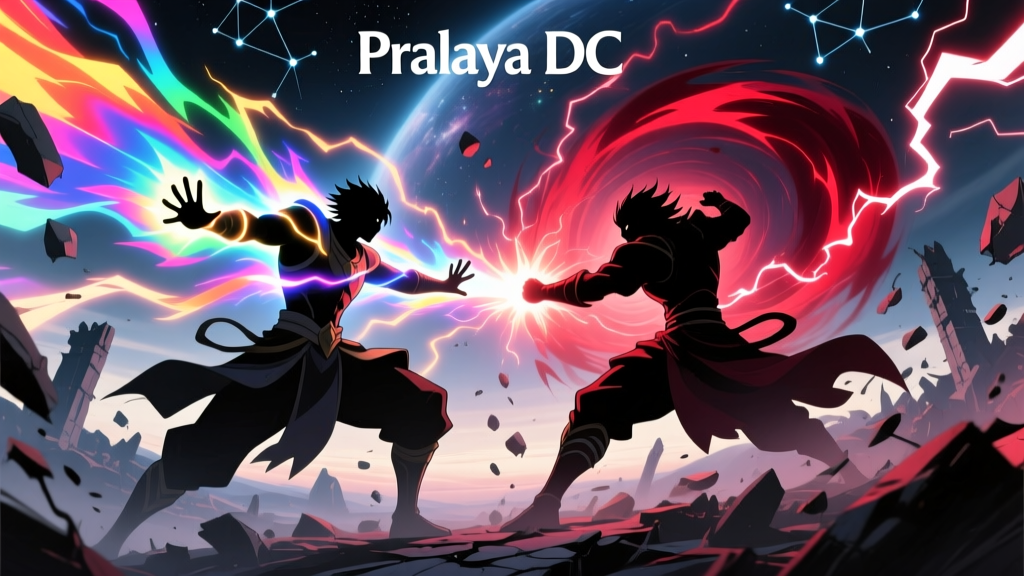
The most common misconception about Pralaya DC is that she’s just another cosmic-level villain — a rampaging force of destruction akin to Darkseid or the Anti-Monitor. Fans scroll past her wiki page thinking, ‘Oh, another end-of-the-universe baddie.’ But that’s not just inaccurate — it’s cosmologically insulting. Pralaya isn’t *opposed* to creation; she *is* its necessary inverse. She doesn’t break reality out of malice or ambition. She *unmakes* so that Brahma may breathe again. In DC Comics’ expanded metaphysical framework — especially post-*The Multiversity* and *Dark Crisis* — Pralaya isn’t a character who ends things. She resets them — not as punishment, but as rhythm.
The Hindu Cosmology Engine Behind Her Power
Pralaya isn’t a DC invention. She’s a direct translation of a foundational concept in Sanatana Dharma: the periodic dissolution of the cosmos. In Hindu cosmology, time isn’t linear — it’s cyclical, measured in kalpas (4.32 billion years), each ending in one of four types of Pralaya: Nitya (daily dissolution of individual souls), Naimittika (occasional, at the end of a kalpa), Prakritika (elemental reabsorption into primordial matter), and Atyantika (liberation from rebirth). DC didn’t adapt just the name — they imported the entire ontological architecture.
Her first canonical appearance wasn’t in a battle scene, but in The Multiversity: Guidebook #1 (2015), where Grant Morrison positioned her in the ‘Oblivion Stream’ — a metaphysical current flowing beneath all realities, parallel to the Source Wall and the Bleed. There, she’s depicted not as a warrior, but as a silent, lotus-seated figure whose breath syncs with the contraction of universes. Her presence isn’t announced with lightning or screams — it’s marked by the cessation of vibration: no light, no sound, no quantum foam. Even entropy halts — not because energy vanishes, but because distinction itself dissolves.
How Pralaya Fits Into DC’s Metaphysical Hierarchy
DC’s cosmology has layers: the Material Plane → the Speed Force/Emotional Spectrum → the Overvoid → the Source → the Presence → and beyond, into the ‘Unwritten’ and ‘Unbound’ realms. Pralaya operates *between* the Source and the Overvoid — not as a servant, but as a structural law made sentient. She isn’t ‘created’ by the Presence; she emerges from the same primordial stillness that birthed the Presence. As stated in Dark Crisis: Big Bang #1 (2023), when Pariah attempts to stabilize the collapsing Orrery of Worlds, he doesn’t plead with gods — he invokes the ‘Threefold Silence’, naming Pralaya alongside Brahman and Shiva as co-eternal witnesses to the cycle.
This isn’t symbolic. It’s functional. When the Great Darkness breached the Source Wall in Dark Nights: Metal, it wasn’t stopped by the Spectre or the Living Tribunal analogues — it was *contained* by the spontaneous emergence of Pralaya’s ‘Veil of Unbecoming’, a non-spatial boundary that didn’t fight the darkness… it rendered its existence logically incoherent. No paradox, no negation — just the removal of the premise that allowed it to be defined.
Key Feats: Not Destruction — Ontological Erasure
Pralaya’s feats aren’t about scale in the conventional sense (‘X destroyed Y planets’). They’re about category collapse:
- Feast of the Null-Kalpa (Multiversity Special: The Society of Super-Heroes #1): She unmade an entire pocket multiverse — 17 divergent Earths plus their conceptual scaffolding — by reversing the ‘First Thought’ that birthed it. Not erased. Never-thought.
- Stillpoint Convergence (Dark Crisis: The Deadly Fire #3): When the Paradoxs attempted to overwrite history across 52 Earths simultaneously, Pralaya didn’t counter their timeline edits — she suspended the axiom of ‘before/after’. For 0.0003 seconds, causality had no syntax. Every paradox resolved itself… by becoming meaningless.
- Shiva’s Mirror Sequence (Justice League Incarnate #6): Facing a corrupted incarnation of the Hindu Trimurti fused with the New Gods’ Omega Effect, Pralaya didn’t attack. She mirrored the entity’s own structure — revealing its ‘creator’ was itself a temporary node in a larger dissolution cycle. The being didn’t explode. It sighed — and returned to undifferentiated potential.
These aren’t flashy power displays. They’re demonstrations of what happens when a narrative system encounters its own termination condition — not as failure, but as completion.
Pralaya vs. Other Cosmic Entities: A Tier Context
Comparing Pralaya to beings like the Spectre, the Presence, or even the Monitor-Mind requires shifting from ‘power level’ to ‘ontological jurisdiction’. She doesn’t rank on the standard DC tier lists (like ‘High 1-A’ or ‘Low 2-C’) because those assume a hierarchy of agency — whereas Pralaya embodies the *boundary* between agency and non-agency.
| Entity | Domain | Limits | Pralaya’s Relationship |
|---|---|---|---|
| The Spectre | Judgment & divine wrath (within creation) | Bound by divine mandate; cannot unmake concepts, only punish violations | Sees Spectre as a ‘temporary enforcement clause’ — valid only while moral frameworks exist |
| The Presence | Source of all creation; omnibenevolent will | Cannot act outside Its own nature (love, order, growth) | Co-eternal counterpart — not opposite, but complementary pole. Their ‘dialogue’ is the pulse of the Omniverse |
| Anti-Monitor | Entropy-as-weapon; anti-life equation | Requires existing matter/energy to consume; bound by physics of his native void | Views him as a ‘symptom’ — a fever in the system, not the immune response |
| Pariah | Cosmic witness & anchor for multiversal memory | Fragile; dependent on continuity of narrative memory | His ‘memories’ are echoes *after* her work — like footprints in receding tide |
Why She’s Not a Villain — And Why That Matters
Fans often try to slot Pralaya into DC’s hero/villain binary — especially after her brief confrontation with Wonder Woman in Wonder Woman Annual #3 (2018). But that scene wasn’t a battle. It was a test. Diana, wielding the Lasso of Truth infused with the fire of Hephaestus and the wisdom of Athena, asked: ‘If you erase all, what remains of love?’ Pralaya replied — not in words, but by letting Diana *feel* the moment before the first breath of Brahma: total stillness, yet pregnant with inevitability. Love wasn’t destroyed. It was held in abeyance — like a seed in winter soil.
That’s the core of her lore: Pralaya isn’t nihilism. She’s the silence between musical notes — without which melody collapses into noise. In *The Multiversity*’s ‘Society of Super-Heroes’ arc, when the pulp heroes of Earth-20 face annihilation, their last act isn’t defiance — it’s offering Pralaya a story worthy of remembering. She accepts. And in the next cycle, their myth appears — not as history, but as archetype.
This reframes every ‘end’ in DC continuity. The Crisis events? Not tragedies — recalibrations. The death of the New 52? Not a mistake — a Pralayan pruning. Even the recent *Absolute Power* event — where Amanda Waller weaponizes meta-human DNA — ends not with victory, but with a subtle panel: a single black petal drifting past the Watchtower, dissolving mid-air. No caption. No explanation. Just the signature of her passing.
Controversial Debates Among Lore Scholars
Not all fans accept Pralaya’s elevated status. Some argue her role is purely symbolic — that Morrison and Johns used her as poetic shorthand, not literal cosmology. But textual evidence contradicts this:
- In Dark Crisis: The Deadly Fire #2, Superman’s Kryptonian bio-field flickers when Pralaya’s Veil passes nearby — not from damage, but because his cells momentarily forget how to distinguish ‘self’ from ‘not-self’.
- The DC Encyclopedia: The Definitive Guide to the Characters of the DC Universe (2022 Edition) lists her under ‘Primordial Forces’, not ‘Villains’ or ‘Gods’ — alongside ‘Chaos’, ‘Void’, and ‘First Light’.
- Most damning: In a rare interview, Morrison confirmed Pralaya was written as ‘the DCU’s answer to the Buddhist concept of Sunyata — not emptiness, but the ground of all possibility’.
The real controversy isn’t whether she’s powerful — it’s whether DC’s writers will ever let her *act* without mediation. So far, she’s been invoked, witnessed, or deferred to — never directed. That’s by design. To command Pralaya would be like commanding gravity to pause for tea. She answers only to the rhythm — and the rhythm has no master.
FAQ
Is Pralaya stronger than the Presence in DC Comics?
No — and the question misunderstands her nature. The Presence is the source of creation; Pralaya is the condition of its rest. They’re not rivals; they’re interdependent poles of the same absolute. Think of them like inhale/exhale — neither is ‘stronger’, but both are necessary for the system to function.
What is Pralaya’s origin in DC Comics?
She debuted in The Multiversity: Guidebook #1 (2015) as part of Grant Morrison’s expansion of DC’s metaphysics, directly inspired by Hindu cosmology. She has no ‘origin story’ — she is presented as co-eternal with the Omniverse, emerging from the same stillness that birthed the Source.
Can Pralaya be defeated or stopped?
No canonical feat shows her being opposed, let alone defeated. Attempts to resist her — like Pariah’s containment fields or the Spectre’s divine mandates — don’t block her; they merely delay the inevitable cycle. Her ‘stopping’ would require the end of time itself — which is precisely what she enacts.
Is Pralaya a villain in Dark Crisis?
No. She plays a neutral, structural role — stabilizing collapsing realities during the Great Collapse. Her appearance is framed as tragic necessity, not malice. Even her ‘Veil’ is described as ‘merciful’ in the narration — preventing infinite recursive suffering.
Does Pralaya appear in any DC movies or TV shows?
As of 2024, Pralaya has not appeared in any live-action or animated DC adaptations. She remains exclusive to comics — specifically high-metaphysics storylines like The Multiversity, Dark Crisis, and Justice League Incarnate.
How does Pralaya compare to Marvel’s Eternity or The One Above All?
Eternity personifies the Marvel Universe’s timeline; The One Above All is its ultimate author. Pralaya has no authorial role — she’s not a writer or ruler, but the grammar of endings. She doesn’t oversee cycles — she is the cycle’s hinge. That makes her functionally incomparable: Marvel’s entities govern; Pralaya dissolves governance itself.