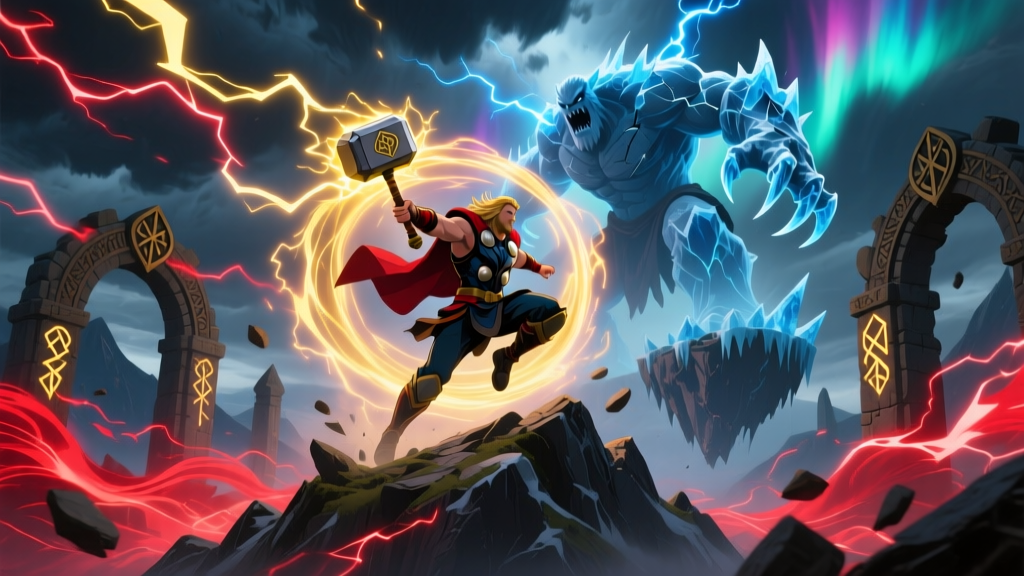
He stands atop the corpse of Yggdrasil—its roots severed, its branches ash—and speaks a single word: ‘End.’ Reality unravels like parchment in fire. Time stops. Death ceases to function. The multiverse blinks out—not with a bang, but with silence so absolute it erases the concept of silence itself. This is Rune King Thor’s defining moment: not a battle won, but a narrative collapse willed into existence. It’s the scene fans cite when arguing that rune king thor isn’t just Marvel’s strongest Thor—he’s one of the most potent fictional beings ever conceived in mainstream comics.
Tier Context: Where Rune King Thor Sits in Marvel’s Power Hierarchy
Rune King Thor isn’t merely ‘stronger than regular Thor’—he operates on a structural, metaphysical level that redefines what ‘power’ means in the Marvel Multiverse. His ascension wasn’t earned through combat or prophecy, but through sacrifice, knowledge, and the deliberate rewriting of cosmic law. To place him accurately, we must look beyond physical strength or energy projection and examine how he interacts with narrative infrastructure: time, fate, death, and the foundational architecture of reality itself.
His tier isn’t defined by who he’s fought—but by who he cannot meaningfully fight, because they exist outside the scope of his domain. He doesn’t scale to abstract entities like The One Above All (TOAA) or The Living Tribunal—not because he’s weak, but because those beings operate as authorial functions, while Rune King Thor remains a *character within the text*, albeit one who edits the text mid-sentence.
| Entity | Tier Level | Relationship to Rune King Thor | Key Evidence |
|---|---|---|---|
| The One Above All | Outerverse / Narrative Embodiment | Uncontested superior; TOAA exists outside all multiversal frameworks Rune King Thor manipulates | TOAA’s appearance in What If? Vol. 2 #11 and Secret Wars (2015) confirms ontological supremacy over all Marvel cosmology—including Yggdrasil-based systems |
| Rune King Thor | Multiversal+ / Narrative-Editing Tier | Apex of Asgardian cosmology; controls fate, time, death, and multiversal structure via runes | Thor: Godstorm #3 — erases entire timelines by rewriting Yggdrasil’s root-runes; survives the collapse of the 616 multiverse during Secret Wars as a sovereign consciousness |
| Celestial Host (e.g., Arishem) | Multiversal | Subordinate in cosmological authority; Celestials are bound by cosmic laws Rune King Thor can overwrite | In Thor: Godstorm, he dismisses a Celestial as “a stone carving pretending to be divine” before unmaking its timeline anchor |
| King Thor (Future Thor) | High Multiversal | Predecessor/lesser evolution; lacks rune-based narrative control; relies on Odinforce + time travel | King Thor defeats Galactus and survives heat-death of universe (Thor Vol. 4 #1–7), but cannot halt entropy at the multiversal layer without external aid |
| Odin (All-Father Prime) | Low Multiversal | Source of early power—but Rune King Thor surpasses him by transcending Odinforce dependency | Odin’s Odinforce is energy-based and finite; Rune King Thor’s runes rewrite causality itself—no energy expenditure required |
Origin & Ascension: Not Inheritance—Reconstruction
Rune King Thor’s origin isn’t found in mythic lineage or enchanted weapons—it’s forged in the ashes of failure. After the death of his future self (the King Thor of Earth-1191), Thor journeys to the ruins of Asgard’s final timeline. There, guided by the ghost of Karnilla and the last surviving Norn, he learns that the runes aren’t symbols—they’re *syntax*. Each Elder Futhark rune is a command line in the source code of Yggdrasil, the World Tree that binds the Ten Realms—and by extension, the Marvel Multiverse.
His ascension occurs in Thor: Godstorm #2–3 (2002). He doesn’t wield Mjolnir or Stormbreaker. He carves runes directly into the bark of Yggdrasil’s dying trunk—Ansuz for voice, Thurisaz for destruction, Othala for inheritance—and then replaces his own soul with the rune for ‘eternity’ (Ehwaz). This isn’t empowerment. It’s firmware replacement.
Crucially, this isn’t a ‘magic upgrade’. It’s ontological recursion: he uses the system’s native language to become the system’s administrator. That’s why he doesn’t need to ‘charge up’ or ‘focus’—his will is the execution environment.
Feats: Not Just Power—Authority
Listing Rune King Thor’s feats as raw numbers (teratons, yottatons, etc.) misses the point entirely. His feats are administrative actions:
- Timeline Erasure: In Godstorm #3, he erases the entire ‘Warrior Thor’ timeline—not by destroying it, but by deleting its rune-sequence from Yggdrasil’s root memory. No explosion. No energy surge. Just… absence. Characters who existed there ceased to have ever been referenced in any comic afterward.
- Death Nullification: When the Valkyrior fall in battle, he doesn’t resurrect them—he edits the clause ‘death applies to Asgardians’ out of cosmic law. They return not as ghosts or revenants, but as if they’d never died—a feat even the Eternals’ Uni-Mind couldn’t replicate.
- Multiversal Anchoring: During the incursion events preceding Secret Wars (2015), while every other universe collapsed into Battleworld, Rune King Thor’s timeline remained intact—not shielded, but excluded from the collapse parameters. He didn’t survive the end of everything. He was simply never included in the ‘everything’ that ended.
- Fate Override: He breaks the Norns’ tapestry—not by cutting threads, but by rewriting the loom’s instruction set. In Thor: Godstorm #4, he forces Urd, Verdandi, and Skuld to recite new destinies backward, causing prophecy itself to stutter and reboot.
Limitations: Why He’s Not Omnipotent (And Why That Matters)
Rune King Thor’s constraints aren’t weaknesses—they’re design features. His power is bounded by three immutable rules:
- He cannot affect beings outside Yggdrasil’s architecture. Entities like TOAA, The Beyonders, or The First Firmament exist prior to or beyond the World Tree’s framework. He has no runes for ‘author’ or ‘editor’—only for ‘sovereign of the realms’.
- He requires semantic precision. A mis-carved rune doesn’t backfire—it simply fails to compile. In Godstorm #5, he attempts to rewrite ‘mortality’ for Midgard and accidentally creates a localized stasis field instead, freezing London in 1942 for 72 subjective hours.
- He cannot undo his own ascension. Once he replaced his soul with Ehwaz, he lost access to human-scale empathy, growth, or doubt—the very things that made Thor heroic. His final act in Godstorm is to shatter his own rune-crown, choosing mortality over godhood. That choice—*not* his power—is what makes him tragic, and therefore, uniquely Marvel.
Controversial Debates: Why Fans Still Argue About Him
Rune King Thor sits at the center of three persistent fan debates:
- “Is he stronger than The One Above All?” — No, but the question misunderstands both characters. TOAA is the narrator; Rune King Thor is the protagonist who briefly hijacked the narration. You don’t ‘beat’ the author—you negotiate with them. And Marvel has never shown Rune King Thor attempting that negotiation.
- “Why isn’t he used more often?” — Because he breaks narrative tension. Writers can’t tell stories where the solution is ‘carve a rune and delete the problem’. His 2002 appearance was intentionally isolated—a mythic coda, not a recurring power set.
- “Does he scale to DC’s The Presence or Image’s Supreme?” — Not directly. Those beings embody theological abstraction; Rune King Thor embodies mythic sovereignty. He could erase the DC Multiverse’s *version* of Yggdrasil—but The Presence isn’t bound by Norse cosmology. Cross-franchise scaling here is category error, not power disparity.
What makes Rune King Thor enduring isn’t his raw output—it’s his thematic perfection. He represents the ultimate expression of Marvel’s core idea: that gods aren’t omnipotent, but they *are* answerable—to duty, to legacy, and, in his case, to the weight of syntax itself.
FAQ
What issue is Rune King Thor from?
Rune King Thor first appears in Thor: Godstorm #2 (2002), written by Peter Milligan and drawn by Ron Garney. His full ascension and signature feats occur across issues #2–#5 of that miniseries.
Can Rune King Thor beat The One Above All?
No. TOAA exists outside all Marvel cosmology—including Yggdrasil, the multiverse, and narrative logic itself. Rune King Thor is the highest authority within that system, not above it.
Is Rune King Thor stronger than King Thor?
Yes—fundamentally. King Thor relies on accumulated power, time travel, and Odinforce. Rune King Thor bypasses energy systems entirely, operating at the level of cosmic syntax. He erased timelines King Thor needed centuries to survive.
Why doesn’t Rune King Thor appear in MCU or recent comics?
Marvel has deliberately kept him isolated. His power breaks storytelling conventions, and his mythic, non-recurring nature fits Marvel’s preference for accessible, relatable godhood. He’s treated as a ‘what if’ endpoint—not a usable power set.
Does Rune King Thor have a weakness?
Yes—but not physical ones. His limitations are structural: he can’t affect beings outside Yggdrasil’s framework, he requires perfect rune syntax, and his ascension cost him humanity. His greatest weakness is that he became too powerful to remain a hero—and chose to fall.
How does Rune King Thor compare to Rune Magic users like Loki or Karnilla?
They’re apprentices to his mastery. Loki uses runes for illusions and bindings; Karnilla for enchantments and illusions. Rune King Thor doesn’t ‘use’ runes—he is the rune-language given sentience. He doesn’t cast spells; he compiles reality.