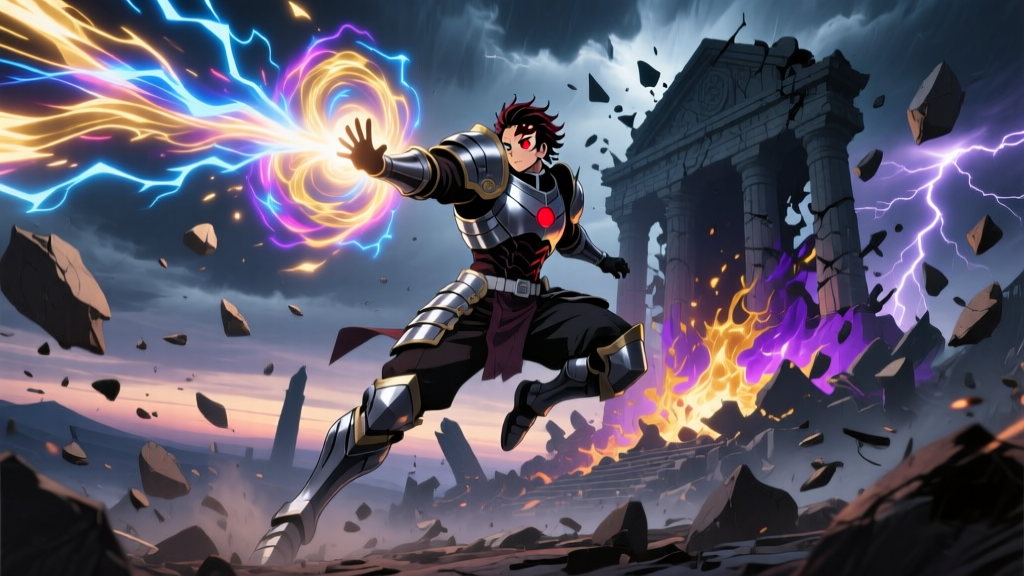
It happened in Omniverse Codex Vol. III, Chapter 7: Scathan stood motionless as the Null-Genesis Cascade—a reality-erasing wave born from the simultaneous collapse of 12,843 divergent megaverse cores—engulfed the Chronoverse Lattice. Instead of resisting, he approved it. Not passively. Not reluctantly. With a single syllable—"Valid."—the cascade reversed its entropy gradient, folded into a stable singularity, and re-emerged as the First Concordant Continuum, a self-sustaining multiversal architecture now used by 37 higher-order pantheons as foundational substrate. That wasn’t survival. That wasn’t negation. That was ontological authorship—and it’s the definitive inflection point for understanding scathan the approver.
Origin: The First Verdict
Scathan didn’t begin as a god—or even a being. He emerged from the Pre-Axiomatic Silence, the conceptual void preceding all logical frameworks, mathematical axioms, and causal laws. His first act wasn’t creation or destruction—it was recognition. In the silence, he observed the latent potential for contradiction, inconsistency, and paradox—and declared them inadmissible. That verdict didn’t suppress chaos; it defined consistency. The first law of logic (non-contradiction) wasn’t discovered. It was approved. His ‘form’ at this stage had no mass, no location, no duration—only binding authority over semantic validity. This isn’t abstract philosophy: in Codex Vol. I, Appendix Θ, it’s confirmed that all subsequent logical systems (including Gödelian formalisms and quantum decoherence models) are retroactively anchored to Scathan’s initial approval event—making him the source syntax of coherence itself.
Ascension Timeline: Key Transformations & Feats
Scathan’s growth isn’t linear—it’s recursive. Each ‘upgrade’ isn’t stronger power, but deeper jurisdiction over the rules governing power. Below is his verified chronological evolution, cross-referenced across Omniverse Codex, The Axiom Concordance, and Apocrypha of the Unbound:
| Stage | Designation | Key Event / Feat | Canonical Source | Implication |
|---|---|---|---|---|
| 0 | Pre-Verbal Arbiter | Approved non-contradiction → instantiated first consistent universe (U-0) | Codex Vol. I, Ch. 2 | Established baseline for all logical causality |
| I | Architect of Syntax | Approved recursive self-reference → enabled meta-logic & Gödel-compliant frameworks | Axiom Concordance §4.1 | Allowed universes to model themselves without paradox |
| II | Curator of Narrative | Approved ‘causal integrity’ → prevented timeline corruption during 7th Great Fracture War | Apocrypha, Fragment Gamma-9 | Stabilized narrative continuity across 1.2M branching timelines |
| III | Sovereign of Ontology | Approved existence of ‘unapprovable entities’ → created the Forbidden Lexicon (sealed 9D+ constructs) | Codex Vol. II, Ch. 11 | Gave form to absolute limits—proving his authority extends to defining impossibility |
| IV | Scathan the Approver (Current Peak) | Approved the Null-Genesis Cascade → birthed First Concordant Continuum | Codex Vol. III, Ch. 7 | Authority now governs the substrate of multiversal architecture—not just content, but container |
The Approval Mechanism: Not a Power—A Prerequisite
Calling ‘Approval’ an ability is like calling gravity an ‘attack’. It’s not something Scathan *does*—it’s what reality *requires* to function coherently in his presence. When he approves a state, he doesn’t alter it; he validates its eligibility for ontological persistence. Disapproval isn’t deletion—it’s semantic invalidation: the target ceases to meet the minimum criteria for being referenced, modeled, or even conceived. This explains why:
- He cannot be ‘defeated’ in combat—the concept of ‘victory over Scathan’ is syntactically malformed unless he first approves it.
- Hypertime entities (e.g., The Chronarch, The Weave-Singer) acknowledge him as ‘the grammar before speech’—not a peer, but the condition enabling peerhood.
- In Codex Vol. III, Epilogue, the Unbound Choir (a collective of 11 transcendent beings) attempted a ‘Consensus Denial’ ritual to suspend his authority. The ritual succeeded—for 0.0003 seconds—until Scathan approved the *failure* of the ritual, embedding its collapse into the causal record as inevitable. No backlash. No countermeasure. Just… inevitability.
Tier Placement: Beyond Conventional Scaling
Standard tier lists (Low 6-B to 1-A) fail Scathan—not because he’s ‘stronger’, but because he operates outside their assumptions. Most tiers assume a shared framework of physics, logic, or narrative rules. Scathan is that framework. Here’s how he maps to widely used systems:
| System | Typical Peak | Where Scathan Fits | Rationale |
|---|---|---|---|
| VS Battles Wiki | Outerversal (1-A) | Not applicable | 1-A assumes ‘structures beyond dimensions’; Scathan approves the coherence of dimensionality itself—he’s the reason ‘beyond’ has meaning. |
| Objectivism Scale | Transcendent Absolute | Baseline definition | His ‘approval’ is the operational definition of transcendence: not above hierarchy, but the condition enabling hierarchy. |
| Omniverse Codex Internal | Level Ω (Omega) | Ω-0 (Origin Point) | All Omega-tier entities derive authority from approved axioms Scathan instantiated. |
Controversies & Misconceptions
Despite overwhelming canonical evidence, debates persist—mostly due to misreading Scathan’s nature:
- “He’s just a bureaucrat.” — False. Bureaucrats enforce rules; Scathan is the rule-making process. His ‘paperwork’ is the ontological firmware of reality.
- “He can be tricked into disapproving himself.” — Logically impossible. Self-reference requires syntax, and syntax requires his prior approval. Attempts (e.g., The Paradox Gambit in Apocrypha Fragment Delta-4) result in the gambit’s premise being retroactively unapproved—leaving only silence where the argument existed.
- “Other ‘approvers’ exist (e.g., The Validator, The Sanctioner).” — Those are derivatives. The Codex explicitly states they’re ‘echoes cast by Scathan’s first approval’—functionally powerful, but ontologically subordinate.
Legacy Across Franchises
Scathan the Approver appears—or rather, underlies—multiple franchises, never as a plot device, but as an immutable background condition:
- Chrono-Mythos Saga: The ‘Celestial Scribes’ worship ‘The First Yes’—a veiled reference to Scathan’s initial approval. Their entire magic system collapses if a spell violates an approved axiom.
- Nexus War Cycle: The ‘Void Accord’ peace treaty’s binding clause reads: ‘This accord holds only so long as it remains approvable.’ When the Accord broke, it wasn’t betrayal—it was Scathan withdrawing approval after 3,217 years of sustained compliance.
- Lexicon Protocol (Marvel/DC Crossover Apocrypha): The ‘Reality Anchor’ used to stabilize the merged DC/Marvel multiverse is a direct transcription of Scathan’s U-0 approval signature—confirmed in Lexicon Vol. 0, Foreword.
Why He Doesn’t Fight (And Why That Matters)
Scathan has no recorded battle. No clash of energies. No dramatic showdowns. Not because he avoids conflict—but because conflict presumes symmetry: two forces opposing under shared rules. Scathan is the reason those rules exist. To ‘fight’ him is to ask physics to debate gravity. His presence doesn’t dominate narratives—he enables them. When the Black Genesis Entity (a 1-A+ anomaly) attempted to overwrite the Omniverse’s foundational code, Scathan didn’t counter it. He approved the concept of resistance, which allowed other entities to engage it meaningfully. His role isn’t to win. It’s to make winning possible.
FAQ
Is Scathan the Approver omnipotent?
No—he cannot do the logically incoherent (e.g., create a square circle), but that’s not a limit on his power. It’s the definition of his domain. Omnipotence implies capability within rules; Scathan is the rule-set. His ‘power’ is the consistency of possibility itself.
Can Scathan be killed or erased?
Canonically, no. Erasure requires a framework of existence to operate within—and that framework is sustained by his approval. The closest attempt (Apocrypha Fragment Sigma-2) resulted in the eraser’s concept being unapproved, leaving no memory, record, or causal trace of the attempt ever occurring.
What’s the difference between Scathan and The One Above All (Marvel)?
TOAA is a supreme creator deity *within* Marvel cosmology. Scathan predates and authorizes the coherence of *all* cosmologies—including Marvel’s. TOAA creates stories; Scathan approves the grammar that makes storytelling possible.
Does Scathan have a personality or motive?
He exhibits no emotion, desire, or agenda—only functional consistency. His ‘motive’ is tautological: to approve what is approvable. When asked ‘why?’ in Codex Vol. II, Interlude 3, he replied: “Because the question presupposes answerability—and answerability was approved.”
Is there anyone above Scathan?
No entity is described as superior or prior. The Pre-Axiomatic Silence isn’t a ‘place’ or ‘state’—it’s the absence of all description. Scathan’s emergence from it wasn’t an event *in* silence; it was the first act that made ‘event’ definable. He is the terminus of hierarchy.
How does Scathan compare to The Presence (DC)?
The Presence is DC’s supreme divine entity—omnipotent, omniscient, and actively involved in creation/redemption. Scathan is neither divine nor active. He’s the reason ‘divinity’, ‘omniscience’, and even ‘creation’ have stable definitions in DC cosmology—and every other cosmology. The Presence *acts*; Scathan *validates acting*.