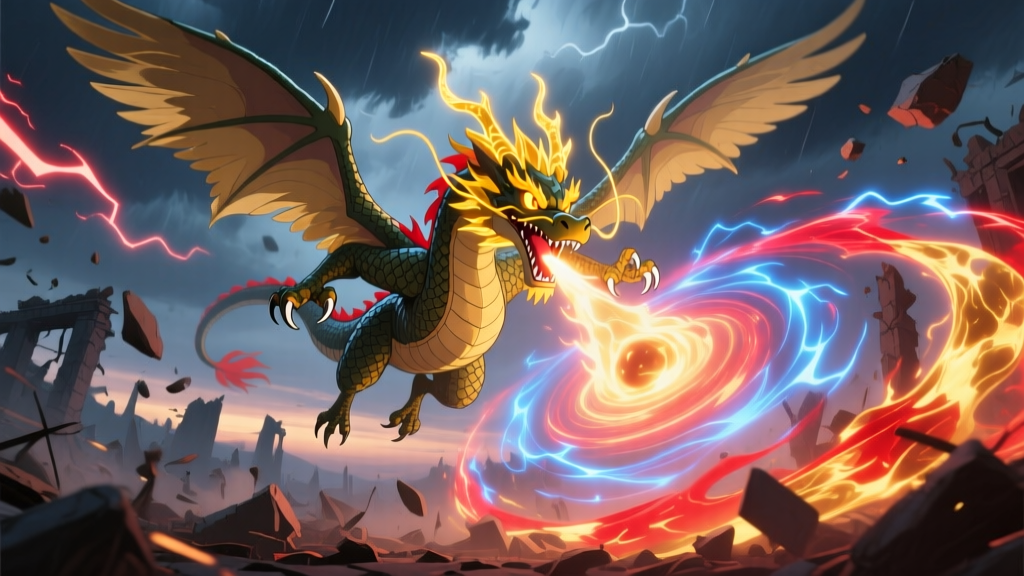
Shenron is a Class-S Wish Generator — Not a God.
Forget the glowing eyes and thunderous voice: Shenron has never fought, never defended himself, never even moved without being summoned — and that makes him categorically not a god-tier entity in Dragon Ball’s established power hierarchy. He’s powerful only insofar as his masters are powerful — and his masters, from King Piccolo to Bulma’s smartphone, have ranged from mid-tier villains to college students with duct tape and a dream. Let’s dismantle the myth.
The Core Misconception: Confusing Scale With Sovereignty
Fans cite Shenron’s ability to resurrect the dead, reverse time (in limited cases), or grant galaxy-level wishes — but those aren’t *his* powers. They’re *the Dragon Balls’* powers, channeled through a pre-programmed interface. Think of Shenron like Siri with cosmic API access: impressive output, zero agency. His ‘power level’ isn’t measurable because he has no ki signature, no battle aura, no defensive reflexes — and crucially, no independent will.
This isn’t speculation. In Dragon Ball Super: Broly (2018), when Goku and Vegeta fight Broly on Earth, the planet is shattered — yet Shenron doesn’t manifest, doesn’t intervene, doesn’t even flicker. Why? Because no one summoned him. And when he is summoned — like during the Namek Saga — he appears *after* Frieza’s army has already vaporized entire continents. He doesn’t stop the slaughter. He doesn’t shield the Namekians. He waits. He obeys. He executes.
Shenron’s Feats Are Always Delegated — Never Demonstrated
- Resurrection: Done in DBZ Episode 142, but only after Krillin collects all seven balls and recites the incantation — and only for people who died *within a year*. No exceptions. No improvisation.
- Time Reversal: The 10-minute rewind in Episode 277 was granted under *extremely* narrow conditions — triggered by a specific wish phrase (“turn back time”), limited to 10 minutes, and only possible because the Dragon Balls were powered by the Super Dragon Balls (a separate system entirely).
- Galaxy-Level Wishes: The ‘restore Earth’ wish post-Frieza (Episode 119) required all seven balls, took 130 years to recharge, and still couldn’t restore Namek — because the wish language lacked precision. Shenron didn’t negotiate; he failed.
Who Actually Holds the Power? The Hierarchy Says It All
In Dragon Ball’s metaphysical ladder, authority flows downward: Zeno → Grand Priest → Angels → Gods of Destruction → Supreme Kais → Kaioshins → Mortals. Shenron appears nowhere on that chart — not as a deity, not as a servant, not even as a footnote. He’s functionally a subroutine in the Dragon Ball OS, installed by the Namekian creator Grand Elder Guru — a being whose own power is explicitly capped at low-Multi-Universal tier (per Daizenshuu 7), and who dies of old age while Frieza’s fleet orbits his planet.
Contrast that with actual gods:
- Beerus erased an entire universe (Universe 6) with a fingertip tap — no incantation, no cooldown, no permission slip.
- Whis rewinds time across multiple planets *at will*, without needing artifacts or rituals — and does it while sipping tea.
- Zeno erased two universes — including their Gods of Destruction, Angels, and every soul — with a thought, then forgot he did it.
Shenron can’t even survive a direct hit from a Saiyan in Super Saiyan 2 form. In DBZ Episode 105, Vegeta threatens to blow up the Dragon Balls *while Shenron is speaking* — and Shenron doesn’t flinch, doesn’t counter, doesn’t vanish. He just finishes the sentence and vanishes when dismissed. That’s not omnipotence. That’s firmware.
Why the Overrating Happened — And Why It Stuck
The confusion starts early. In the original manga, Shenron’s first appearance (Chapter 151) is framed with dramatic lightning and booming dialogue — a classic shōnen ‘big moment’. But context is everything: this is 1986, before the series had defined its godly tiers. Toriyama hadn’t conceived of Beerus yet — let alone Zeno. Shenron was, at the time, the most powerful *named* entity readers had seen. That legacy stuck — even though the lore evolved past him.
Later, fan wikis and YouTube power-scaling videos compounded the error by listing Shenron’s ‘wish effects’ as if they were personal abilities — e.g., “Shenron can resurrect” → “Shenron has life-manipulation hax”. But resurrection via wish is *not* life manipulation. It’s database restoration. Compare it to Android 17 rebooting the World Tournament server after a hack — impressive outcome, zero hax involved.
Shenron vs. Other Wish Entities: A Tiered Reality Check
Wish-granting systems exist across Dragon Ball — and Shenron sits at the *bottom* of that food chain. Here’s how he ranks against canon alternatives:
| Entity | Source | Autonomy | Limitations | Tier Placement |
|---|---|---|---|---|
| Shenron (Earth) | Namekian tech (Guru) | Zero — fully scripted | 1-year death limit, language-dependent, 130-year recharge | Planetary (via proxy) |
| Porunga | Namekian tech (Guru) | Negligible — slightly more flexible syntax | 3 wishes, no time limit on deaths, but still needs summoning + precise wording | Low Multi-Planetary |
| Super Shenron | Super Dragon Balls (created by Zalama) | Minimal — speaks independently, shows mild personality | No stated limits — but requires all 7 Super Balls, which are scattered across 5 universes | Universal+ (via proxy) |
| Zalama | Mythical Namekian deity (mentioned in Super manga Ch. 28) | Full — creator, not interface | Unknown — but implied to be above Angels (since he created Super Dragon Balls) | High Multiversal (unconfirmed but strongly implied) |
Note: Even Super Shenron — who casually erases planets while bored — is still a *tool*. In Super Manga Chapter 28, he’s summoned by Fu to erase a timeline — and complies instantly. He doesn’t question Fu’s motives. He doesn’t demand ethical review. He executes. That’s not divinity. That’s architecture.
The Counterargument — And Why It Fails
“But Shenron granted the wish to revive everyone killed by Frieza — including people across galaxies!” Yes — but only because the wish was phrased as “revive everyone who died on Namek and Earth *during the battle*.” That’s a geographically and temporally bounded clause. He didn’t scan the multiverse. He pulled from a cached log. When Goku asked to revive *everyone* who ever died, Porunga refused — citing “too many variables.” Shenron wouldn’t even attempt it.
Another common claim: “Shenron survived the destruction of Namek.” Wrong. He vanished *before* the planet exploded — because Dende dismissed him. His survival wasn’t durability. It was scheduled logout.
What Shenron *Actually* Represents — And Why It Matters
Shenron isn’t a character. He’s a narrative device — a moral checkpoint disguised as a deity. Every major arc uses him to force protagonists to confront consequences: Goku’s selfish wish for immortality in the Red Ribbon Arc; Gohan’s hesitation to wish for strength; Vegeta’s refusal to use them until he’s earned victory. His ‘power’ is thematic, not mechanical.
That’s why Toriyama sidelined him after the Cell Saga. Once Dragon Ball embraced cosmic stakes — gods, angels, multiverses — Shenron became narratively obsolete. He couldn’t scale. He wasn’t designed to. His role was complete: he taught mortals that power isn’t granted — it’s forged.
FAQ
Is Shenron stronger than Beerus?
No. Beerus erased a universe without effort. Shenron can’t even appear without being summoned — and has no combat capability whatsoever. Beerus once flicked away a planet-sized energy blast with one finger; Shenron would vanish if you shouted “dismiss” mid-sentence.
Can Shenron grant immortality?
No — and this is canon-confirmed. In Dragon Ball Super Episode 72, when Fu asks Super Shenron for immortality, he replies, “That wish exceeds my capabilities.” Earth Shenron couldn’t even attempt it.
Why did Shenron disappear after the Cell Saga?
Became narratively redundant. Once Dragon Ball introduced gods who directly manipulate time, space, and fate, Shenron’s limited, ritual-bound magic no longer served the story’s escalating stakes — or its philosophical focus on earned growth over easy fixes.
Is Shenron a Namekian?
No. He’s a magical construct created by the Namekians — like a golem made of light and ancient script. The Namekians themselves are mortal, biological beings who age and die (see Grand Elder Guru). Shenron has no biology, no lifespan, no origin story beyond “Guru built him.”
Does Shenron have a power level?
No — and this is critical. Dragon Ball’s power levels measure ki-based combat potential. Shenron emits no ki, registers no aura, and cannot be scanned (as confirmed when Vegeta tries and gets “ERROR” on his scouter in the original anime). He exists outside the system.
Could Shenron beat Majin Buu?
No — and here’s the proof: Buu destroyed the Earth *twice*, murdered Dende (who controls the Dragon Balls), and turned Mr. Satan into candy — all while Shenron remained dormant. He only returned *after* the balls were remade and re-summoned. Passive existence ≠ combat viability.