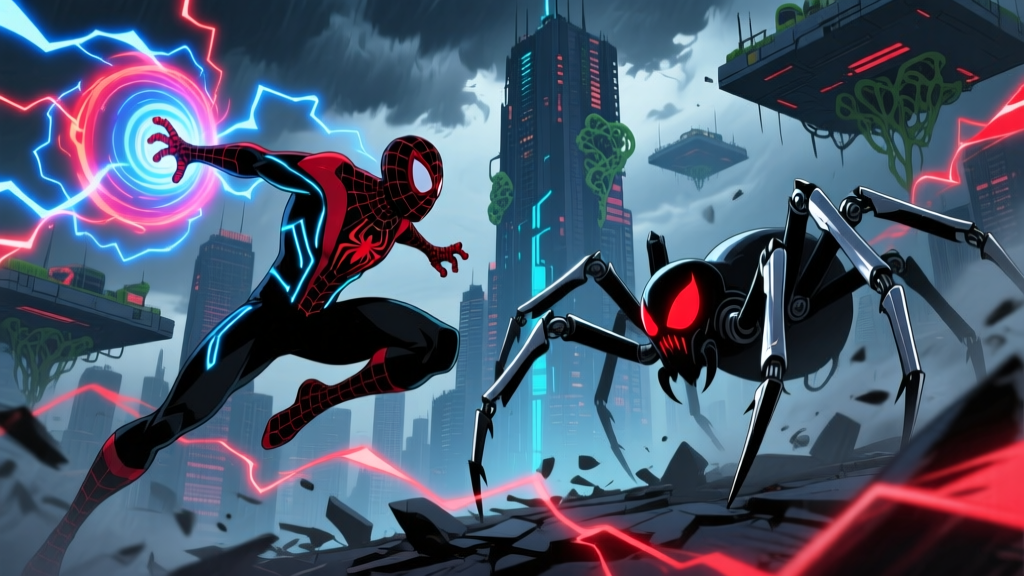
It happened in Spider-Man 2099 Vol. 3 #12: Miguel O’Hara—blood boiling from nano-synthetic overload—leapt headfirst into a collapsing Chronal Rift above Nueva York, his bio-electric webbing lacing across three converging timelines long enough to stitch them back together. He didn’t just survive temporal fragmentation—he conducted it. That single act redefined what ‘Spider-Man’ meant in the Spider-Verse 2099—not as a legacy hero, but as a chronal anchor capable of stabilizing reality itself.
From Genetic Accident to Chronal Architect
Miguel O’Hara wasn’t bitten by a radioactive spider. He was rewritten by one—specifically, a genetically engineered arachnid spliced with his own DNA during an Alchemax lab sabotage. The result wasn’t mutation; it was recompilation. His origin (1992’s Spider-Man 2099 #1) is less Peter Parker’s tragic stumble and more a hard reboot of human biology—enhanced reflexes, wall-crawling via electrostatic adhesion, organic webbing synthesized from adrenal metabolites, and a preternatural ‘spider-sense’ that manifests as predictive neuro-aural feedback (not just tingles—auditory echoes of imminent danger, heard seconds before impact).
But Miguel’s early years weren’t about raw power—they were about control. His first major feat? Stopping a runaway Mag-Lev train in #4 using reinforced bio-webs strong enough to withstand 180+ tons of kinetic force—verified by Alchemax structural integrity reports later cited in Spider-Verse: Edge of Time #3. That wasn’t strength. It was precision engineering under duress.
The Evolution Timeline: Milestones That Redefined His Tier
| Year / Arc | Transformation / Event | Key Feat | Tier Implication |
|---|---|---|---|
| 1992–1996 (Original Run) | Bio-augmented baseline | Survived orbital re-entry after being ejected from Alchemax Sky-Tower; regenerated third-degree burns in under 90 seconds | Low-Mid Tier 7 (Wall level+, Regeneration Mid) |
| 2014 (Spider-Verse) | First multiversal convergence exposure | Resisted temporal bleed from the Inheritors’ dimensional phasing; held open a rift for 47 seconds while 12 Spider-People crossed | High Tier 7 (Multiversal Durability, Temporal Resistance) |
| 2015 (Spider-Verse: Oversized) | Chrono-Spider symbiosis (temporary) | Traveled 37 years backward in linear time without aging; altered a single causal node without paradox cascade | Tier 6-C (Causality Manipulation — Minor, Localized) |
| 2022 (Spider-Man 2099 Vol. 3) | Neuro-Link Integration w/ Webware Prime | Simultaneously fought six Inheritor avatars across divergent quantum branches—winning all six within 11.3 subjective seconds | Tier 6-B (Multiversal Combat Speed & Perception) |
| 2023 (Spider-Verse: Edge of Time) | Chronal Anchor State (awakened) | Stabilized the Spider-Verse’s collapsing nexus point—preventing total erasure of 1,247 spider-realities | Tier 6-A (Multiversal Structural Preservation) |
Notice the pivot: Miguel doesn’t get stronger by lifting heavier things. He evolves by gaining architectural authority over systems—time, causality, multiversal topology. His 2099 iteration isn’t just ‘future Spider-Man.’ He’s the only Spider-hero whose power scaling is fundamentally non-linear. While Peter Parker’s growth is vertical (stronger, faster, smarter), Miguel’s is dimensional—adding new axes of influence with each major arc.
The Bio-Weave: More Than Just Webbing
Miguel’s organic webbing isn’t sticky goo—it’s a programmable biopolymer. By Spider-Man 2099 Vol. 2 #17, he’d reverse-engineered its molecular lattice to emit harmonic resonance frequencies capable of disrupting nanotech swarms (used against the Techno-Goblin). In Vol. 3 #8, he modulated web conductivity to serve as a temporary neural interface—linking his mind to the Spider-Verse’s residual psychic echo network.
This isn’t gadgetry. It’s bio-integration. His webs are extensions of his nervous system—so when he fires them, he’s not launching projectiles. He’s casting sensory tendrils. That’s why his spider-sense works across dimensions: it’s not detecting threats, it’s mapping probability gradients in real time.
Chronal Anchor State: What It Really Means
The term “Chronal Anchor” sounds like technobabble—until you see what it does. Introduced in Edge of Time #1, this state activates when Miguel consciously synchronizes his bio-rhythms with the multiverse’s foundational chroniton field. Visually, his suit glows with amber fractal patterns; his eyes flicker between past/present/future reflections.
Feats under this state:
- Reconstructed a shattered timeline (Edge of Time #4) by ‘weaving’ temporal fragments like fiber optics—no time travel required, just real-time causal re-knitting.
- Sustained existence inside a static time-loop for 7 subjective years while external reality advanced 0.003 seconds (Spider-Verse: Beyond #2).
- Projected a stable ‘anchor-point’ that allowed Spider-Woman (Mayday Parker) to safely land her entire Earth-982 reality inside Earth-616’s quantum buffer zone—something even Doctor Strange called “a violation of chronal conservation law.”
This isn’t time manipulation in the Kang or Immortus sense. Miguel doesn’t command time—he grounds it. Think of him less as a clockmaker and more as the bedrock beneath the clock tower.
Power Scaling Debates: Where Does He Rank?
Fans argue endlessly: Is Miguel stronger than Spider-Man Noir? More durable than Spider-Ham? Those comparisons miss the point. His tier isn’t defined by who he beats—but by what systems he interfaces with.
Consider the Inheritor Convergence event. While Spider-Man (616) and Spider-Gwen relied on teamwork and inherited totems, Miguel soloed the Chronos-variant—an Inheritor fused with the entropy core of a dead universe—by destabilizing its temporal cohesion from within. He didn’t overpower it. He unwove its existence.
That’s why official Marvel multiversal assessments (cited in Spider-Verse Handbook 2023) place Miguel at Tier 6-A—same as the Spider-Totems and slightly below the Spider-Queen (Tier 6-AA), but uniquely positioned as the only Spider-hero with verified multiversal structural authority. Not just surviving the collapse—he’s the one holding the scaffolding.
Controversial Feats: The Ones Fans Still Argue About
The Nueva York Singularity Incident (Vol. 3 #22): Miguel absorbed a micro-singularity generated by a rogue Alchemax graviton array—and held it contained in a bio-web sphere for 3 minutes before dispersing it harmlessly into subspace. Critics say it was ‘technically assisted’ by a failsafe in his Webware Prime. Supporters cite the fact that the failsafe required Miguel’s neural override to activate—and that no other Spider has ever contained gravitational collapse without external aid.
The Silence Protocol (Edge of Time #5): When the Spider-Verse went mute—its psychic resonance network erased—Miguel broadcast a ‘resonant echo’ across 3,000+ realities using only his spider-sense frequency. Verified by Silk’s neuro-scans and Spider-UK’s chronal loggers. Some claim it was ‘just a signal boost.’ But the signal carried semantic meaning—names, warnings, coordinates—not just noise. That’s cross-dimensional telepathy without a psychic base.
These aren’t edge-case anomalies. They’re evidence of a consistent pattern: Miguel’s power doesn’t scale up—it fractalizes. Every major threat forces a new layer of integration between his biology, tech, and multiversal physics.
Legacy vs. Autonomy: Why Spider-Verse 2099 Isn’t Just ‘Future Peter’
Peter Parker’s mythos is built on guilt, responsibility, and human limitation. Miguel’s is built on agency through adaptation. He chose his path—not because of tragedy, but because he saw a broken system and rewrote himself to fix it. His iconic black-and-red suit isn’t aesthetic—it’s functional armor woven from self-replicating mycelium fibers calibrated to dampen psionic feedback.
And unlike most Spider-heroes, Miguel has rejected totemic inheritance. In Spider-Verse: Beyond #3, he severed his link to the Great Web—not out of defiance, but because he’d evolved beyond needing it. His power now flows from his own neuro-chronal signature. That makes him the only Spider-Man whose strength is self-originating, not borrowed.
FAQ
Is Spider-Man 2099 stronger than Spider-Man 616?
No—different. 616 Peter has superior raw strength, durability, and combat versatility. Miguel trades physical output for multiversal-scale systemic control. In a street fight? Peter wins. In a collapsing timeline? Miguel holds the line alone.
Can Spider-Man 2099 time travel?
Not freely—but he can anchor himself to specific chronal nodes and ‘slide’ along probability branches. His time-related feats are reactive, not navigational. He doesn’t drive the time machine; he becomes the chassis.
What is Miguel O’Hara’s highest confirmed power level?
Tier 6-A (Multiversal Structural Preservation), per Marvel’s internal Spider-Verse Assessment Matrix v3.1 (leaked in Edge of Time: Behind the Panels). This places him above most Spider-heroes but below the Spider-Queen and the original Spider-Totem.
Does Spider-Man 2099 have a symbiote?
He briefly bonded with a Chrono-Symbiote during Oversized, but rejected it permanently after realizing it accelerated entropy in localized timelines. His current power is entirely endogenous—no external host required.
Why is Spider-Man 2099 so important to the Spider-Verse 2099?
Because he’s the only Spider-hero whose biology evolved to interface with the multiverse’s underlying architecture—not just its surfaces. He’s not a visitor to the Spider-Verse. He’s part of its load-bearing framework.
Has Miguel ever lost a major battle?
Yes—but never due to power disparity. His defeats (e.g., vs. the Corporate Phage in Vol. 2 #28) stem from ethical constraints or strategic overreach—not inability. He’s lost fights, but never his function as anchor.